|
|
Kings Island
Mason, Ohio – Sunday, June 18th, 2023
 We rolled up to Kings Island by 6:00pm after starting the day at New River Gorge National Park, Camden Park, and Serpent Mound State Memorial. It had been over two weeks on the road criss-crossing the southeast to visit countless parks and destinations, so it felt like a homecoming to finally make it back to a park I was much more intimately familiar with… with the sun correctly illuminating the Eiffel Tower at the end of International Street. I’ve been to Kings Island well over a dozen times going back as far as 1996, and long considered it a third-ring home park after Michigan’s Adventure and Cedar Point, although my most recent visit hadn’t been since 2017. In that six year span, there was one major new coaster to look forward to, along with two removals, as well as a handful of other changes. Although truthfully, I was more interested in renewing my acquaintance We rolled up to Kings Island by 6:00pm after starting the day at New River Gorge National Park, Camden Park, and Serpent Mound State Memorial. It had been over two weeks on the road criss-crossing the southeast to visit countless parks and destinations, so it felt like a homecoming to finally make it back to a park I was much more intimately familiar with… with the sun correctly illuminating the Eiffel Tower at the end of International Street. I’ve been to Kings Island well over a dozen times going back as far as 1996, and long considered it a third-ring home park after Michigan’s Adventure and Cedar Point, although my most recent visit hadn’t been since 2017. In that six year span, there was one major new coaster to look forward to, along with two removals, as well as a handful of other changes. Although truthfully, I was more interested in renewing my acquaintance with some old favorites than I looked forward to the new offerings. with some old favorites than I looked forward to the new offerings.
The plan was to spend the last four hours tonight and a couple hours the next morning at the park before flying out of Columbus the next day, although (spoiler alert) poor weather and a general travel exhaustion put the kibosh on the morning plans. I definitely needed more time; the first coaster on my review list below I didn’t even get to ride on this visit, but rather am basing on previous experiences in 2017 and 2014. But since I haven’t written about this park since the first year of this website’s existence in 2009, I figured this was a good occasion to comment on some of the changes that have taken place since then, both to the park and in my own thinking regarding some of the rides.
Banshee
I’m probably in the extreme minority on this but Banshee is my favorite B&M coaster at Kings Island. As I write this more than a decade after it opened, Banshee is still the second-newest inverted coaster by the Swiss manufacturer, once one of the most sought-after coaster models ever produced that has now clearly reached its saturation point. Yet Banshee feels less like a culmination of lessons from the thirty-some installations that preceded it, and more like a new experiment with the old formula.
The quality of the track engineering is very “swoopy” in a way that seems to lack the traditional heartlining techniques that B&M made their name for, going as far back as the original Z-Force “Space Diver” model. Whereas nearly every previous B&M inverted coaster has fairly snappy transitions that quickly rotate around the centerline, Banshee more slowly tips up and over into its upside down maneuvers. Even the traditional arched zero-G roll has a different kind of shaping that’s more like it’s been stamp-pressed. The extended dive down the hillside on this element, reaching top speed after three inversions, makes Banshee a more effective terrain coaster than Diamondback, followed by the very unique pretzel knot, a sort of dive loop and Immelmann combo with more of the swoopy track shaping. While the result is arguably a gentler ride with longer transitions, it trades whippiness for hangtime, spending more time upside down in each maneuver with more time to savor the sky beneath your feet. Banshee more slowly tips up and over into its upside down maneuvers. Even the traditional arched zero-G roll has a different kind of shaping that’s more like it’s been stamp-pressed. The extended dive down the hillside on this element, reaching top speed after three inversions, makes Banshee a more effective terrain coaster than Diamondback, followed by the very unique pretzel knot, a sort of dive loop and Immelmann combo with more of the swoopy track shaping. While the result is arguably a gentler ride with longer transitions, it trades whippiness for hangtime, spending more time upside down in each maneuver with more time to savor the sky beneath your feet.
Of course, the irony is that the final inversion is one of the only times B&M built a straight inline roll with traditional centered seating where you can see down the barrel of the heartline.1 Again, there’s a lot of odd hangtime in this maneuver, and it serves as an effective change of pace to mark the end of the ride, which culminates immediately after with a fairly traditional helix finale.
Ultimately, Banshee stands as the longest inverted coaster ever built, even if that length doesn’t quite add up to one of the best inverted coasters ever built.2 The unique layout is an interesting experiment that helps set it apart from older nearby installations like Raptor or Batman, but the deliberate pacing just doesn’t quite hold as much variety or excitement as some of the classics. Yet it still offers more variety than Diamondback, and a more complete ride than Orion. I particularly like sitting in the back middle row, where the revised car design offers a clear “tunnel vision” looking down the middle of the train as it twists and warps around the elements. I rode Banshee a handful of times in 2014 and 2017, and regret that plans to reacquaint myself in 2023 didn’t pan out; if I had known the weather forecast for the next morning I would have made more of an effort on our first night. It’s possible I’d be less enthusiastic about it, as I’ve heard the new train design has developed some roughness issues, possibly a reason why 2021’s Monster in Sweden reverted to the traditional car design. But for now, I’d comfortably rate it a top three coaster at Kings Island.
     
Adventure Port & Adventure Express
After sister park Kings Dominion transformed its Safari Village into the elaborate Jungle X-Pedition themed section, for 2023 Kings Island followed suit, splitting part of the Oktoberfest section that contained the Adventure Express into a new tropical themed area called Adventure Port. In addition to the mine train, it got a refreshed restaurant in Enrique’s Cantina, as well as two new flat rides, Sol Spin, a Zamperla Endeavor, and Cargo Loco, a Zamperla tea cups. On paper, all good ideas. However, where Jungle X-Pedition demonstrated a high level of creative ambition for a budget constrained regional park, Adventure Port set its sights much lower, and the result is a rather disappointing mismash.
 My first impression was that, for being newly re-themed, this area feels much less immersive as a remote jungle outpost. Many of the mature trees formerly lining the pathway have been cut back to make room for the new elements and increased crowds, replaced with rather pitiful planters covered with woodchips and a few shrubs. Banshee, once peeking through the foliage, now dominates the skyline, and the widened walkway adds much more pavement, creating a heat island effect. There are a few temple-like stone walls around the entrance to Sol Spin and Adventure Express, but it seems the theming budget was stretched by mostly adding lots of cargo crates, barrels, and rough hewn wooden fences and signs. The result of this approach is a jungle setting that feels thoroughly depleted by the ravages of colonial capitalism, with nearly every natural resource and cultural artifact My first impression was that, for being newly re-themed, this area feels much less immersive as a remote jungle outpost. Many of the mature trees formerly lining the pathway have been cut back to make room for the new elements and increased crowds, replaced with rather pitiful planters covered with woodchips and a few shrubs. Banshee, once peeking through the foliage, now dominates the skyline, and the widened walkway adds much more pavement, creating a heat island effect. There are a few temple-like stone walls around the entrance to Sol Spin and Adventure Express, but it seems the theming budget was stretched by mostly adding lots of cargo crates, barrels, and rough hewn wooden fences and signs. The result of this approach is a jungle setting that feels thoroughly depleted by the ravages of colonial capitalism, with nearly every natural resource and cultural artifact in the vicinity stripped and shipped away. These elements have long been part of “adventure” motifs that romanticize the legacy of white European colonialism across the third world, but when packed shipping crates exceed 50% of the visible thematic elements, the tenor of storyline dramatically changes in a far darker direction. in the vicinity stripped and shipped away. These elements have long been part of “adventure” motifs that romanticize the legacy of white European colonialism across the third world, but when packed shipping crates exceed 50% of the visible thematic elements, the tenor of storyline dramatically changes in a far darker direction.
That said, it quickly becomes clear that Adventure Port’s goal is less a cohesive storyline or sense of place, but rather an onslaught of easter eggs. At some point, the theme park nerds took over, and every single crate and environmental sign within Adventure Port contains a not-so-subtle insider reference to one nostalgic theme park thing or another; the deeper the cut, the better. Not even just Kings Island’s own legacy, but winks and nods to the entire Cedar Fair chain can be found scattered about. The whole point of easter eggs is to experience a brief delight in being one of the cognoscenti to understand the meaning of something that most others would overlook. But there’s hardly any other way to experience Adventure Port than through these never-ending non-sequitur self-references, and either you get them, or you realize you’re left out. And even if you do get them all, the constant recognition is tiring. There’s no cognitive engagement with the land or story, it’s all interrupted by repeating some prior cognition, literally where the word “recognition” comes from. Lord help me if I ever get the opportunity to lead the design for another themed land that I can have the strength to banish all easter eggs from the final design to focus on creating an experience that’s actually cohesive worthwhile in the present moment, no matter how clever the hidden references may be. a not-so-subtle insider reference to one nostalgic theme park thing or another; the deeper the cut, the better. Not even just Kings Island’s own legacy, but winks and nods to the entire Cedar Fair chain can be found scattered about. The whole point of easter eggs is to experience a brief delight in being one of the cognoscenti to understand the meaning of something that most others would overlook. But there’s hardly any other way to experience Adventure Port than through these never-ending non-sequitur self-references, and either you get them, or you realize you’re left out. And even if you do get them all, the constant recognition is tiring. There’s no cognitive engagement with the land or story, it’s all interrupted by repeating some prior cognition, literally where the word “recognition” comes from. Lord help me if I ever get the opportunity to lead the design for another themed land that I can have the strength to banish all easter eggs from the final design to focus on creating an experience that’s actually cohesive worthwhile in the present moment, no matter how clever the hidden references may be.
Adventure Express remains the heart of the revised Adventure Port. The entry area took a bit of a hit; the trees that once shrouded the queue’s entrance and created an inviting sense of mystery beckoning you in to explore have been cut back to accommodate more overflow queue and crates. The ride itself is still the same great Arrow mine train it’s always been, one of the best of the genre, with most of the original theme elements still intact and given a refresh to ensure everything is literally presented in the best light. The biggest addition is a bit of dramatic irony to the fictional rail company’s slogan that the Adventure Express is “on the right track.” This predictably pays off near the beginning of the ride when a left turn detours past a faux piece of track on the right side, sending us down the left/”wrong” track. The placement could have been refined a little bit to better sell the illusion, but it’s an overall reliable bit of theme park misdirection. The placement could have been refined a little bit to better sell the illusion, but it’s an overall reliable bit of theme park misdirection.
Audio on the lift and final brake run adds a little bit more storytelling, which mostly harps on the “right track” motif, probably a bit more than necessary when the Adventure Express already had enough other elements of worldbuilding they could have incorporated into the new narrative. But the “you will pay” idols doing their arm day workouts still make one of the best mine ride (anti) climaxes around, and they’re looking very good after the renovation. If nothing else, the Adventure Port refresh needed to pay these long-standing (since 1991) idols proper tribute, and in that regard the project is a success.
       
Orion
 Walking through the queue for Orion, the final new for me coaster of the entire two week journey, I was once again confronted with numerous references to current or past attractions at Kings Island which all supposedly fit into the ride’s backstory as a space flight training mission, although in places it feels more like a coaster enthusiast’s rec room.3 Maybe it’s the simple corrugated steel station or the ride’s imprecise placement in the middle of a large backstage area, but my first impression was that for being the second giga coaster in Ohio, Orion feels much less significant than Millennium Force to the north. It stands “only” 287 feet tall, which to me isn’t much of an issue (the whole “is it a hyper or giga” controversy is stupid). But it made me reflect on how the elemental simplicity of Millennium Force probably wouldn’t be enhanced if it was given a backstory that’s mostly Walking through the queue for Orion, the final new for me coaster of the entire two week journey, I was once again confronted with numerous references to current or past attractions at Kings Island which all supposedly fit into the ride’s backstory as a space flight training mission, although in places it feels more like a coaster enthusiast’s rec room.3 Maybe it’s the simple corrugated steel station or the ride’s imprecise placement in the middle of a large backstage area, but my first impression was that for being the second giga coaster in Ohio, Orion feels much less significant than Millennium Force to the north. It stands “only” 287 feet tall, which to me isn’t much of an issue (the whole “is it a hyper or giga” controversy is stupid). But it made me reflect on how the elemental simplicity of Millennium Force probably wouldn’t be enhanced if it was given a backstory that’s mostly easter egg graphical references to stuff like the Jumbo Jets or Disaster Transport. A futuristic ride should look to the future, not back at the past. easter egg graphical references to stuff like the Jumbo Jets or Disaster Transport. A futuristic ride should look to the future, not back at the past.
Fortunately the B&M giga coaster is high capacity and there was very minimal wait, allowing us two rides, first in the front and then in the back. We could have easily done more, but we were limited on time and, after two rides, thought we’d rather spend more time reacquainting ourselves with Diamondback instead. Admittedly, Orion was not the disappointment that I had with Fury 325, but that’s mostly because I didn’t have high expectations to begin with. And based on those two laps, I would still rate Orion ahead of Fury if I were to rank them all, although Leviathan still gets the giga formula most correct of the three (the first half, at least).
 The first drop is like every other big parabolic first drop being built these days. It’s big! No further comment there. I wasn’t sure how I’d like the banked camelback hill that follows. It’s not really a good airtime maneuver due to the inward banking along the curve, but I suppose that’s what Diamondback is for. However, I had underestimated the impact of being that high in the air while tipped sideways, and sitting on the left side of the train made it interesting to look left down at the ground so far below for such an extended time. The turnaround offers a similar sensation, only for the right side of the train, so I can appreciate that it uses the first part of the layout building a pattern that’s fair to everyone. After diving down there’s a fast speed hill that follows the curvature of the terrain. This was my favorite single element, and I suspect the favorite of most every else who rides Orion as well. (It’s also an experience that Fury conspicuously lacks despite having a much longer “speed run” than Orion.) A second, larger camelback hill follows, again establishing a pattern that the middle section is for airtime, even if it’s not quite as effective as similar hills on Diamondback. The first drop is like every other big parabolic first drop being built these days. It’s big! No further comment there. I wasn’t sure how I’d like the banked camelback hill that follows. It’s not really a good airtime maneuver due to the inward banking along the curve, but I suppose that’s what Diamondback is for. However, I had underestimated the impact of being that high in the air while tipped sideways, and sitting on the left side of the train made it interesting to look left down at the ground so far below for such an extended time. The turnaround offers a similar sensation, only for the right side of the train, so I can appreciate that it uses the first part of the layout building a pattern that’s fair to everyone. After diving down there’s a fast speed hill that follows the curvature of the terrain. This was my favorite single element, and I suspect the favorite of most every else who rides Orion as well. (It’s also an experience that Fury conspicuously lacks despite having a much longer “speed run” than Orion.) A second, larger camelback hill follows, again establishing a pattern that the middle section is for airtime, even if it’s not quite as effective as similar hills on Diamondback.
 Next comes an inclined helix, which feels like a middle break but acts more as a concluding finale… all of six elements into the layout. The actual ending that follows is the worst of all the giga coasters ever built, not just for coming far too soon, but for not even acting like a proper conclusion. A 180 degree upward inclined curve followed by a dip and rise into the brakes are both half elements, the kind used as transitions in the middle of the layout between full elements. Full elements like helices, complete inversions, or a camelback are how the ride choreography can signify finality; even better if they’re extended even longer, like a double helix or a set of multiple airtime hills. Instead, Orion feels like it’s setting itself up for a finale that’s revealed simply to be the brake run. Both Diamondback and Banshee have a much better idea of a well-balanced experience with a satisfying conclusion. Next comes an inclined helix, which feels like a middle break but acts more as a concluding finale… all of six elements into the layout. The actual ending that follows is the worst of all the giga coasters ever built, not just for coming far too soon, but for not even acting like a proper conclusion. A 180 degree upward inclined curve followed by a dip and rise into the brakes are both half elements, the kind used as transitions in the middle of the layout between full elements. Full elements like helices, complete inversions, or a camelback are how the ride choreography can signify finality; even better if they’re extended even longer, like a double helix or a set of multiple airtime hills. Instead, Orion feels like it’s setting itself up for a finale that’s revealed simply to be the brake run. Both Diamondback and Banshee have a much better idea of a well-balanced experience with a satisfying conclusion. Heck, when factoring out the extra length of the brake and lift hills, the older, 85 foot shorter Diamondback has a longer gravity-driven track length, and a solid 20 seconds of additional ride time from lift to brakes. Heck, when factoring out the extra length of the brake and lift hills, the older, 85 foot shorter Diamondback has a longer gravity-driven track length, and a solid 20 seconds of additional ride time from lift to brakes.
Ultimately, despite being Kings Island’s largest and most expensive attraction, I’d put Orion as the least essential of the B&M coasters at this park, and just outside my top five overall at Kings Island. Orion’s not a bad ride, but a giga coaster should be a defining ride at any park, not the kind of experience where you ride twice with no wait for the very first time and still decide to move on to older, more familiar attractions. For as long as a giga coaster had been rumored for Kings Island,4 and for as long as a giga coaster is built to stand the test of time, Orion feels like a last-minute rush order addition. It’s a generic product to drop into an open plot of land mostly to help market a single 2020 seasonal cycle that ended up being a wretched year all the same, and is overshadowed even in its own queue by what came before. I’ll give it a second consideration with an open mind whenever I make a return visit to Kings Island, but I’m not going out of my way for it.
        
Diamondback
 Diamondback was one of the first coasters I wrote a dedicated analysis for, being one of the most significant new for 2009 rides when I started this website. I can’t bring myself to re-read the whole thing, although I remember attempting to court controversy by proclaiming I didn’t like airtime. I think what I was really responding to was how much enthusiast assessment of rides at the time felt like just counting up the quantity and duration of airtime moments and rating rides off that total figure. But the appeal is self-evident: in a world where we spend our entire lives under the thumb of Earth’s gravity, to have a device that allows us to temporarily become uplifted and experience weightless flight is one of the most magical sensations that roller coasters can provide us, and is markedly different from any other physical force it can produce. Airtime is not just enjoyable on its own merits, but increasingly essential to scatter pops around layouts that are becoming increasingly intense and forceful as a counterbalance to prevent draining riders’ stamina too quickly. Diamondback was one of the first coasters I wrote a dedicated analysis for, being one of the most significant new for 2009 rides when I started this website. I can’t bring myself to re-read the whole thing, although I remember attempting to court controversy by proclaiming I didn’t like airtime. I think what I was really responding to was how much enthusiast assessment of rides at the time felt like just counting up the quantity and duration of airtime moments and rating rides off that total figure. But the appeal is self-evident: in a world where we spend our entire lives under the thumb of Earth’s gravity, to have a device that allows us to temporarily become uplifted and experience weightless flight is one of the most magical sensations that roller coasters can provide us, and is markedly different from any other physical force it can produce. Airtime is not just enjoyable on its own merits, but increasingly essential to scatter pops around layouts that are becoming increasingly intense and forceful as a counterbalance to prevent draining riders’ stamina too quickly.
 In general, I still prefer B&M’s looping coasters over their hyper models, which done correctly can offer more variation than the typically one-note focus on camelback hills. I would put Nemesis, Kumba, Raptor, Tatsu and Thunderbird all ahead of my top-rated hyper/giga model, which would probably be Canada’s Wonderland’s Leviathan. I’ve also had very good experiences with Great Adventure’s Nitro, which I’ve caught a couple of times on hot days when it was running way overspeed, as well as SeaWorld’s Mako, which is surprisingly aggressive for a smaller-sized hyper coaster. Yet despite writing what was essentially a pan of Diamondback in 2009, I’d still probably pick it as my number four choice among that ride model, of which I’ve done all except for three of the 17 operating installations.5 In 2009, I was disappointed that the special potential of a terrain setting was used for a formulaic layout that mostly focused on camelback and spirals and largely clear-cut the forest around it. But in 2023, I’ve concluded that despite being formulaic, it succeeds at hitting all the important beats expected of a hypercoaster, does so with a layout that feels well-balanced, and has what is still a quite unique splashdown that serves as an iconic finale anchoring Rivertown. The wooded setting isn’t used to its full potential, but it still adds something that most other hypercoasters don’t have. That’s much more than can be said for later attempts to “experiment” with the design but don’t even get some of the fundamentals of pacing and balance right, such as 2010’s Intimidator at Carowinds, or Kings Island’s own Orion, which helped me to compare the positive qualities in Diamondback I had taken for granted. In general, I still prefer B&M’s looping coasters over their hyper models, which done correctly can offer more variation than the typically one-note focus on camelback hills. I would put Nemesis, Kumba, Raptor, Tatsu and Thunderbird all ahead of my top-rated hyper/giga model, which would probably be Canada’s Wonderland’s Leviathan. I’ve also had very good experiences with Great Adventure’s Nitro, which I’ve caught a couple of times on hot days when it was running way overspeed, as well as SeaWorld’s Mako, which is surprisingly aggressive for a smaller-sized hyper coaster. Yet despite writing what was essentially a pan of Diamondback in 2009, I’d still probably pick it as my number four choice among that ride model, of which I’ve done all except for three of the 17 operating installations.5 In 2009, I was disappointed that the special potential of a terrain setting was used for a formulaic layout that mostly focused on camelback and spirals and largely clear-cut the forest around it. But in 2023, I’ve concluded that despite being formulaic, it succeeds at hitting all the important beats expected of a hypercoaster, does so with a layout that feels well-balanced, and has what is still a quite unique splashdown that serves as an iconic finale anchoring Rivertown. The wooded setting isn’t used to its full potential, but it still adds something that most other hypercoasters don’t have. That’s much more than can be said for later attempts to “experiment” with the design but don’t even get some of the fundamentals of pacing and balance right, such as 2010’s Intimidator at Carowinds, or Kings Island’s own Orion, which helped me to compare the positive qualities in Diamondback I had taken for granted.
    
Mystic Timbers
Let me start by saying that Mystic Timbers is among the top five best coasters ever built by Great Coasters International, and the single best attraction Kings Island has built in the 21st century. It’s fast-paced and punchy, a rapid-fire dance of laterals and airtime, a terrific night ride, very good capacity, and even some good (or at least memorable) theming. If this ride didn’t have so much competition at Kings Island, I could ride Mystic Timbers all day long, especially into the evening hours after dark.
However, there are other attractions at Kings Island, including the longest and most famous terrain wooden coaster ever built directly next to it, and as such Mystic Timbers does have to compete in ways that don’t feel fair to either coaster. Son of Beast was not nearly as good of a ride, but it at least had a sense of how to build upon the legacy of The Beast while still being its own unique, separate creation. Mystic Timbers, on the other hand, is both similar and different from The Beast in ways that neither coaster adequately contrasts or complements each other. Both are terrain coasters prowling the woods beyond Rivertown, but where one is a minimalist operatic epic, the other is a maximalist pop riff. Mystic Timbers strikes me as a Beast-style coaster intended to appease those who have long found The Beast overrated and wanted a similar idea in more modern packaging. And for those who adore The Beast, and as such Mystic Timbers does have to compete in ways that don’t feel fair to either coaster. Son of Beast was not nearly as good of a ride, but it at least had a sense of how to build upon the legacy of The Beast while still being its own unique, separate creation. Mystic Timbers, on the other hand, is both similar and different from The Beast in ways that neither coaster adequately contrasts or complements each other. Both are terrain coasters prowling the woods beyond Rivertown, but where one is a minimalist operatic epic, the other is a maximalist pop riff. Mystic Timbers strikes me as a Beast-style coaster intended to appease those who have long found The Beast overrated and wanted a similar idea in more modern packaging. And for those who adore The Beast, Mystic Timbers can feel uncomfortably like a cheap bastardization that adds lots of bells and whistles while scaling back and missing the soul of the originator’s greatness. Of course it’s also possible to love them both (they’re my #1 & #2 rides at Kings Island), but not completely free of complication as the inevitable comparison between these similar but opposed design philosophies lined up next to each other practically insists we pick sides. Coke or Pepsi? Beatles or Stones? Hegel or Schopenhauer? Mystic Timbers can feel uncomfortably like a cheap bastardization that adds lots of bells and whistles while scaling back and missing the soul of the originator’s greatness. Of course it’s also possible to love them both (they’re my #1 & #2 rides at Kings Island), but not completely free of complication as the inevitable comparison between these similar but opposed design philosophies lined up next to each other practically insists we pick sides. Coke or Pepsi? Beatles or Stones? Hegel or Schopenhauer?
 I’m solidly on Team Beast, and so I can’t help but find some flaws in Mystic Timbers that I might have overlooked in a different context.6 The main one: it’s too short! Even without the world’s longest wooden coaster next door, the 3,265 feet of track puts it around the median of GCI twister layouts, but the ground-hugging layout means it takes it at a faster average speed, completing the run from lift to brakes in about 45 seconds. A good mid-sized wooden roller coaster should be about 50 to 60 seconds; just a couple hundred extra feet of track would have really made it. This feeds into the next couple of points. I’m solidly on Team Beast, and so I can’t help but find some flaws in Mystic Timbers that I might have overlooked in a different context.6 The main one: it’s too short! Even without the world’s longest wooden coaster next door, the 3,265 feet of track puts it around the median of GCI twister layouts, but the ground-hugging layout means it takes it at a faster average speed, completing the run from lift to brakes in about 45 seconds. A good mid-sized wooden roller coaster should be about 50 to 60 seconds; just a couple hundred extra feet of track would have really made it. This feeds into the next couple of points.
 I wish the main out and back run could have gone just a little bit farther, past the rail tracks and into the woods. The forest setting is far better than most, but it still has the rapids, the train, and some back-of-house interrupting the sense of a mystic forest. The farther out it goes, the more sparse the trees seem to get. And again: The Beast is right there next to it! My favorite part of Mystic Timbers is the serpentine s-bends leading up to the tunnel turnaround which get a really good flow going, but there’s something about how the tunnel is built at a high elevation and the long curve hits a couple beats too soon that feels awkward to me. I wish the main out and back run could have gone just a little bit farther, past the rail tracks and into the woods. The forest setting is far better than most, but it still has the rapids, the train, and some back-of-house interrupting the sense of a mystic forest. The farther out it goes, the more sparse the trees seem to get. And again: The Beast is right there next to it! My favorite part of Mystic Timbers is the serpentine s-bends leading up to the tunnel turnaround which get a really good flow going, but there’s something about how the tunnel is built at a high elevation and the long curve hits a couple beats too soon that feels awkward to me.
I also wish it had a bit better of a finale. In some ways I concede it’s good that it doesn’t try to compete with The Beast in that regard, but after a really cool double-skip over the water, it rises up and does an uncomfortable left-hand shimmy slam into the brakes. There was a bit of empty space to work with between the lift and the brakes, a couple of cool GCI twister curves or even a flat Prowler style final turn might have helped the ending not feel so abrupt.
 “What’s in the shed” has attracted some criticism as an anticlimax, although I think it’s more a factor of a layout that leaves riders wanting something a little bit more once they get to this point. But as a way to ensure that riders have something to interest them while waiting for the station to clear, especially in the event of a cascade stop while balancing three train operations, I think it’s better thought of as a novel value add where the alternative was an empty maintenance shed. The whole theme was clearly inspired by the 80s supernatural nostalgia of Stranger Things, and it’s arguably a much better fit for the rustic, midwestern-set Rivertown than the western-inflected Diamondback.7 That said, with three different possible endings, I find the story for Mystic Timbers a little more noncommittal than mysterious. Which, again, The Beast is the standard bearer for creating a sense of mystique and danger out of very little. “What’s in the shed” has attracted some criticism as an anticlimax, although I think it’s more a factor of a layout that leaves riders wanting something a little bit more once they get to this point. But as a way to ensure that riders have something to interest them while waiting for the station to clear, especially in the event of a cascade stop while balancing three train operations, I think it’s better thought of as a novel value add where the alternative was an empty maintenance shed. The whole theme was clearly inspired by the 80s supernatural nostalgia of Stranger Things, and it’s arguably a much better fit for the rustic, midwestern-set Rivertown than the western-inflected Diamondback.7 That said, with three different possible endings, I find the story for Mystic Timbers a little more noncommittal than mysterious. Which, again, The Beast is the standard bearer for creating a sense of mystique and danger out of very little.
Maybe I’m alone in my fixation on comparing the two rides. I’ll definitely concede some defensiveness, worried that with more time, Mystic Timbers might supplant The Beast as the favorite among the public, rendering the older attraction’s sprawling layout more valuable for other real estate ventures. I really, really like Mystic Timbers, and my three dusk to night rides were among the best of this entire two week trip. But The Beast is a lifelong passion, and we don’t get to have many of those. Am I allowed to feel protective of it?
          
The Beast
We jumped into line for The Beast right at 9:30pm before the start of the fireworks show. Mystic Timbers had been great, but at this point I was feeling a little disillusioned. At first because we’d be stuck in a cattle pen as the ride suspended operations for nearly an hour while the fireworks launched nearby, and required crews to manually check the entire ride area after the show to confirm no falling embers had caused any fires. This renders getting night rides on The Beast, the most famous night ride coaster on the planet, needlessly difficult. Just make it a 100% drone show! If nothing else it would be immensely better for the environment.
 But as we waited for the ride to restart in order to conclude our last night of the two week journey, I also had to reflect feeling a little disappointed about the trip as a whole. It was a great experience, and I felt very lucky to have the means to take it. With only a few exceptions, everything went according to plan, and the diversity of cities, landscapes, and discoveries along the way nearly all surpassed my expectations and gave me newfound appreciation for this corner of the country. But the roller coasters and theme parks—not so much. I expected a top five steel coaster in Fury 325, and instead just barely got a top five coaster for that park. Big Bear Mountain was another much hyped family coaster for 2023, but the one ride I got between breakdowns didn’t leave much of an impression. Thunderhead was still a favorite, but I was disturbed by how much the landscape around it had changed. In fact, the best new-to-me coasters I reckoned were ArieForce One, Copperhead Strike, Intimidator 305, and Pantheon, and all of those came with some major caveats that made me question if I wasn’t pumping them up just so I could have something to be more positive about. Even today, my overall assessment of Adventure Port and Orion made me question if my long admired Kings Islands was still on the right track, as it were. But as we waited for the ride to restart in order to conclude our last night of the two week journey, I also had to reflect feeling a little disappointed about the trip as a whole. It was a great experience, and I felt very lucky to have the means to take it. With only a few exceptions, everything went according to plan, and the diversity of cities, landscapes, and discoveries along the way nearly all surpassed my expectations and gave me newfound appreciation for this corner of the country. But the roller coasters and theme parks—not so much. I expected a top five steel coaster in Fury 325, and instead just barely got a top five coaster for that park. Big Bear Mountain was another much hyped family coaster for 2023, but the one ride I got between breakdowns didn’t leave much of an impression. Thunderhead was still a favorite, but I was disturbed by how much the landscape around it had changed. In fact, the best new-to-me coasters I reckoned were ArieForce One, Copperhead Strike, Intimidator 305, and Pantheon, and all of those came with some major caveats that made me question if I wasn’t pumping them up just so I could have something to be more positive about. Even today, my overall assessment of Adventure Port and Orion made me question if my long admired Kings Islands was still on the right track, as it were.
 Yet I also had to contend that maybe it was all subjective, and I was setting expectations for myself and what I wanted out of this hobby that didn’t have as much basis in the real world. I was worried about this last ride of the night: would The Beast still mean the same to me now as it had in all the years past, or would I finally discover the rampy, over-trimmed, over-long, over-rated coaster that its many detractors had always insisted? Or would the recent reprofiling work to “modernize” the first drop and curve, take away some essential quality I was expecting from the ride? We tend to get from our experiences what we bring to them, and maybe I was becoming more of the pessimist, increasingly perturbed that I’m unable to recapture the spark of enthusiasm from youth simply because I’m not young anymore and the world isn’t the exact same as it was back then?8 Yet I also had to contend that maybe it was all subjective, and I was setting expectations for myself and what I wanted out of this hobby that didn’t have as much basis in the real world. I was worried about this last ride of the night: would The Beast still mean the same to me now as it had in all the years past, or would I finally discover the rampy, over-trimmed, over-long, over-rated coaster that its many detractors had always insisted? Or would the recent reprofiling work to “modernize” the first drop and curve, take away some essential quality I was expecting from the ride? We tend to get from our experiences what we bring to them, and maybe I was becoming more of the pessimist, increasingly perturbed that I’m unable to recapture the spark of enthusiasm from youth simply because I’m not young anymore and the world isn’t the exact same as it was back then?8

Finally, The Beast reopened. Forty-five minutes after the park closed, we got a seat in the back car. (There wasn’t enough queue behind us to wait for the front.)

Four minutes later, we were back on the brake run. We looked at each other, instantly in agreement:
“That was—by far—the best single ride of this entire trip!”
It was incredible. Everything I remembered loving about this ride came back and bit just as hard as it did all those years ago. The roar of the wheels over lumber, through the stillness of the dark forest and the crisp night air. The rampaging sense of movement, restlessness, pushing harder and faster as we go, lifting off and taking flight through the trees as if hovering between dreaming and hyperalertness in the dead of night. The momentary return to calm and civilization as we’re pulled, clink clink clink, back up the hillside, only to turn and face the long, inexorable ramp pulling us into the event horizon of a black hole. And then all hell breaks loose. Still to this day the most vicious, face-rippingly intense finale to a roller coaster ever built… and it happens twice.
It restored some measure of faith in myself, that there was still a ride out there capable of making me feel the depth of pure elation that at times seemed replaced by my hypercritical tendencies. Yet I also realized that such experiences tend to only supercharge that way of thinking: if this much good is possible in the world, then why can’t everything else be at this level? For as many words as I spill trying to ask that question of everything else I come across, I still don’t have the answers, not least about my own strange relationship to this hobby. But at least I still have The Beast, for me the greatest wooden roller coaster ever built.
Mason, Ohio – Friday, May 8th, 2009

Departing from Lansing early that morning we arrived to Kings Island shortly after its 10:00am opening time planning for a full day at the park. The weather wasn’t supposed to be great but when we arrived it was clear if not very humid. The parking setup they have is somewhat confusing, since I presented my voucher for a Platinum Kings Island pass which is supposed to get us into the closer premium lot, but instead we somehow still got shuttled into the regular lot. Not much of a problem since the crowds were still fairly light that morning. I was fearful of what the wait for season pass processing would be like and was quite pleased to find that not only did the process now take less than a minute, there consequently was no line. The time it took to find the processing center (it’s just off to the left of the main gates) easily outweighed the time it took to get it processed. Inside the park we went straight to start out the season with a front row ride on Diamondback. Every detail about that ride can be found in my Diamondback Analysis. After two rides there we went over to the Beast, which I again will not elaborate here since that can all be found in my Beast 30th Anniversary Analysis.
Okay, now that I’ve got all those requisite-of-every-amusement-park-trip-report anterior ramblings out of the way it’s time to get to the meat of the story.
With the additions of all these high-profile new attractions from respected designers to the former Paramount Parks a lot of people are saying that Cedar Fair is the best thing to ever happen to Kings Island. Count me out of that group. After experiencing the park that day it became clear to me that Cedar Fair has totally and wholly become the new Premier Parks/Six Flags. That’s not to say that I wish the former Paramount management back into their parks, since they did display a general incompetence in choosing their ride systems. (If it wasn’t a flat-out bad decision it was still a relatively conservative investment compared to what the rest of the industry was doing; Son of Beast was the chain’s last real attention-grabbing installation and look how well it turned out after a few years… more on that one later). But Cedar Fair seems to be adopting an attitude that is turning the parks into expensive corporatized carnivals. Rides, shows and buildings compete for your attention as totally compartmentalized structures threaded together by a midway, rather than try to coalesce into a complete and complementary mise-en-scène as it had been during the Duell years of amusement park design during the 1960’s and 70’s. I am aware that KI was not one of R. Duell’s work, but Taft seemed to be following the same philosophy when it was first designed and the park fits in that same strand of theme park history. For the most part Paramount tried it’s best to retain that feeling of grandeur to their parks except perhaps their last few years when Italian Job was plopped down in the middle of what had formally been the beautifully landscaped heart of the park. (Looking at satellite imagery, it would have fit PERFECTLY in the Action Zone where the go-karts and part of King Cobra used to fit, WHY didn’t it go there? Now we’ve got Diamondback filling in the other half of that peaceful centerpiece and the park is now completely homogenized to meld with the Action Zone area) during the 1960’s and 70’s. I am aware that KI was not one of R. Duell’s work, but Taft seemed to be following the same philosophy when it was first designed and the park fits in that same strand of theme park history. For the most part Paramount tried it’s best to retain that feeling of grandeur to their parks except perhaps their last few years when Italian Job was plopped down in the middle of what had formally been the beautifully landscaped heart of the park. (Looking at satellite imagery, it would have fit PERFECTLY in the Action Zone where the go-karts and part of King Cobra used to fit, WHY didn’t it go there? Now we’ve got Diamondback filling in the other half of that peaceful centerpiece and the park is now completely homogenized to meld with the Action Zone area)
The Cedar Fair philosophy of park layout planning and design seems to have big investments especially like Behemoth and Diamondback (although many other new coasters such as most of the Geauga Lake relocations, WoF’s Patriot and Knott’s Silver Bullet) appeal to guest as a very expensive, high-end carnival ride, essentially. They’re designed to dominate their surroundings and call as much attention to themselves as they can, in nearly the exact same way a carnival ride is designed by its manufacturers to stand out wherever it happens to be placed along a generic midway filled with other rides also competing for your attention.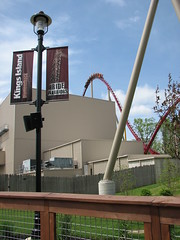
There actually is some theoretical justification to this sort of park design that’s been in place as early as the 1980’s and has been present in nearly every major theme park (although probably best personified by Cedar Fair) to this day, and it’s not a surprise that this type of park design has emerged almost exclusively from the more corporatized parks in the United States: Economics. Classical economic theory states, among much else, that in a case where you have several individuals inhabiting the same system (in this case, individual rides and attractions within a singular amusement park), what is best for each individual is therefore best for the system. Why hold a certain ride back from appearing as spectacular in the park as it could be, just for the sake of other lesser attractions around it? A perfectly valid and logical argument, however it is from that argument that the ‘expensive carnival’ conclusion necessarily arises when all their coasters are painted the flashiest colors imaginable and I think that is something that anyone can agree is not what we’re looking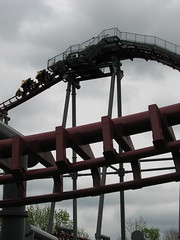 for out of a top-end regional theme park. for out of a top-end regional theme park.
Transitioning from those thoughts I’ll start the reviews with Firehawk, the first major addition to the park preformed entirely under the Cedar Fair banner. I’ve always liked this ride for what it is, mostly from my experience on it back at Geauga Lake/Six Flags Worlds of Adventure. I only got one ride on it back in 2007 when it first opened thanks to the long lines, and unfortunately long lines were encountered here as well. One side of the station was open but with both trains being run, which didn’t make that big of an impact because the time it took for the second train to make it from the main brake run to the station, raise the cars and get the last load of riders off the other train was already back to the main brakes. I’m quite positive they have (or had) a third train with this ride that might have been refurbished and put into service a year after opening, but it seems as though those plans have been scrapped, and a shame, too. The coaster works better as a generic looper that crosses between inverted and upright styles than a “flying experience” as the park would have advertised. If I could fly,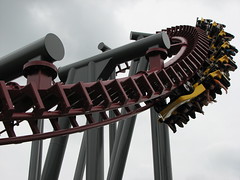 I imagine I would fly smoothly and gracefully rather than shunt around the track as this ride had (there was a very loud squealing that accompanied the trains today), and the whole effect is lost anyway by the ride’s placement over an empty field with nothing but concrete footers below. The B&M flyers probably do a much better job at providing this experience, although of the three of those kind that I’ve been on (the Superman Ultimate Flight trio) none have yet resolved the ‘open field’ problem yet. Again with these expensive carnival coasters… But as I said, it’s an okay ride if you think of it as a kind of bizarre inverted/sitdown looper combo rather than a flying coaster, fitting in well for the park with the likes of Invertigo, Vortex and Flight of Fear, the last of which I’ll review next. I imagine I would fly smoothly and gracefully rather than shunt around the track as this ride had (there was a very loud squealing that accompanied the trains today), and the whole effect is lost anyway by the ride’s placement over an empty field with nothing but concrete footers below. The B&M flyers probably do a much better job at providing this experience, although of the three of those kind that I’ve been on (the Superman Ultimate Flight trio) none have yet resolved the ‘open field’ problem yet. Again with these expensive carnival coasters… But as I said, it’s an okay ride if you think of it as a kind of bizarre inverted/sitdown looper combo rather than a flying coaster, fitting in well for the park with the likes of Invertigo, Vortex and Flight of Fear, the last of which I’ll review next.
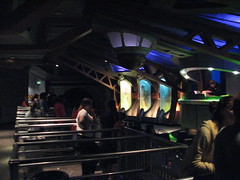 The line for Flight of Fear was thankfully very short, and we were able to snag a front row ride after only two cycles. I think this could be one of the best rides in the park if only they would turn off that midcourse brake which brings it to a complete stop. The first cobra roll and a half are extremely powerful and disorienting. My dad commented after the ride that at first he had no The line for Flight of Fear was thankfully very short, and we were able to snag a front row ride after only two cycles. I think this could be one of the best rides in the park if only they would turn off that midcourse brake which brings it to a complete stop. The first cobra roll and a half are extremely powerful and disorienting. My dad commented after the ride that at first he had no 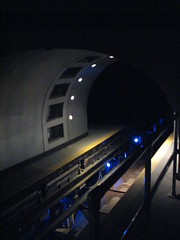 clue which way was up or down, a testament to both the high g-forces that are sustained all the way around that don’t give away which direction gravity is pulling us, and the lack of spatial awareness created by the darkness and spider web of track whizzing by. Then after a few more turns the midcourse brake kicks in and completely transforms the ride. It is now all-too clear which direction gravity is pulling us, which is most likely 90 degrees to the side since the banking in this section was clearly intended for speeds closer to 55 mph, not 5. It finally gets a bit more pep back in its step towards the end with the low-to-the-floor left curve that has a great moment of a false banking rise as if to enter a corkscrew, followed by another banking rise that leads us into an actual corkscrew to cap off the ride experience. This probably is still one of my favorite launched or indoor coasters around, just the amount of track and supports wound into that room still boggles my mind. clue which way was up or down, a testament to both the high g-forces that are sustained all the way around that don’t give away which direction gravity is pulling us, and the lack of spatial awareness created by the darkness and spider web of track whizzing by. Then after a few more turns the midcourse brake kicks in and completely transforms the ride. It is now all-too clear which direction gravity is pulling us, which is most likely 90 degrees to the side since the banking in this section was clearly intended for speeds closer to 55 mph, not 5. It finally gets a bit more pep back in its step towards the end with the low-to-the-floor left curve that has a great moment of a false banking rise as if to enter a corkscrew, followed by another banking rise that leads us into an actual corkscrew to cap off the ride experience. This probably is still one of my favorite launched or indoor coasters around, just the amount of track and supports wound into that room still boggles my mind.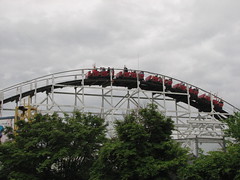
Continuing on through the Coney Mall section of the park is their original coaster The Racer. I feel that John Allen doesn’t get nearly enough credit as he deserves among today’s coaster enthusiasts, although it is perhaps understandable given that his surviving designs all tend to handle much rougher than they should. A long series of parabolic airtime hills on the way out and back, with nothing but a slight dogleg along each course and a turnaround at the far end. If you can try to tune out the bad tracking (which on all of my experiences has alternated between “hardly even noticeable” and “my head was placed inside a paint mixer”) the perfectly parabolic profiling of the hills is still very present to this day, a very gentle lift from the seat, sustained, and then easily set back down (unlike a circular hill where the sharpest airtime is at the entry and exit of the curve, and the weakest is at the apex; even CCI worked with this model for most of their lifetime). If the ride ever could get back a lighter, more flexible set of trains with single-position lapbars I’m positive this ride would rank high as one of the most joyfully blissful, aesthetically attuned coaster experiences ever to grace plant Earth.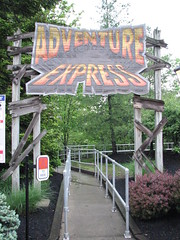 With modern wooden coaster criteria requiring so many changes in dynamics to be considered a well-rounded or worth-while ride I’d really like to see a ride like the Racer show all of those rides up for it’s simple, straightforward beauty. With modern wooden coaster criteria requiring so many changes in dynamics to be considered a well-rounded or worth-while ride I’d really like to see a ride like the Racer show all of those rides up for it’s simple, straightforward beauty.
Just beyond the Racer is another small gem that only those who have actually been to Kings Island likely know about: Adventure Express. This is probably the best mine train I’ve ever been on, with the possible exception of Silver Dollar City’s Thunderation (also a late-era Arrow mine train), but that one lacks the extended, meandering layout and somewhat lackadaisical pacing that was signature to the original mine rides and still present in Adventure Express. It manages both real speed and forces, a long layout that’s hard to memorize (whenever I fear it’s about to end I remember there’s still an entire section left to go) several distinct areas of themeing as well as interaction with the natural terrain, plus the greatest surprise ending of all time. Whatever you’re expecting from the ending, expect the opposite. And then you’ll be surprised.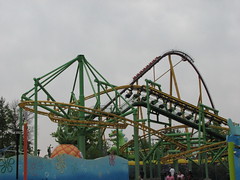
Before heading over to review the rides in the Action Zone area of the park I recall making a quick stop through the Nickelodeon Universe area of the park, which I’ve never been through since I was part of the demographic intended. Rugrats Runaway Reptar was new for me, even though I’ve been on the version at Carowinds and did not like it. This one felt a bit better for me, probably through random chance that I didn’t bang around as much however since this one also felt much more hurky-jerky than it needs to be, especially considering it isn’t at all fast. After that I headed over to the Fairly Odd Coaster (née Beastie, née Scooby Doo) just as a few light sprinkles started coming down. I could have sworn that this ride had a small tunnel at the bottom of the first drop at one point… 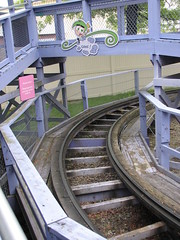 (one minute later I see on the RCDB that it did in fact have a tunnel, which now raises the question why did they purposely decide to rid of it?) Shortly after disembarking that slightly wet ride the rain started to come down much harder. At first I headed over to the Beast only to find it closed, where I waited around for a few minutes before deciding to ditch it and head back to the car where my dad went to rest for an hour or so. On my way through I stopped at the Scooby Doo Haunted Mansion dark ride, which was the only ride so far as I could tell that was still open from the rain. I wasn’t really sure what to expect… this is the first dark ride I’ve been on that uses a continuous chain of cars that all move at the same speed, with riders boarding and exiting from a turntable similar to the old White Water Landing at Cedar Point. Props and story are pretty unimpressive, although that’s almost a requisite of any interactive dark ride just by their very nature, and that’s partly why I (one minute later I see on the RCDB that it did in fact have a tunnel, which now raises the question why did they purposely decide to rid of it?) Shortly after disembarking that slightly wet ride the rain started to come down much harder. At first I headed over to the Beast only to find it closed, where I waited around for a few minutes before deciding to ditch it and head back to the car where my dad went to rest for an hour or so. On my way through I stopped at the Scooby Doo Haunted Mansion dark ride, which was the only ride so far as I could tell that was still open from the rain. I wasn’t really sure what to expect… this is the first dark ride I’ve been on that uses a continuous chain of cars that all move at the same speed, with riders boarding and exiting from a turntable similar to the old White Water Landing at Cedar Point. Props and story are pretty unimpressive, although that’s almost a requisite of any interactive dark ride just by their very nature, and that’s partly why I  don’t buy a lot of the industry chatter that says that the future of theme parks is in more interactive entertainment. Well, I didn’t make any use of the shooter anyway because I was without competition and was planning on just taking pictures inside the whole thing, but only one picture into the ride the camera froze up and informed me it was out of memory space; apparently my dad forgot to tell me he still had several hundred photos from some random graduations and football games stored on there. Thankfully immediately after the ride I met up with him at the car and we deleted unnecessary photos, uploaded the first batch on my laptop, then, contemplating the permeating sour weather, decided to pack up for the afternoon and found a Subway nearby for lunch. I afterward called my mother to let her know how things were going and to see if she could look up the weather forecast to see if it would be like this throughout the rest of the evening. Happily she informed me that it appeared as though it might blow over within the next 30-45 minutes. don’t buy a lot of the industry chatter that says that the future of theme parks is in more interactive entertainment. Well, I didn’t make any use of the shooter anyway because I was without competition and was planning on just taking pictures inside the whole thing, but only one picture into the ride the camera froze up and informed me it was out of memory space; apparently my dad forgot to tell me he still had several hundred photos from some random graduations and football games stored on there. Thankfully immediately after the ride I met up with him at the car and we deleted unnecessary photos, uploaded the first batch on my laptop, then, contemplating the permeating sour weather, decided to pack up for the afternoon and found a Subway nearby for lunch. I afterward called my mother to let her know how things were going and to see if she could look up the weather forecast to see if it would be like this throughout the rest of the evening. Happily she informed me that it appeared as though it might blow over within the next 30-45 minutes.
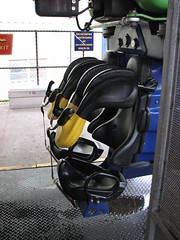 Shortly afterward we found ourselves re-entering the park and heading left toward Invertigo, which they opened the queue for right as we were walking up to it making us only second in line. Score! My favorite seat has always been second to the rear on the ride, the farthest back that’s facing forward on the first circuit. Not only do you get the best vertigo-inducing view straight down when climbing the first lift, my neuroses dictate that I should Shortly afterward we found ourselves re-entering the park and heading left toward Invertigo, which they opened the queue for right as we were walking up to it making us only second in line. Score! My favorite seat has always been second to the rear on the ride, the farthest back that’s facing forward on the first circuit. Not only do you get the best vertigo-inducing view straight down when climbing the first lift, my neuroses dictate that I should  experience the ride first forward and then backward, as to do the opposite would not make much logical sense. I actually kind of disliked this particular ride- the positive g-forces and slight rattle in the cars really strained my neck and this was the closest I ever got to getting a headache from a coaster in a long time. Still, I must give huge props to Vekoma for the innovation of having riders sit face-to-face. experience the ride first forward and then backward, as to do the opposite would not make much logical sense. I actually kind of disliked this particular ride- the positive g-forces and slight rattle in the cars really strained my neck and this was the closest I ever got to getting a headache from a coaster in a long time. Still, I must give huge props to Vekoma for the innovation of having riders sit face-to-face.
Exploring the ‘new’ park, the renaming of nearly every attraction that needed to be changed to avoid copyright infringement once their Paramount licensing was lost is frankly quite embarrassing. Top Gun’s transformation into “Flight Deck” or Drop Zone: Stunt Tower’s transformation into “Drop Tower” I think tells a lot about the attitude of the Cedar Fair management. Rather than re-brand their newly acquired Paramount Parks to be given a fresh identity to distinguish themselves from the old regime, Cedar Fair decided to find names that would allow them to both avoid re-themeing attractions AND avoid paying for even a trademark, let alone for licensing royalties. This is either genius or idiocy. Who ever thought that Flight Deck was even acceptable for a name? I’ll suspend my disbelief for a moment and believe that maybe they were having difficulty finding suitable alternative names that fit the fighter jet theme. 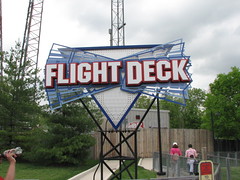
A): Why do they need to retain the old theme for the ride? What themeing did Top Gun really have to begin with that a simple paint scheme change couldn’t have transformed it into something new and unique? It’s a sparrow’s flight swooping through the backwoods, since when did the grey Naval themeing ever work to begin with? (Also the logos for the new names look like they’re bought in bulk)
B): Why would they want to retain the old theme for the ride? People overheard in the queues refer to the changeovers in park with the negative form of “it used to be Paramount” rather than a positive form of “it has a new identity”. There is no new identity to be found in the park, just an empty husk of the old one. 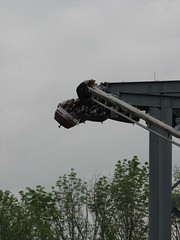
I’ll use those thoughts to transfer into my next couple reviews, starting with Top Gun… err, Flight Deck. This is probably one of the better suspended coasters devised. As I recall Canada’s Wonderland’s Vortex is the exact same layout but with shorter trains resulting in increased speed and swinging, but without quite as good, wooded terrain to work with, plus a very close fly-by of Son of Beast’s structure. The only grievance I have to levy against this ride is that it’s much too short. Like the mine rides, the original Arrow suspended coasters found a lot of their pleasures in having a lengthy, more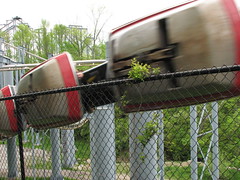 complex ride with multiple lifts, whereas Flight Deck, after the first drop and elevated sharp first turn, is just an overdrive of back-and-forth fast paced swinging until it ends some 45 seconds later. Big Bad Wolf is probably the ride that combined the best the fast-paced nature of Flight Deck or Vortex with the longer, more complex layering found on the earlier suspendeds. Of course there’s also Eagle Fortress in South Korea which appears to be operating complex ride with multiple lifts, whereas Flight Deck, after the first drop and elevated sharp first turn, is just an overdrive of back-and-forth fast paced swinging until it ends some 45 seconds later. Big Bad Wolf is probably the ride that combined the best the fast-paced nature of Flight Deck or Vortex with the longer, more complex layering found on the earlier suspendeds. Of course there’s also Eagle Fortress in South Korea which appears to be operating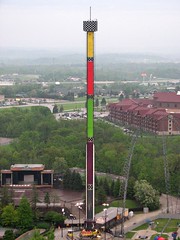 on an entirely different level altogether… on an entirely different level altogether…
Next up is Drop Zone: Stunt Tower… err, Drop Tower (okay, I’ll stop doing that now). The line for this one had been really short on my last visit here in 2007, and while there was maybe a cycle’s wait for it this time around it really wasn’t bad at all. At least it gave us a chance to enjoy the tremendous gust of wind that blows through the queue just after that giant ring lands back on the boarding pad. I’m never quite sure of how I feel about these drop rides (except for the S&S towers, which are always lame unless they’re at Indiana Beach). On the one hand, especially on Kings Island’s version which features the extreme height and rotating ascension, I still become nervous. On the other, for a ride that’s basically nothing but a long build-up to an exciting climax, getting off I always have the feeling that the proceedings are somewhat anti-climactic.
This now leaves one final ride to be reviewed in the area and it’s a big one:
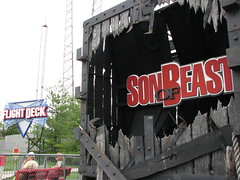 Son of Beast Son of Beast
The most egregious roller coaster dereliction since ever. What were the designers thinking… or smoking… or injecting into their arms… when they built this ride? This enormous heap of fail would make better use as recycled toilet paper to wipe my sorry behind with than anything even approaching a roller coaster.
Such are examples of comments amongst internet newsgroup members that reflect their personal feelings towards the Son of Beast. So hold on to your hats when you hear what I’m about to say… Son of Beast is nearly as good as Diamondback.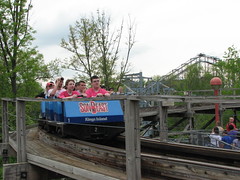
If you haven’t read my Diamondback analysis do so here as that may fit the above comment in better context. And I’ll admit, when I last experienced it before the accident and subsequent overhaul in 2004, it was bad. Really bad. The level of roughness was simply intolerable. This is one of those great ironies, since when the ride was first announced there was all this fuss over the trains Premier rides were designing for it, how they represented the most advanced, cutting edge design for wooden roller coaster trains, how they were by far the safest coaches ever designed for a woody and included features to ensure the best ride experience such as wheels that contained a layer of shock absorption. While a seemingly impressive technical background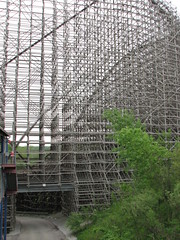 it proved very short-sighted in terms of safety, apparently occurring to no one that so much advanced design and technology would make the cars very heavy and inflexible, chewing up the soft wooden track and putting it in horrible maintenance condition, while the riders would receive every bump and jolt from said deteriorating track. it proved very short-sighted in terms of safety, apparently occurring to no one that so much advanced design and technology would make the cars very heavy and inflexible, chewing up the soft wooden track and putting it in horrible maintenance condition, while the riders would receive every bump and jolt from said deteriorating track.
But all that’s behind the ride now, unfortunately the signature vertical loop has been removed, but the ride has received a complete re-tracking and new lightweight trains, so of course it will continue to be bashed by the enthusiast community with extreme discrimination. Honestly, the ride’s no longer uncomfortable. I’m not sure why I’m still reading reviews that say it is, since on my three rides on the new Son of Beast (in 2007 and 2009, twice in the back and once in the front) all were totally tolerable. The biggest disappointment is that the new trains, while fine, are relocated from Myrtle Beach’s former Hurricane wooden coaster rather than purchased specifically for this ride. Two standard, six car trains on a coaster this scale? On the plus side stacking is rarely a problem, and thanks to the rides poor reputation lines weren’t out of control long, but still the wait seemed to be moving very slow. Apparently RCCA (the builders of the coaster itself) messed up the blocking configuration badly so the main brake run can only function as a single block instead of a double, thereby eliminating the feasibility of a three train operation. are relocated from Myrtle Beach’s former Hurricane wooden coaster rather than purchased specifically for this ride. Two standard, six car trains on a coaster this scale? On the plus side stacking is rarely a problem, and thanks to the rides poor reputation lines weren’t out of control long, but still the wait seemed to be moving very slow. Apparently RCCA (the builders of the coaster itself) messed up the blocking configuration badly so the main brake run can only function as a single block instead of a double, thereby eliminating the feasibility of a three train operation. 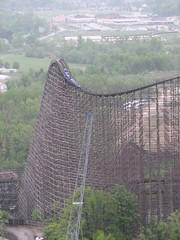 But still, this ride is calling for seven or eight car trains instead of a simple six. But still, this ride is calling for seven or eight car trains instead of a simple six.
The first part of the new coaster is quite amazing, starting with a short pre-lift section that drops a good 50 feet and lets you get a good look at the massive size of what’s to come as you slowly, inevitably make the rounds to that colossal lift, an intimidation factor that seems sadly missing from many other large-scale coasters including Diamondback. The lift is loud, dangerously so. Plug your ears on the way up because while it may not lead to any immediate lawsuits the way the track collapsing did in 2006, the overall long term damage done to people’s eardrums likely exceeds any damage done from that singular, attention grabbing incident. After the crest, instead of diving straight down, the coaster teases us once more with another amazing tension-building showoff. I must wonder who during the design process thought that it was an efficient use of resources to design it with such a wide turn right off the top of the lift when you’re having to support it 200 ft. in the air. But since they did, we at least now have one of the most impressive coaster structures to look at, and it’s a great build-up to that first drop as well.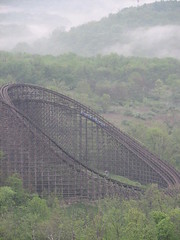 The drop and speeds feel incredibly amplified by the wooden nature of the ride, not at all rough on the pullout (in fact it probably equals the smoothness of many Gravity Group or Great Coasters projects), but the slight edge lent from the wooden track makes just the raw speed feel much more intense than anything else found this side of Top Thrill Dragster. The drop and speeds feel incredibly amplified by the wooden nature of the ride, not at all rough on the pullout (in fact it probably equals the smoothness of many Gravity Group or Great Coasters projects), but the slight edge lent from the wooden track makes just the raw speed feel much more intense than anything else found this side of Top Thrill Dragster.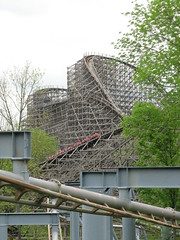
The next hill that leads into the gigantic double helix is still a show-stopper. This ride might not focus much on sharp dynamic contrasts and intense forces the way others would but frankly for this element it doesn’t need to. In the back especially there seems to be a sort of ‘hunting’ effect in the train as if it’s trying to come off the tracks. Again, never uncomfortable, but very unnerving and a real display of power this ride has. I love it.
Unfortunately after the helix is where the ride for the most part ends. There is then a very long (and useless) mid course block brake, before diving down towards where the loop used to be. There’s now a slight s-curve hill which is far too reserved to provide anything interesting.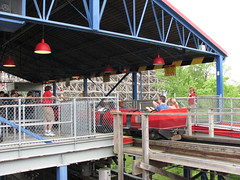 The second helix buried behind the lift structure pales compared to the first, and I would almost criticize it for being too smooth. Still, just being encased in the shadow of such a magnificent structure is interesting enough, and there’s some pretty good head choppers on the exit. The final hill, turn around and rise into the brakes are just worthless. Oversized, forceless and none of the signature speed and power found in the first part of the coaster. The second helix buried behind the lift structure pales compared to the first, and I would almost criticize it for being too smooth. Still, just being encased in the shadow of such a magnificent structure is interesting enough, and there’s some pretty good head choppers on the exit. The final hill, turn around and rise into the brakes are just worthless. Oversized, forceless and none of the signature speed and power found in the first part of the coaster.
Some have suggested that Intamin’s plug-and-play wood coaster design should be retrofitted to the ride to make it great. A good idea and an improvement to be sure, but I feel that would make the coaster just a lesser version of Diamondback, since very little air or other strong forces would be found along the course.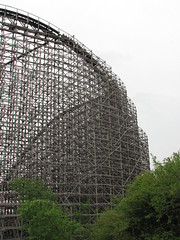 The ride isn’t just about 200 ft. tall drops and 78 mph speeds, it’s about 200 ft. tall drops and 78 mph speeds taken with raw, untamed wooden coaster technology. What I think would work well to make the ride the top-tener it potentially could be would be if Kings Island could hire the Gravity Group to do a second extensive re-working of the ride. I’m sure another surface retracking wouldn’t hurt especially with GG’s techniques. Mostly I would like to see the addition of some 14 or 16 bench Timberliner trains added to both increase capacity and improve the riding experience while still maintaining the wooden coaster edge. They could also hopefully re-build the main brake sequence so it could accommodate three trains. I’m also fairly certain that the Timberliners might feature secure enough restraints (haven’t seen a finished version of them yet) that maybe the loop could be restored? The second half of the ride just has so little going for it, and without the loop the coaster still feels a bit too close to Diamondback. More pie-in-the-sky hopes, but I’d like to see the track after the second helix completely razed and build from scratch a new finale featuring a much tighter, forceful Gravity Group design to finish off the ride. That’s pretty much all wistful thinking, probably I should be grateful if Kings Island The ride isn’t just about 200 ft. tall drops and 78 mph speeds, it’s about 200 ft. tall drops and 78 mph speeds taken with raw, untamed wooden coaster technology. What I think would work well to make the ride the top-tener it potentially could be would be if Kings Island could hire the Gravity Group to do a second extensive re-working of the ride. I’m sure another surface retracking wouldn’t hurt especially with GG’s techniques. Mostly I would like to see the addition of some 14 or 16 bench Timberliner trains added to both increase capacity and improve the riding experience while still maintaining the wooden coaster edge. They could also hopefully re-build the main brake sequence so it could accommodate three trains. I’m also fairly certain that the Timberliners might feature secure enough restraints (haven’t seen a finished version of them yet) that maybe the loop could be restored? The second half of the ride just has so little going for it, and without the loop the coaster still feels a bit too close to Diamondback. More pie-in-the-sky hopes, but I’d like to see the track after the second helix completely razed and build from scratch a new finale featuring a much tighter, forceful Gravity Group design to finish off the ride. That’s pretty much all wistful thinking, probably I should be grateful if Kings Island ever decides to swap out anti-roll backs on the lift for something quieter. If nothing else, Gravity Group could replace just a couple washers and the ride would automatically gain more sympathy from enthusiast communities. ever decides to swap out anti-roll backs on the lift for something quieter. If nothing else, Gravity Group could replace just a couple washers and the ride would automatically gain more sympathy from enthusiast communities.
One last major coaster I forgot to mention is Vortex. I was hoping to score several Vortex rides since every time I go to Kings Island, despite short lines and possibly being my second favorite ride in the park, I somehow manage to miss this one after getting only a ride or two in. This is my favorite of the large-scale Arrow multi-loopers. The Great American Scream Machine on paper would seem to be a better ride, but that one has a problem of seemingly running out of speed and height very rapidly, so that by the final corkscrews the ride feels no larger than a standard double corkscrew model. Vortex makes great use of moments that build in momentum, rather than lose it. First there’s the first drop, which rather than a twisting drop found on the other mega-loopers, Vortex features a tight, flat turn that whips into a straight, steep, kind of scary, ejector laden first drop if you’re in the back, which is where I’m almost always found. Instead of blasting through a first vertical loop in mere seconds, the ride takes it’s time with a large swooping curve, holding the inversions until later. Out of the turn is a long, descending straightaway that builds momentum and anticipation as it surges into the tight double loops. After the loops is another terrifying moment, the ultra-sharp turn of death that leads into the midcourse. How such a sharp turn is managed to be taken at such high speeds and not result in whiplash is beyond me, but I always have to think, “oh shit, not going to make it problem of seemingly running out of speed and height very rapidly, so that by the final corkscrews the ride feels no larger than a standard double corkscrew model. Vortex makes great use of moments that build in momentum, rather than lose it. First there’s the first drop, which rather than a twisting drop found on the other mega-loopers, Vortex features a tight, flat turn that whips into a straight, steep, kind of scary, ejector laden first drop if you’re in the back, which is where I’m almost always found. Instead of blasting through a first vertical loop in mere seconds, the ride takes it’s time with a large swooping curve, holding the inversions until later. Out of the turn is a long, descending straightaway that builds momentum and anticipation as it surges into the tight double loops. After the loops is another terrifying moment, the ultra-sharp turn of death that leads into the midcourse. How such a sharp turn is managed to be taken at such high speeds and not result in whiplash is beyond me, but I always have to think, “oh shit, not going to make it this time” right before we blow through this turn with ease. Going back to that motif of building momentum established with the first straightaway into the loops, this second half of the ride featuring four inversions is basically one continuous buildup until it’s over. First the corkscrews, not only do they dangle us high above the ground but they’re threaded improbably between the two loops. The train picks up speed quickly out of these and enters the signature batwing element, the most unique and intense singular element found on the ride, and partially buried in a trench for added effect. The only moment that does not serve the ride well is the final helix, but it’s not a problem since it doesn’t detract from other elements but simply acts as a bonus after the would-be finale of the batwing. this time” right before we blow through this turn with ease. Going back to that motif of building momentum established with the first straightaway into the loops, this second half of the ride featuring four inversions is basically one continuous buildup until it’s over. First the corkscrews, not only do they dangle us high above the ground but they’re threaded improbably between the two loops. The train picks up speed quickly out of these and enters the signature batwing element, the most unique and intense singular element found on the ride, and partially buried in a trench for added effect. The only moment that does not serve the ride well is the final helix, but it’s not a problem since it doesn’t detract from other elements but simply acts as a bonus after the would-be finale of the batwing.
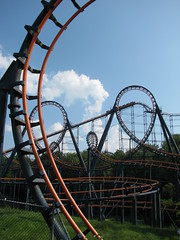 Unfortunately we found upon re-entering the park after the rain storm that for some inexplicable reason every coaster in the park was reduced to one-train operation, with the exception of Beast and Diamondback (and I think Backlot Stunt Coaster; never went on that one) which were down to two, although Diamondback was suffering from some mechanical problems before the storm which could have also been part of the cause. Vortex and Son of Beast definitely suffered the most for this; what was a queue that didn’t even leave the station ended up taking nearly 25 minutes to get through, so unfortunately it was only one ride on this visit as well. We wrapped up the night with two rides on Diamondback (could have managed more, but again, the reduced capacity really slowed things down; Unfortunately we found upon re-entering the park after the rain storm that for some inexplicable reason every coaster in the park was reduced to one-train operation, with the exception of Beast and Diamondback (and I think Backlot Stunt Coaster; never went on that one) which were down to two, although Diamondback was suffering from some mechanical problems before the storm which could have also been part of the cause. Vortex and Son of Beast definitely suffered the most for this; what was a queue that didn’t even leave the station ended up taking nearly 25 minutes to get through, so unfortunately it was only one ride on this visit as well. We wrapped up the night with two rides on Diamondback (could have managed more, but again, the reduced capacity really slowed things down;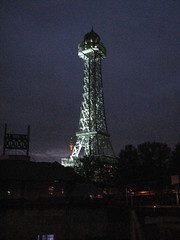 the train was being held on the main brake run instead of the one right behind the station as it normally is, so the time it took to get off the main run, make the turnaround and back into the station after the other train dispatched held things up a great deal) and then three on the Beast, which didn’t have much of any line, thankfully, although they did hold up the entire ride for a good twenty minutes when there were only two cycles left to load because they were launching the nightly fireworks from back near the ride area; apparently the fear is we’ll all catch on fire if they run it while the fireworks are going, and then they had to send maintenance around the ride just to make sure it hadn’t burned down. the train was being held on the main brake run instead of the one right behind the station as it normally is, so the time it took to get off the main run, make the turnaround and back into the station after the other train dispatched held things up a great deal) and then three on the Beast, which didn’t have much of any line, thankfully, although they did hold up the entire ride for a good twenty minutes when there were only two cycles left to load because they were launching the nightly fireworks from back near the ride area; apparently the fear is we’ll all catch on fire if they run it while the fireworks are going, and then they had to send maintenance around the ride just to make sure it hadn’t burned down.
After last rides we left to drive to our Louisville hotel that night for Six Flags Kentucky Kingdom the next day.
|
|
Comments