Carowinds
Charlotte, North & South Carolina – Wednesday, June 14th, 2023
 Theme parks are often characterized as places to “leave the outside world behind,” but this overlooks the reality that a great many are based on local culture and identity. As location-based experiences, the location obviously matters to the experience. Locals want a place that reflects their homeplace pride, and long-distance visitors hope to find something they couldn’t get closer to home. Four of the six largest theme parks on this southern road trip carried state or regional themes (with a fifth having a partial area), and several smaller parks also carry localized names and branding. Even the second gate to the original Disneyland adopted this localizing concept, however poorly it worked out.
Among the genre of “state theme parks,” Carowinds is unique in that the location expresses the theme not in terms of natural landscape or even so much local culture, but through political geography with the North and South Carolina border running through the middle of the park. Let’s not overlook how big of an attraction a state line running through a theme park is, especially for younger kids, who are just beginning to comprehend the political realities of their world and the idea of existing in two states simultaneously is kind of mind-blowing for them. With age, I’m less fascinated by this political border itself and more interested by how politics might shape what I find on either side. Sales tax is different depending on where in the park you buy a meal or souvenir, and I can’t imagine the complexities that happen behind the scenes with regards to labor laws and safety permits. I couldn’t help but note that the South Carolina side of the park appeared much newer, more vibrant, and with a better roster of attractions than the older, more spartan North Carolina side. Even odder, the two states have apparently “traded” many of their theme zones. The beach boardwalk-themed area appears on the North Carolina side, while areas dedicated to the Blue Ridge Mountains or aviation history
 are on the South Carolina side.1 A political border is both completely imaginary and one of the most complex geographical features to choose to build a theme park around.
If they had to build Carowinds all over again, I wonder if this specific border-straddling location would be deemed worth it? For being one of the most precisely location-specific theme parks ever built, Carowinds’ setting amid the low industrial exurbs of Charlotte has the distinct feeling of a Non-Place. The park is very flat, with sparse manicured landscaping inside and separated only by a parking lot from the endless expanse of Cracker Barrels and office campuses just outside, visually not so different from the theme park itself. The entry gate has an even more corporate-core aesthetic than Cedar Point; with the parent corporate offices in Charlotte, Carowinds serves as a flagship park for the chain’s clean, minimalist design style. Even the name, “Carowinds,” is a not particularly clever portmanteau, the kind you might expect from a suburban real estate development because it’s aggressively normcore while also being easy to trademark.
Which is perhaps the most concrete assertion of place and identity that modern Carowinds actually has: this is the theme park that represents the Sun Belt, that balmy, upwardly mobile, politically purple region where jobs are plentiful, air conditioning is ubiquitous, and everyone is friendly in that anonymous, corporatized way. It’s the American version of those other up-and-coming parts of the world who would buy one of the world’s tallest, fastest, and longest roller coasters for the prestige, and brand it after a local symbol of pride.
Fury 325
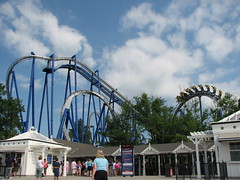
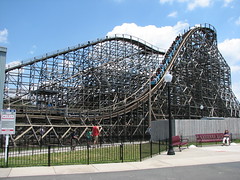
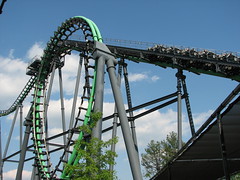
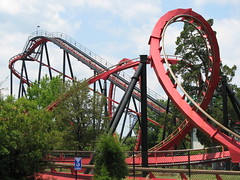
 Fury 325 was my largest single motivating factor for not just returning to Carowinds, but to undertake this entire trip. It’s the world’s tallest and fastest gravity-driven coaster, as well as the longest steel coaster in North America, and has ranked as the #1 steel coaster in the Golden Ticket Awards every year since 2016.2 “Bigger isn’t always better” is an easy aphorism for roller coasters, but on the other hand, I think it certainly helps. Height and speed have their benefits, but I believe length has the strongest correlation to overall ride quality, which can be measured by enthusiast polls. Roller coasters offer the dream of flight, and while taller and faster rides help achieve that transcendent state, it’s when a dream is long enough that I might momentarily forget that I’m still awake.
 Prior to today I had been on three other giga coasters, all rides that I enjoy to different degrees, but that I also believed none quite lived up to their full potential. Millennium Force, the original, is the best but has a relatively conservative dynamic profile. Steel Dragon 2000 simply scaled up a Morgan hyper coaster layout and the result is mostly the same. Leviathan’s first half showed tremendous potential, but was let down by a weak second half and too-brief ride time. Fury seemed like it finally reached the full potential of a giga coaster. It combined some of the best aspects of Millennium Force and Leviathan and even dialed up the statistical numbers a bit higher. I was a little concerned about a middle portion that seemed drawn out, and the aesthetics of the ride’s placement in the park still didn’t quite compare to Millennium Force. But I arrived at Carowinds believing the only mystery was whether Fury 325 would crack into my top five steel coasters or remain just outside my top ten.
The best coasters in the world have a strong sense of identity, by which I mean you can simply and easily classify its experiential qualities in your mind. In many cases this is defined by one strong quality, but it can also be a strong sense of story or progression over the ride experience. In Fury 325’s case, I was expecting a ride that would be defined by “speed and power” unlike any I had experienced before. I wasn’t completely wrong, but after my first ride, and then my second, and then several more re-rides, I had to revise my assessment to a different, if related, quality: windy.
It sounds silly, but the sustained speed, especially in the low-to-the-ground first half, generates a lot of air movement across the vehicle. Over and over I found that the feeling of wind whipping and fluttering across my skin was the most deeply ingrained sensation in my memories of the ride. My face actually felt a little raw and windburned after a few laps. (Hey, it is “Carowinds” after all!) I had to consider if I had somehow caught it under poor circumstances. The day’s weather had a somewhat stiff breeze, with a minor storm front forecast for later in the afternoon, but nothing too unusual that impacted the other rides. My riding partner was of the same mind towards the ride, and was ready to move on after a couple of laps, even with almost no wait.
I was confused. The experience was so underwhelming and even slightly unpleasant that I had to reassess several of my priors. I started with questioning my own subjectivity, and am still open to the possibility that I may be of a completely different mind towards Fury on a return visit some day. But I also had to consider that I may have misjudged some of the qualities I expected from the ride, or even that qualities I expected to be positive ended up more of a negative.
 For one thing, I’m now more convinced that past a certain level, excess speed actually hurts a coaster’s experience. Sustained wind is one factor. But another is how force around a curve increases with speed, requiring it to be spread over longer durations to remain within safe limits. I actually greyed out a little at the bottom of the first drop, which is weird because it’s not the kind of place where it feels like that should happen. The parabolic curvature has a very gentle, free-falling feeling, different from Millennium Force’s rounder curvature that produces more ejection as you reach the steepest point. Fury smooths and stretches out all the transitions so it never feels like anything too extreme is happening, but this masks the raw G-forces, which are actually quite high and sap a greater toll on the body than you might at first realize.3
 Another thing I’ve learned is how big, forceful rides need airtime regularly mixed in. It’s not just for fun, but even a small pop helps release the strain on the spine and circulatory system and greatly improves rider comfort. It hadn’t originally occurred to me but Fury 325 is nearly all positive G-forces for the first 20+ seconds, from the pullout of the first drop until the top of the treble clef turnaround. I was expecting more pops of air during the transitions, or at least some good rotational whip, but apart from the wind I mostly just felt a sustained sagging sensation on my body for the entire first half. I looked at Leviathan’s phenomenal speed hill and expected Fury’s S-bends to be an extended take on that, but the big sweeping curves are missing the surprise contrast with airtime and laterals.
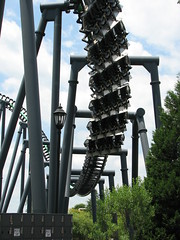
The treble clef dive into the tunnel is indeed the highlight of the layout. However, I perhaps placed too many expectations on this one single element to uplift the rest of the experience. It’s a good exclamation point to the first half, but still feels quite conservative compared to similar maneuvers designed by Alan Schilke or Joe Draves. And then the post-tunnel section, when a lot of the speed has already been drained from the vehicles, hits with a whimper. There’s an awkward banked turn with a long, rampy exit that’s a cold splash of water when it seemed things were finally getting interesting. The following camelback hill finally offers some real airtime, but is heavily trimmed and blandly generic; too little, too late. And the wide, slow helix under the turnaround is the third major element in a row that feels like it’s just wasting time. Fortunately, Fury does regain a little bit of pep with a couple of well-balanced, S-bending airtime hills, which feel like a decent finale to a much smaller coaster. 6,600 feet of track and precious few moments where it does much of anything fun or interesting with it.
 As the train slinked through the overbuilt brake run that forms one of the most notable visual elements from the ride’s entry plaza, I had one last realization of something I may have underestimated: the importance of presentation and setting, especially for giga coasters. Arguably Fury 325 is one of the most intentional about this, with the ride design being integral to the entire renovated front entrance gate project (which almost certainly justified the larger budget for the longer ride). If these rides are akin to a waking dream, Fury 325 is one where you’re flying but not going anywhere. Most of the ride takes place over a massive empty grass lawn with a few, repetitive “corporate park” style features anywhere nearby. There’s no point to all that excess speed if there are few points of reference against which to measure it. The closest we get are the back of house
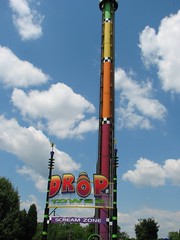
 storage areas around the base of the first drop and the final bunny hops. Maybe the unwieldy size of gigacoasters make them difficult to place in existing parks, but I’m struck by how nearly every one built after Millennium Force is kind of ugly to look at. Millennium Force, while wedged in on an underused strip along the Cedar Point peninsula, takes riders on a physical and emotional journey past water, forests, tunnels, and rivers. Even Leviathan, with its superficially similar parking lot adjacent setting, still has a row of trees next to its speed hill that works wonders with misdirection and heightening the sensation of rush exactly where it’s most needed. Fury 325 does have some good design elements going for it with its neon honeycomb motifs, but nearly a decade later it all looks a little drab and tired in this forgotten “Thrill Zone” corner of the park.
If there is one silver lining to my experience with Fury 325, it’s that it strengthened my appreciation for Millennium Force even more. As one of the only giga coasters in the world for a decade plus, it was easy for armchair designers to wonder how the layout could have taken some bolder risks. Now that it has more competitors that have tried to rival and even exceed it, the original giga coaster’s winning qualities are pulled much more clearly into focus. As for Fury 325, I started the day expecting I might have a new top five steel coaster in the world, and finished regarding it as having cracked the lower half of my top five coasters specifically at Carowinds.4


Carolina Cyclone
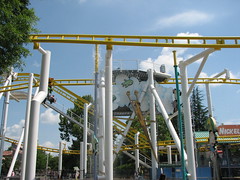
 This Arrow Dynamics double loop and corkscrew coaster today feels like a generic production model ride standing in the shadows of record-breaking coasters like Fury 325. The generic name doesn’t help. Yet remarkably, the Carolina Cyclone actually was a major record holder when it debuted in 1980, breaking the world record for most inversions on a coaster, one of only nine modern roller coasters to do so.5 Given that the Cyclone is commonly rumored as the next coaster on the chopping block mostly due to the lack of public interest, it’s clear that such records are ephemeral in nature.
It was still a big deal at Carowinds when I first visited in 1998, one of the park’s “Big Four” along with Vortex, Hurler, and Thunder Road. Even today, if I had to rank Carowind’s coaster collection, this one would probably take the #5 spot after the modern “Big Four” of Fury 325, Afterburn, Copperhead Strike, and Intimidator (now Thunder Striker). The layout is more or less the same as the Adventuredome’s Canyon Blaster, which might be one of the better Arrow looping coasters for its furious speed through its elements. The curve between the loops and corkscrews features an ejector pop of airtime and keeps a low, fast profile, differentiating it from the older corkscrew or single loop and corkscrew coasters. The inversions are decent; if you blinked and missed the first one, there’s another one just like it coming up! The final helix doesn’t have the tunnels and rockwork of Canyon Blaster, but a partial trench with headchoppers is still a lively conclusion.


Carolina Goldrusher
 Apparently North Carolina had the nation’s first gold rush in 1799. You’d never know that history from riding this Arrow mine train coaster that opened with the park in 1973, and which has been lightly updated to fit the park’s beach boardwalk area. Unlike Six Flag’s Dahlonega Mine Ride, the name isn’t even interesting enough to inspire a Wikipedia search.
The ride itself isn’t particularly interesting either, which I would rate as one of the weaker mine train coasters that Arrow Dynamics ever built. A sizable portion of the nearly 2,400 feet of track is consumed by long straight sections and flat curves that seemingly exist only to re-orient the layout to a different position. There are only two short sections where it even acts much like a roller coaster: first, a ground-hugging trench run through wood frames (an effect later borrowed for the Carolina Cyclone) that could have been part of a great family coaster yet doesn’t last nearly long enough before it reaches the second lift. From there, it combines the downhill helix finale from the mine trains at Cedar Point and Magic Mountain with the drop down tunnel finale on the Six Flags Over Texas, Georgia, and Mid-America (St. Louis) mine rides, although neither element is quite as effective here as on the originators.
But what most hurts the Carolina Goldrusher is its placement in the middle of the park, where newer and taller attractions on nearly all sides have taken away the sense of being in the wilderness. Most other regional parks with classic mine trains had the sense to place them near the edge of the property, or at least in an area with more natural scenic interest like a hillside or lagoon. Carowinds by contrast is a fairly flat and barren park, and while there are still quite a few trees within the layout area, a mine train just doesn’t seem like a natural fit for this park. By 1973 the mine train was a seven year old product, with many newer concepts hitting the market that Carowinds could have chosen for their first coaster. But it seems they just wanted to follow the trends rather than start a new one.


The Flying Cobras & County Fair
I had last ridden the Flying Cobras when it was known as Head Spin at Geauga Lake. Actually I’m not even sure about that, it might have been when it was still Mind Eraser at Six Flags Worlds of Adventure. It opened at Carowinds in 2009 as the Carolina Cobra (groan), before it was upgraded as the Flying Cobras along with the rest of the surrounding area as the County Fair in 2017.
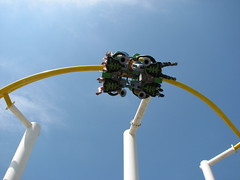
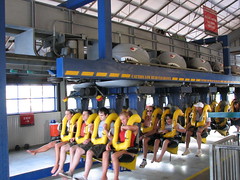
This is definitely the best iteration of this attraction, an inspiring tale of a Vekoma Boomerang improving with age. The modern vest restraint train is the largest factor, although the Flying Cobras stunt pilot theme is well done on a limited budget, with each car as a biplane with a different color design, and even a set of flight gauges along the “dash” of each vehicle. We rode once in the back car. The heavy dose of G-forces still made it a one-and-done, although in a smaller park with less to draw my attention elsewhere I might have considered riding it more than once.


We also rode the Do-Si-Do, a Huss Troika brought to the park in 2017. This was part of an interesting experiment when Cedar Fair purchased older flat rides from Europe for their superior build quality and longevity. It seems they’ve since reverted to buying everything from the Zamperla catalogue, but it was fun while it lasted.


Copperhead Strike
After being let down by the otherwise nearly unanimously praised Fury 325, I was worried what my reaction to Copperhead Strike might be, given that reviews for the 2019 Mack Rides custom launch coaster have been a bit more mixed. Once again I was surprised… this time in a positive way! While Copperhead Strike is no Maverick (the obvious point of inspiration, at least as far as Cedar Fair’s planning and design is concerned), it’s still a remarkably fun and imaginative multi-launch coaster with a good mix of elements that I’d have been happy to ride all day long.
The overall presentation is one of the best at Carowinds, with the serpentine copper track coiled around the pathways and queues with plenty of spots for close-up views. The thematic storytelling is one of the better attempts I’ve seen at a Cedar Fair park. The venomous snake name provides a good logo that isn’t taken too literally, instead giving inspiration to a “Bluegrass Breaking Bad” storyline about a granny’s jam factory serving as the front for an illegal moonshine distillery. While taking a factory tour in a black 1939 Ford DeLuxe Convertible Coupe, riders accidentally discover the operation and hightail it out of there as Grandma Byrd grabs her shotgun.
It’s simple and gettable with just a few scenes and environmental props, yet it exposes a depth of worldbuilding around double identities where friendliness masks danger, perfect for a roller coaster. The nostalgia for childhood treats is actually a cover for an adult vice. Grandma Byrd’s friendly marketing is turned upside down when we meet her, where she’s intent to kill or at least maim or scare us. Even the “Copperhead Strike” name carries multiple meanings depending on how deep into the storyline you read. It’s a much more clever and edgy take on the American back country than anything Dollywood has produced in a long while, yet ultimately serves a practical purpose: a cool name and logo, and enough rationale for why these cars are taking off on a wild ride. I only wish the landscaping could have been more robust to better fit the Blue Ridge Junction setting; orange is a color you paint a ride if you need it to complement a green backdrop, of which there’s not much. Maybe with more time.6
 Copperhead Strike begins with a heartline roll directly out of the station. This is perhaps the most divisive element. While I don’t view it as essential (and even kind of forget that it’s part of the ride’s five inversion count), I think the slow roll and hangtime serves a purpose in starting on a humorous note, getting riders laughing and hooting right out of the station and into the moonshine distillery. (They might otherwise be a bit impatient in this scene if they’re still “waiting” for the coaster thrills to begin.)
 The first launch has a nice punch even if it’s not too fast. It feeds directly into a nearly circular vertical loop, which has a good contrast of biting positive G-forces at the bottom with some hangtime around the top. This is immediately followed by a sharp ejector airtime hill into a corkscrew inversion with good, full-bodied rotational whip. Nothing too crazy in terms of sustained forces, but the name “Strike” is fitting this medley of sharp, distinct initial elements.
After the corkscrew there’s a quick right turn into a lefthand helix, showing off Copperhead Strike’s more flowing sense of pacing. Before any speed loss becomes noticeable, the second launch hits along a unique undulating airtime hill. I like this design, as it preserves the sense of flow and serpentine movement, without interrupting the pacing for a big “second launch” moment that happens with a straight launch track, which at 50 mph isn’t that noteworthy anyway.
 What is noteworthy is what comes immediately after the second launch, a kind of inside-tophat-meets-cutback inversion that’s the tallest point of the ride… again with a great tickle of hangtime around the top. This begins my favorite sequence on Copperhead Strike, which drops down into a high speed, low-to-the-ground, and very whippy overbanked turn. With hardly a moment to realize what happened, it then surges up into a second vertical loop, faster paced with more evenly distributed force, and threading the launch track we just came from. It then rises up into a zero-G camelback hill that pitches 90 degrees to its side over the crest falling out the other side into a banked curve. This maneuver also threads through the first vertical loop, and reminds me very favorably of the “dragonfly turns” found on Silver Dollar City’s Powder Keg, but with more comfortable seats.
After this element, the last twenty or so seconds is a collection of S-curves. The first couple have a lot of speed and whip, but these gradually peter out into a more leisurely pace. There are a couple of slow bunny hops at the end that don’t produce much airtime; it’s like the ride is skipping and sputtering back to the station. Part of me wants to dismiss this ending as anti-climatic and advocate for a different layout that might have included more inversions near the end. But after riding several times and considering it, part of me also feels like there is a place for this gradual denouement. Not all dramatic experiences need to have a huge climax, and I think that can apply to coasters as well. What works here is that there’s never a point in the layout where the flow seems to break. Every motion makes choreographic sense from the one preceding it, but it just gradually tapers off, letting riders start to re-compose themselves and signal to them that the ride is winding down before reaching the brakes. I don’t love it, but I don’t hate it. I think better landscaping or decorative elements would have improved this section, as might an on-board soundtrack, which could switch to a different key or tempo to better signal the emotional intent of the slow finale.
Overall, Copperhead Strike is one of the most well-balanced coasters with a creative presentation that I found in the South. The comfortable trains and smooth ride help tremendously. It’s also handily my favorite Mack Rides coaster in North America,7 and in contention for one of my top new-to-me coasters on this entire Southeast trip. I did not anticipate this outcome when I started my day, but I’ll happily accept wins whenever the heart discovers what speaks to it.


Aeronautica Landing
 Aeronautica Landing was the new for 2023 addition, consisting of a Zamperla flat ride package and a refreshed thematic zone based on a vintage aviation motif. The idea is clearly inspired by North Carolina’s legacy in the history of human flight from the Wright brothers’ first powered flight at Kitty Hawk. There’s nothing directly based on that piece of history (for that go to the kid’s area to ride the Kiddy Hawk family inverted coaster), instead offering a mashup of early 20th century aviation aesthetics, steampunk style gears and gack, and a little bit of stunt plane carny showmanship (which was already represented with the Flying Cobras). Aeronautica Landing seems to be designed from a mood board collage rather than a clear idea or thesis, but I do appreciate that for once a state history theme park can include a section that’s a little more technologically aspirational,
 rather than the usual folk culture motifs you get everywhere else.
There are six flat rides in Aeronautica Landing, nearly all manufactured by Zamperla. They’re all perfectly good choices; if I was a local kid, I’d probably have a blast riding them all day long, although I had to be pickier with limited time.
The one must-ride for me was Gear Spin, an example of the relatively new Zamperla Nebulaz. I had yet to ride one of these, and was curious to see how the on-board ride experience compared to the stunning kinetic visuals. In just a few short years since the debut of the model, they’re getting spammed out everywhere as Zamperla’s biggest hit since the original Disk’O. The criss-crossing arms are hypnotic to watch, and it checks that low-tier family thrill category while still being an anchor flat ride that everyone wants to try.
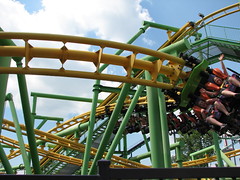
However, I suspect the Nebulaz’s top target audience is managers and executives at theme parks who decide to buy an installation after watching one at a trade show and realizing how many hypothetical boxes it checks. Actually riding one tampered my enthusiasm for the model quite a bit. The undulating circular motion mixed with the slow lateral rotation is fairly boring and unpleasantly nauseating, made worse by the overkill bulky shoulder harnesses that limit your viewshed, with no good view of the near-misses from on-ride. The complicated two-stage loading procedure is also not great when combined with the typical iROC operating standards. Counting on low capacity, this was the attraction I decided to rope drop at the start of the day, after which I determined I’d be happier watching these models from the ground.


One of the other rides I tried was the Air Racers, a Zamperla (wait for it…) Air Race model that represents Aeronautica Landing’s high thrill flat ride. While this also has a pretty extreme undulating motion with the constant flipping upside down, I find the fast forward-moving speed while flying around in circles keeps the air flow moving and prevents it from becoming overly nauseating.


As I recall we also did Hover and Dodge, and oddly cyberpunk futuristic themed bumper cars (by a different Italian flat ride manufacturer, Barbieri), just for the heck of it because bumper cars are fun.


Other rides in Aeronautica Landing that I did not ride are the Airwalker, a skater-style Zamperla Disk’O; Gyro Force, a Chance Rides Trabant that was not yet open; and Wind Star, a (wait for it…) Zamperla Windstarz, also still testing at the time of my visit.


Afterburn
It’s not clear to me whether Afterburn is now included as part of Aeronautica Landing or if it’s still part of a residual “Crossroads” zone that was mostly repurposed for Aeronautica. Either way, this B&M inverted coaster is virtually unchanged since my last visit in 2008, and remains one of the best coasters at Carowinds. That review from fifteen years prior remains fairly accurate, even if it’s painful to re-read something written so long ago as one of the first pieces of writing on this website.
The only thing that’s changed is that I’ve ridden many more B&M inverted coasters, and would now rank Afterburn nearer the middle of the pack. It’s very good (I still especially like the batwing through the trench) but the ride seems to end a little too early given the strength and power of the first half, and seems caught in an awkward phase between early and middle era B&M designs that doesn’t offer much to distinguish it from the competition. Good on Afterburn if it’s able to draw some favorable comparisons to Montu… but then why not just ride Montu?


Intimidator
 From 1996 to 1998, Cedar Fair built three Morgan Manufacturing hyper coasters for three parks they viewed as potential growth markets.8 Then from 2008 to 2010, they did the same thing for parks from their Paramount acquisition, only with Bolliger & Mabillard as the supplier this time around.9
Given the similarity in business strategy, it’s worth noting the differences in design nuances. All three in each set are very similar to each other, of course, but as big, site-specific creations they still make some attempt to differentiate themselves. The Morgan coasters, being the first-ever hyper coasters offered as a standard product, started with a somewhat wonky design in 1996’s Wild Thing before finding a more simplified, effective strategy by the time of 1998’s Mamba. By contrast, B&M had already been making hyper coasters for other customers some time prior to Cedar Fair giving them a call, and if 2008’s Behemoth was a fairly standardized showcase of what the model could do (big hills, a hammerhead curve, and a few helices), by the time they got to 2010’s Intimidator at Carowinds it seems they felt compelled to experiment a little more to avoid turning in a too-similar assignment.
 Not that Intimidator is an experimental take on the B&M hyper coaster genre. It’s a fairly safe, conservative ride, quite unlike its wild-eyed Intamin giga-sibling further north. But it has several moments of weird little serpentine S-bends—on the descent of the second hill, entering the far turn around, and then crossing under again on the exit—that are a little different from anything B&M has attempted on their hyper coaster models before or since. Do they add very much to the ride experience? Not really. There’s probably a reason they were never replicated on later designs. I do like how the crest of the second hill has a fairly sharp rotation into the banked curve, all while experiencing weightlessness at a high elevation. For me this is the best part of Intimidator. But the wiggly back-and-forth curves, including the one that immediately follows on the descent of that second hill, are unremarkable.
What Intimidator does well is sustained floater airtime. There’s nothing special about it, and arguably both Diamondback and Behemoth do it a little bit better, but in direct contrast to the negative-G deficiency on Fury 325, it’s a breath of fresh air(time). There are three full camelback hills, plus several other pops at different points along the layout.
 The biggest drawback to Intimidator is the midcourse brake run and everything that comes after. While Behemoth and Diamondback try to introduce new elements to keep things interesting to the very end, Intimidator’s set of dips sandwiching a lethargic swooping helix feels like a misguided attempt to replicate elements from much better finales on other coasters. Overall, Intimidator gets the basic formula correct even if its attempts to add a twist to the formula don’t pay off. Which stands in stark contrast to Fury 325’s more ambitious attempt to create a new formula that, fundamentally, I don’t think works as well as it should. Perhaps tellingly, once we had our fill of Copperhead Strike, we spent the remaining time before park close getting more laps on Intimidator instead of Fury 325.10


Nighthawk & Other Rides
I didn’t ride Nighthawk, after having a pretty dismal experience with it fifteen years earlier. Even with the FastLane pass, I just didn’t make time for it. Would I have done differently if I had known it was a little over a year away from a permanent demolition, with the end of the entire portfolio of Vekoma Flying Dutchmans not far behind? Maybe, but even then I knew this problematic first-generation flying coaster probably didn’t have more time left than whenever my next visit might be. I still hold memories from 2008 of my battering and bruising while on Nighthawk.
The ride’s prominent placement in the middle of the park essentially makes it the big “welcome weenie” for Carowinds, in place of the Eiffel Towers, Wonder Mountain, or Columbia Carousel found at the other former Paramount Park properties. Which is good for getting photos, but not good if it’s to serve as a park icon that people associate positive memories with.


 Apart from skipping Nighthawk, several other coasters were closed for my visit: Vortex, the B&M stand-up coaster; Hurler, a wooden coaster closely inspired by Kentucky Kingdom’s (superior) Thunder Run; even the cutely re-themed Kiddy Hawk family suspended coaster. I had ridden all of these rather rough coasters on previous visits and they weren’t high on my list to try again. But if I had been a first-time visitor, Carowinds would have had more than half the missed coasters across all parks on this two week trip. And just a couple weeks later, Fury 325 would unexpectedly join the lineup of closed rides as well. Plus the famed Thunder Road racing coasters had already been demolished shortly after completing an extensive refurbishment to make room for more water slides… but they’re still more than happy to sell you Thunder Road souvenirs!
People cite Six Flags Over Georgia as a park needing updates to meet Cedar Fair quality standards, but apart from a few newer headlining attractions, I feel like Carowinds still has more catching up to Six Flags Over Georiga’s standard than the other way around.


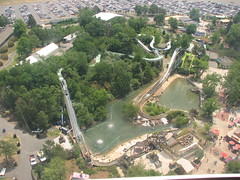
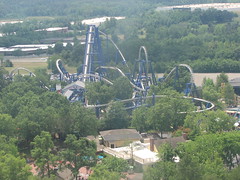
One last ride worth doing every visit is the Carolina Skytower, a 262 foot tall observation tower offering panoramic views of the park.








Comments