Kings Dominion
Doswell, Virginia – Thursday, June 15th, 2023
They say it’s bad luck to meet your doppelgänger. But what about doppelgängers of places? That momentary comfortable feeling of returning to a familiar place, only to remember you’re somewhere you’ve never been.
Thanks to the cost savings and risk mitigation of replicating successful park plans, theme parks are full of instances of eerily similar but not-quite replica parks built hundreds if not thousands of miles apart. Tokyo Disneyland has inspired such feelings in countless American Disney fans. China is full of them, especially among the Fantawild chain. The U.S. has a few as well. Marriott built two nearly-identical Great America theme parks near Chicago and San Francisco that were later sold to different owners and grew quite differently over the next fifty years.
Then there are the original KECO parks, Ohio’s Kings Island in 1972, followed by Virginia’s Kings Dominion in 1975. Even though they’ve changed hands multiple times, these two parks have always stayed linked together under the same parent ownership. The original masterplans were nearly identical, and they share many attractions that are exact copies, near-copies, or at least similarly inspired. Yet these parks have evolved in significantly different ways that, for this lifelong Kings Island visitor, always strikes me as surreal on the couple of occasions I’ve made my way out to Virginia.
 Approaching the entry gates are very similar, as is the main International Street just past that gate, terminating in identical 1/3 scale replicas of the Eiffel Tower. Yet immediately something feels different, like we’ve entered an inverted shadow realm. That’s because Kings Dominion’s Eiffel Tower is quite literally in the shadows when you arrive. At Kings Dominion the entire park is oriented facing south, a 180 degree switch from the northerly orientation at Kings Island. In the northern hemisphere this means the sun illuminates Ohio’s tower as you approach from the entrance, while from the same view it backlights the tower in Virginia, forcing you to squint to look up at the top.
Apart from International Street, both follow a similar rubric for the core themed lands. There’s the former Hanna-Barbara (then Nickelodeon, finally Snoopy) kid’s area near the front, the rustic woodland area in Rivertown and Old Virginia along the back right, the traditional amusement midway in Coney Mall and Candy Apple Grove near the back center-left, and then the African themed Lion Country Safari on the park’s lefthand side. That last section has diverged most radically between the two, getting completely eliminated from Kings Islands, while an evolving safari themed area has now grown to encompass nearly half the park at Kings Dominion.
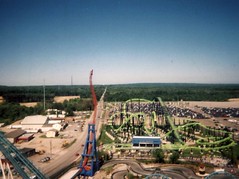
But more than individual lands and rides, one thing that distinguishes the two parks from each other today is the sense of balance. Kings Island keeps a collection of small-to-medium sized thematic areas distributed around the central Eiffel Tower. New rides generally try to complement and contrast the rest of their collection. Kings Dominion, on the other hand, seemingly looks at what’s already popular in their park, and then continues to double down on that. For example, after both parks received copies of the world’s first LIM launch coasters in 1996, Kings Dominion continued adding launch coasters until they had a total of four just ten years later.1 Before that, in 1994 Kings Dominion built their fourth wooden roller coaster 23 years before Kings Island added their own fourth. Kings Island currently has eight different themed areas; Kings Dominion only has five, but they’re huge. And this zoning hasn’t grown the park with an even geographical balance. If you divide Kings Dominion down the middle of International Street, the eastern half covers more than twice as much developed area as the western. As of today, you can find ten of the park’s thirteen coasters (plus the water park) if you hook a left after entering. (An additional two are found if you walk directly straight to the back, and only one, Grizzly, requires a very slight veer to the right.)
 Even the park names are similar but carry different connotations. “Kings Island” (named for the former Coney Island in Cincinnati) sounds regally exotic, a place that promises escape and adventure. Meanwhile, “Kings Dominion” (after Virginia’s historical nickname as the “Old Dominion”) sounds monarchically foreboding, a fiefdom where fun is lorded over guests.
All of this is a long way to say that Kings Island is one of the best regional theme parks in the U.S. and Kings Dominion… isn’t that. But it is a much odder park, one still in the process of figuring out its identity and searching for its future. Unlike the more sacrosanct Kings Island, at Kings Dominion there’s still plenty of room for big, risky, transformative ideas that could result in an entirely different theme park a generation from now. And more than just the familiar comforts, it’s that kind of place that I’m interested in returning to.
Dominator
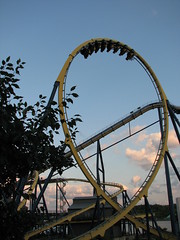
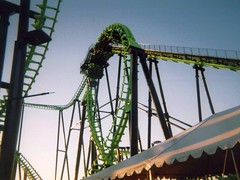
This is my favorite floorless coaster. Or was. I love the size of this ride, the world’s longest floorless coaster with the second-largest vertical loop B&M ever constructed. Yet despite its scale, the five inversion count is on the low side for a B&M multilooping coaster, dedicating more of its layout to a broader dynamic range of twists and turns, particularly a huge, sweeping overbanked speed curve after that first loop.
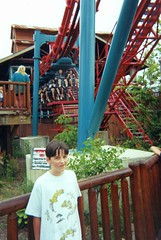
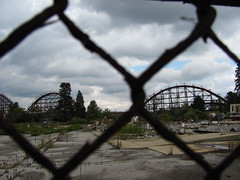
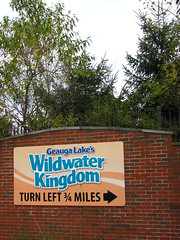
 I spent a good amount of time with Dominator when it was at Geauga Lake, before finally catching up to it again sixteen years later at Kings Dominion. Sometimes a relocated coaster fits its new home like a glove; Dominator is not one of those examples. It’s awkwardly located at the very, very front of the park, hanging out alone atop a big grassy lawn just behind International Street, wedged between the kid’s zone and the parking lot. At least it avoided the “parking lot coaster” fate of several other floorless coasters, but the loss of the lakefront setting definitely knocks it down a notch. The approach is also less impressive, entering from what was once the backside instead of the much more iconic view of the cobra roll and overbanked turn symmetrically framed overhead while the 157 foot lift hill and 135 foot vertical loop fill the background. And while the name stayed the same for the relocation, and the ride is essentially the only major roller coaster in the state of Virginia without a thematic identity, there is an odd bit of poetic synchronicity in having the Dominator dominate the entrance to the Dominion.
But it’s gotten much rougher, either from the relocation or due to advancing age. Despite being the second largest coaster in the park with no line, I only rode it twice, front and back. I hope my old friend will feel better whenever I next return to this park.


Woodstock Express
 I rode this junior wooden coaster along with a gaggle of giggling children just once for the +1. It is, truthfully, a fairly good ride. The lack of high forces means the wooden structure is still allowed to bend and flex, giving life but not roughness to this 50+ year old wooden coaster. It actually predates the theme park by one year, opening as a preview ride attached to the Lion County Safari attraction while the rest of the park was still under construction.
I also looked into whether I could ride the Great Pumpkin Coaster nearby, but a maximum height limit for those unattended by a youngster kept it off my list. This policy has evidently been revised to be more accommodating since my visit, giving me yet another (small) reason to return.


Old Virginia & Shenandoah Lumber Company
 A good themed environment can feel like stepping through a portal into another time. Old Virginia does just that, whisking visitors away to the long-forgotten 1980s. The last full-sized attraction to open in this section was in 1983. At present there is one roller coaster, two water rides, and two family rides, plus some shops and shows, and a lot of trees. This represents pretty much everything to the west of International Street. It’s actually very nice to have a section of a major theme park that doesn’t feel endlessly optimized to maximize its footprint, with a forest with depth that isn’t just used for sight block along the perimeter. Still, with the recent removal of former upcharge attractions such as the Go-Karts, Sky Coaster, and Dinosaurs Alive, this area feels way overripe for new development, so long as the mature trees shading Old Virginia’s pathways will continue to have a long life.
We didn’t spend much time in this section, but one ride I wanted to try was the Shenandoah Lumber Company. This is a very classic Arrow log flume ride that opened with the park in 1975, and I doubt the experience has changed much in that time. There’s a small lift and drop, then a long meandering run through the forest, and then a big lift and drop for the finale. Apart from a water wheel near the station, there are no major themed elements along the run, just the sound of water gently sloshing amongst the trees, and a refreshingly light amount of spray after the drops. It’s not one of the more interesting log flumes ever built, as even the name is pretty boring, but I’m glad it hasn’t followed the trend of removing older water rides entirely.


Grizzly
 I had been to Kings Dominion only once before, in 2007, and my strongest memory was riding Grizzly lap after lap for the last hour of the night. Opened in 1982, this was essentially Kings Dominion’s answer to the Beast. By that measure the Grizzly is woefully inadequate. Despite the Beast’s tremendous success and enduring popularity, it seems KECO swore off ambitious custom-built wooden coaster projects again in favor of re-creating the traditional Coney Island Wildcat layout at three of their other parks during this time period. The other two installations, at California’s Great America and Canada’s Wonderland, are among the worst wooden coasters ever built.
Which is why it’s surprising that Grizzly, despite its modest ambitions, still manages to have more in common with the Beast than either of its clonal siblings. The densely wooded setting helps (although was compromised by the addition of Hurler). There’s a section in the middle where the train roars through a tunnel while mixing airtime with laterals that still rates as one of the best single coaster moments in this entire park. Apart from this intense section, there are several more moments of airtime or laterals, with good pacing and a relatively smooth ride.
When I visited, Kings Dominion was promoting a “Roar Restored” campaign for having recently completed a major wood-tracked refurbishment of the Grizzly using the Gravity Group’s pre-cut track technology. I vastly prefer this approach to other steel-railed track replacement products, which sound and feel too noticeably different from traditional stacked wooden track. Nevertheless, it still carries the same challenge that steel track replacements carry, which is that if it’s not applied to the entire layout, the difference between the old track and new is very noticeable. As we approached the smaller bunny hops for the last lap, it was like a switch turned on to suddenly transform us into ragdolls driving over potholes.
 A good wooden roller coaster is often likened to a story with a beginning, middle, and end. But the current all-or-nothing approach to wood coaster restoration means that increasingly the “story” of classic rides is primarily told through the maintenance schedule. More than anything else that happens on the ride, the thing people take away from the experience is getting a smooth, exciting ride for the first half, and then in the second half you get a jackhammer for the shock absorbers. Upon disembarking I’d overhear several other riders, all of them seemingly “normie” park visitors, comment on how rough it gets at the end. Grizzly is undoubtedly better for the retracking, but in some cases I do ponder if a more consistently rough ride has its own merits over these frankensteined creations.


Candy Apple Grove & Apple Zapple
 This area of the park has a somewhat complicated history. It opened in 1975 as more or less a copy of Kings Island’s Coney Mall area. Just one year later, it was rebranded as Candy Apple Grove, with a fanciful if somewhat loose orchard theme. The 70s Hanna-Barbera-esque aesthetic was gradually stripped away as it reverted to a generic amusement midway simply called “The Grove”. But nostalgia sells, and in 2014 it was restored to Candy Apple Grove.
 I like the idea behind Candy Apple Grove. It’s a colorful, cartoony identity where such a look is usually reserved for children’s areas in regional parks, and it also offers much more specificity than a generic “fantasy” theme, especially like what you’d find in Europe or Asia. Yet despite the rebirth, it still feels stuck in the middle of a longer history that swings back and forth between kind of committing to the bit and not at all. There are some elements that retain the nostalgic 70s children’s entertainment look, others that have a more stylized mid-century modern aesthetic, while Twisted Timbers is doing its own “dark fantasy orchard” thing in the far back… but most of the main midway still looks more like “Coney Island” than it does “Candy Apple Grove” unless you look closely. Once they’re done with Jungle X-Pedition, I think they need to re-re-establish Candy Apple Grove so that the storyline comes across much more clearly and uniformly throughout the zone.
Most of the rides like Drop Tower, WindSeeker, or Delirium don’t connect to the Candy Apple Grove theme at all. The couple that do include the Bad Apple flat ride, as well as the Apple Zapple, a rethemed Mack Rides large wild mouse model formerly known as Ricochet. It looks cute, even if the name is just somewhat inexplicable jazz scatting around the concept of apples. I’m not a huge fan of Mack’s so-called “large” model mouse layouts, since it messes up the typical thrill progression that makes a wild mouse fun, just so it can have one big drop. That drop is placed at the very beginning, which gets the most exciting bit out of the way early and thus diffuses the usual tension for the elevated switchbacks that come next. It also leaves us waiting for the ride to switch back into some more sharp drops before it’s over, but instead it ends on a lackluster set of mild dips and an even more anticlimactic set of slow, low-to-the-ground switchbacks directly into the brakes. I’ll never forget sitting behind a young boy and his mother, where upon the end of the ride the boy indignantly declared “that was a ripoff!”


Twisted Timbers
 After Kings Dominion was gifted the biggest prize in 2008 from the closure of Geauga Lake, followed two years later with North America’s second-ever gigacoaster, it felt like Cedar Fair had anointed Kings Dominion with “favored child” status from their acquisition of the Paramount Parks. But it didn’t last. The rest of the 2010s were a bit of a slump for this park, with a few significant ride closures and only one major new coaster near the tail end of the decade… and it was a reimagining of an existing ride. Still, Twisted Timbers could hold a credible claim as a top two headlining ride at Kings Dominion. Honestly, given the nearly concurrent closure of Volcano, The Blast Coaster in 2018, that wasn’t too difficult to achieve. My question was how it would compare to the rest of the RMC oeuvre?
 The Hurler was both an obvious and a difficult candidate for RMC Ibox conversion. Being the fourth wooden coaster in the park, as well as the roughest, least nostalgic, and most thematically challenged, it was only a matter of time for a major retooling. The Hurler’s tall lift hill with a relatively low-to-the-ground layout already followed the patterns of previous RMC redesigns. However, the pill-shaped out-and-back configuration offered a more limited canvas to reimagine the layout. Hurler, like its predecessor Thunder Run, also has a design quirk where the lateral curves feature very long, gentle lead-ins as the track banks to its side. This isn’t really necessary with modern heartlined design, but it makes for some awkward compound curvatures along the footer pathways that would have to be accommodated in the new design.
 Let me start with what I like about Twisted Timbers. The story, while less elaborate than Mystic Timbers (which clearly was the point of inspiration), generally works well as a “dark” extension of the Candy Apple Grove theme, especially with the rusted 1937 Ford pickup trucks as the ride vehicles.2 The barrel roll down drop inversion fits the original layout well and is a great visual for spectators approaching the ride. And I appreciate that they kept the series of three straight camelback airtime hills on the first part of the run. RMC designs sometimes feel like every element is straining to feel different from the others and compete for the rider’s attention, so to have three of the same, simple element sequenced in a row achieves a pattern of repetition and flow that’s relatively rare for an RMC ride. Also, the cutback inversion at the far turnaround is a little goofy but I had fun with it all the same.
 But now here’s what I think could have been done better. The name is more than a little generic, and doesn’t adequately introduce the storyline nor the steel hybrid nature of the coaster. The whole section around the first overbanked speed curve with weird curving speed bumps leading in and out just doesn’t work for me. It produces a sharp lateral jab at the beginning and end, but then the main curvature itself is a bland maneuver that eliminates all lateral force in favor of mild positive Gs. I honestly believe it would have been better to have kept the exact same flat, lateral-heavy profile from the original Hurler design. I don’t know why sustained lateral forces are almost never allowed on modern coasters, given that it’s traditionally one of the basic ingredients in a dynamic ride profile.3
 I also find that as the ride gets closer to the end, it gets increasingly less confident on what type of experience it wants to be… which I believe should have been an idealized version of what the original Hurler/Thunder Run layout aspired to be, a ride that alternates between fast speed curves and ejector airtime pops. After the cutback inversion there’s a series of four more airtime hills, the first and last ones straight, the middle two with alternating banking to the left and right, a fine if slightly uncomfortable variation on the main theme. The next curve tries to do a reverse banking maneuver at the top, but it’s too small to really execute on the idea. Then there’s another barrel roll, seemingly because every RMC coaster has to have three inversions with the last one a barrel roll near the end. The final curve has a lot of back-and-forth wobbliness,
 seemingly trying to find something interesting in an element that didn’t offer very much potential. Even the final brake run has a weird kink in the middle that feels like the result of a misalignment issue.
Overall, Twisted Timbers is a very good ride for Kings Dominion that I was happy to ride several times throughout the day. But to answer my question about how it stacks up to other RMCs: I’d put it near the bottom of the pile, just above Six Flags Over Georgia’s Twisted Cyclone. Fundamentally the Thunder Run/Hurler track profile wants to be a simple, sharp, straight forward experience, like a bite out of a crisp apple. Twisted Timbers gets halfway to respecting that recipe, but then feels compelled to throw in a few too many different ingredients in an attempt to elevate the dish, and instead just overcomplicates the palette.


Racer 75
 The removal of a Confederate monument in Charlottesville, Virginia in 2017 triggered a riot of white supremacists that resulted in numerous injuries and one death. One year later, Cedar Fair and Kings Dominion decided they were finally overdue to remove their own monument of sorts to the Confederacy in nearby Richmond, by renaming the Rebel Yell racing wooden coaster to become “Racer 75”. The new name, which includes a reference to the ride and park’s history both opening in 1975,4 is truthfully a little bland and unmemorable. Which is probably a good thing; the park avoided much media attention around the name change and never became subject to the increasingly militant right-wing harassment campaigns. I’m grateful that today I can experience Racer 75 only as a classic (if middling) wood coaster, not tied to yesterday’s Civil War or today’s culture wars.
 Like several other attractions in Kings Dominion, Racer 75 is directly inspired by Kings Island’s The Racer, which opened in 1972. That ride is heralded as the spark that ignited the roller coaster renaissance since the 1970s. Racer 75 has a much smaller cultural footprint, and seemingly a narrower physical footprint as well. Instead of the larger divergence between tracks at the far end, Racer 75 keeps the twin tracks side-by-side on the full out-run until they split at the turnaround to return home. It further simplifies an already-simple formula, and I still find the original Racer the superior design (especially with its recent retracking effort that hopefully comes to Racer 75 next). Still, it’s a classic that you can count on to never have a long wait, and I hope it sticks around as a landmark at Kings Dominion for a very long time… which is much better than can be said for Carowinds.


Jungle X-Pedition
 Jungle X-Pedition opened in 2022 as an updated version of Kings Dominion’s former Safari Village/Congo area. While at the time the only new ride was an S&S Free Spin, Jungle X-Pedition represents one of the most ambitious thematic overlays found in a regional American theme park in this century.
Functionally, there’s not much that distinguishes it from other recent Cedar Fair themed design projects—the landscaping and environmental design is pleasant if not overly ambitious, graphics and small props do most of the heavy lifting for storytelling and attention to detail (especially in the queues, restaurants, and gift shops), and there’s no real show action to speak of on any of the decorated thrill rides. But what sets Jungle X-Pedition apart is the commitment to developing a full backstory that connects everything inside the land to a consistent story and style guide. And that’s a big area to cover under one cohesive theme. In 2022, that was only three rides, but in the time since, it’s now expanded to cover the majority of the eastern half of the park, including six of the park’s thirteen roller coasters.
From what I can tell, the storyline behind Jungle X-Pedition is that there are multiple ancient temples scattered throughout the jungle, each dedicated to a different animal: monkeys, crocodiles, spiders, and now also panthers and birds of prey. Visitors are part of an archeological expedition to uncover these temples, with the shops and restaurants being outposts to service the explorers, and the rides themselves being manifestations of the mythical spirit animals found in each temple. You’ll notice the naming patterns and logo design for all the rides bear similarities to each other, which is satisfying to everyone’s inner graphic designer to appreciate the different variations of a theme.
But I also worry if Jungle X-Pedition is attempting a little too much cohesion, especially as it continues to grow. Excessive similarity makes it hard to distinguish individual components from one another. I still find myself somewhat struggling to mentally separate “Rapterra” from “Reptilian” from “Pantherian,”5 and I question the rationale that the logo for a repainted scrambler should be given a similar design with about the same visual pull as those for a landmark gigacoaster or a record-breaking launched wing coaster nearby. And at a certain point, relying on the same style guide and storytelling rubric gets tedious, exposing the weaknesses and limitations of what in a smaller context was a good idea. Sameness can translate to smallness, yet these are landmark coasters that should stand out and have their own strong, distinct identities from one another.6
Of course, the fracturing of a once-cohesive themed environment is a common process at many regional theme parks that will inevitably occur over time. I doubt Jungle X-Pedition will be an exception to that rule. One just hopes that it can retain the original spirit while finding new directions to grow and evolve, and doesn’t follow the usual pattern of conceptual Balkanization that happens to many lesser themed amusement parks.

Tumbili
When Tumbili was announced, at first I worried that it was yet another case of a theme park modifying an English word to give the impression of an exotic-sounding language. So I was pleasantly surprised when I learned that Tumbili is a real Swahili word meaning “monkey,” the fictional deity of this attraction’s temple. That it fits both the storyline and alliterates with the English word “tumble” to describe the ride experience is a happy bit of synchronicity that I have to commend them on.7
As a replacement for the old Tomb Raider: Firefall attraction, I’ll happily take a new coaster credit. Yet the smaller model of the S&S Free Spin Coaster offers relatively little to the experience that a Top Spin doesn’t already, only with a much shorter ride time compared to the flat ride. It also removes the only attraction that once had synchronized show elements from the current Jungle X-Pedition realm, so whether this represents a step in the direction of more immersive themed design may depend on your perspective.
 As someone who had the displeasure of riding the Intamin ZacSpin variation at Six Flags Magic Mountain for several years before trying my first S&S Free Spin, I can say that Tumbili is a tremendous improvement in design given the similar footprints. Still, this thing is way too short. The regular sized Free Spin models found at many of the other Six Flags parks should be the smallest standard size available. On Tumbili there’s only about twenty seconds of action from the top of the lift to the brakes. While admittedly intense for that short duration, even with no queue I didn’t find it worth the effort of dealing with load and unload procedures to go around a second time in a different position. Kiddie coaster rules ought to apply where they send you out around the course at least twice.


Reptilian
 This is now the only steel bobsled coaster in North America, making Reptilian the rarest and most unique attraction at Kings Dominion. Like the endangered suspended coasters, modern ride manufacturers don’t want the uncertainty and liability that comes from vehicles whose positions aren’t fixed to the track, even as free-spinning and flipping seats appear in increasingly extreme designs. (See, Tumbili above.) As such, I’m relieved to see the former 1989-built Avalanche bobsled coaster by Mack Rides get a major facelift to integrate it into Jungle X-Pedition (even though it had always technically been a part of Safari Village since its debut), which hopefully sparks renewed interest in this great family attraction and will help to ensure its longevity for years to come.
It had been a number of years since I last tried one of these ride models in Europe, and I forgot how strange the seating position is, essentially sitting on the floor of the ride vehicle, legs splayed out in front of you like you’re sitting for kindergarten story time. You can sit tandem if you want, but most people now opt for their own cars; we certainly did. Since the lap bar needs to accommodate up to two people it’s more of a gentle reminder of safe riding behavior than an actual safety retraining device. I love rides like this.
Despite its ferocious theme, the ride itself is quite gentle, even compared to most of the European installations I’ve tried. The first section consists of a single helix and then a long, drawn out ascent into the midcourse block brake. Fortunately there’s still more than two-thirds of the ride left to go, and while the brake takes a lot of the speed out of the next section, there’s still a good mix of S-bends and helices to keep things lively all the way up to the final brake. With a minimal queue, Reptilian was worth riding a couple times both front and back. It might even be a top five attraction at Kings Dominion.8


Backlot Stunt Coaster
 It’s ironic how the most ambitious attempts to create immersive themed, story-driven roller coaster experiences now stand out as the most ill-fitting black marks that detract from the visual beauty and thematic cohesion of Kings Dominion. The first try was Flight of Fear which resulted in a massive gray warehouse in the middle of the “jungle,” and now the even worse offender is Backlot Stunt Coaster. The industrial concrete and gravel aesthetic is a poor match for the jungle safari themed part of the park, although in all earnestness I can’t imagine any other location at Kings Dominion it might have been a better fit. (Maybe off International Street next to the parking lot like Dominator?)
It’s too bad because I generally like this ride as a coaster. The launch into an uphill helix is a surprisingly intense maneuver you don’t see anywhere else. The steep overbanked curve into a trench and handful of quick S-bends in the middle section offer a fun variety. And the tunnel after the finale is impressively long. But there are so many missing effects and the drab landscaping is such an unpleasant heat island that I didn’t have any patience for it beyond a single courtesy lap. Hopefully the rumors bear out that it will eventually get re-themed as a jungle jeep exploration coaster… even if the budget for such an ambitious project will inevitably be linked to how investors are feeling about the corporate stock price.9


Anaconda
 R.I.P. Anaconda. The 1991-built ride was always one of the weirder Arrow custom looping coasters, with its underwater tunnel on the first drop and the odd serpentine knot in the middle of the layout. I was sure to grab a couple of laps since I figured the big water snake wasn’t long for this world, and sure enough Anaconda met its fate a year later at the end of the 2024 season.
Truth be told, it wasn’t one of the better Arrow Dynamics looping coasters. Despite having a 144 foot first drop, it didn’t feel particularly large, with just four inversions in an era when six or seven were the norm. The curving first drop was more of a flat ramp, the underwater tunnel looked cool from the ground but was very brief on ride, and the first two inversions were rather disorienting and with the characteristically bad transitions. The midcourse brake takes most of the speed out of the remainder of the rather lethargic layout. The butterfly figure-eight element was perhaps somewhat conceptually interesting, as Arrow’s first attempt at the more complex maneuvers being performed by European manufacturers that had recently entered the scene, but the formula isn’t quite right and the imperfections are made far worse by the horsecollar restraints.10 The final corkscrews over the water come with a lot of hangtime due to the heavy braking needed to make the butterfly element less brutal.
In general I like Arrow looping coasters, the way you feel hugged in your seat, the way every element announces itself with a snap, and the satisfying metallic “clug-clug-clug” it makes going up the lift. Being a fairly unique example, I was frustrated that I couldn’t enjoy Anaconda more than I did. It wasn’t so bad as to be a firm “one and done” ride, but I still had to rationalize a re-ride as likely being my final on the coaster. Of course, the fact that Arrow Dynamics struggled this much with their slightly more novel designs (and Anaconda doesn’t even have any particularly complex customizations) was part of the reason that ultimately brought down not just the Anaconda, but the company as a whole.


Flight of Fear
 Yet another thematic misfit for the Jungle X-Pedition area. Interestingly, Flight of Fear did get an exterior refresh after my visit to repaint the top secret government warehouse in earth tones. I guess the idea is to make it look more like an archaeological storage site or something, although this might only further draw attention to the contradictions and messy storyline. Maybe they can eventually update the story on the interior to something like Indiana Jones and the Kingdom of the Crystal Skull?
Somehow I never realized that after all these years, Flight of Fear continues to operate with shortened five car trains compared to the planned six cars found on the outdoor models. That would partially explain the poor capacity and extended wait times this ride gets. With most of the other attractions being near walk-ons all day, this was the only one with a half hour wait. As such, we only rode once to get the +1 (it was closed on my one previous visit), as I was very familiar with the experience from Kings Island.
The heavy-handed midcourse brake run makes what could be a great ride into an okay one, with the awkward pacing and lateral hangtime through most of the middle portion. It also doesn’t help that the main ride building is lacking the total light block and special effects needed to make it feel like you’re whizzing around outer space and not a dark warehouse. Still, the layout is one of the most effective space-constrained spaghetti bowl designs ever devised, with fluid twists and a great set of inversions, far superior to Disney and Vekoma’s attempt to copy the same formula.


Intimidator 305
When Intimidator 305 was first announced, everyone immediately drew the comparison to a Millennium Force-sized ride with Maverick-style elements. Given those are two of my favorite coasters in the world, and my top two produced by Intamin, I felt guilty that it took me well over a decade to finally ride I-305 for myself. As I walked up to Intimidator for the first time, I approached it with the excited mentality as if it was still the big new ride at Kings Dominion, but the faded paint, overgrown field, and empty queue told the story of an older ride past its prime years… yet it still reigns as the king of its dominion.
After a disappointing experience with Fury 325 the day before, I was especially curious what my reaction to Intimidator 305 (now Pantherian) would be. Part of my challenge with Fury was that the wind and force was a little too much while still not being very much. Intimidator I knew to be an order of magnitude more intense, so would I even last more than a couple of laps?
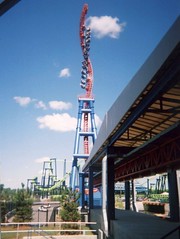
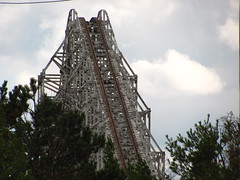
 In my analysis of Fury 325, I concluded that placement and presentation are essential elements to a successful gigacoaster. Intimidator 305 doesn’t score particularly well on this metric. Like both Millennium Force and Fury 325, the slender profile of the lift rising directly away from view, the drop secretly tucked away from view on the far end, is the magnet that draws you closer. But then, also like Fury 325, the brake run is the most prominent element in the foreground. At least this one is closer to ground level so you can watch riders’ reactions at the end of the run. One telling feature is actually an absence: there are no nearby restrooms in this cul-de-sac at the back of the park. That means no plumbing was routed here, and it underscores how Intimidator was set in a remote undeveloped corner rather than attempting to be integrated with the park. The fact the ride was confined to its own rectangular plot, requiring it to frequently cross over and wrap around itself, rather than being allowed to more organically thread in and around a broader area of existing development, may be one of the key factors that led to its intense reputation.
 The cable lift is fast and the first drop has a similar rounded profile to Millennium Force, making the drop seem bigger than it really is since you keep getting pulled over it. The ground level turn at the bottom is the ride’s most controversial feature: the heavy G-forces cause tunnel vision on nearly everyone who rides it. I was no exception, and while I like intense rides, I’m not one of those perverts who enjoy the amusement park equivalent of erotic asphyxiation. (Trust me, those folks are out there.) Fortunately a camel back airtime hill is the next element, which quickly brings the blood flow back up to the brain and lifts the fog of stupor that was setting in. I don’t love this as a beginning, and wish I could enjoy the main camelback hill on its own terms rather than as a recovery for the preceding turn, but it does prove early on that Intimidator absolutely lives up to its name.
 And while I-305 has some of the most intense positive forces around, it doesn’t make the mistake that Fury 325 does of only serving one flavor for extended periods of time. The onslaughts of positive forces are interspersed every few seconds with airtime, in both sustained parabolic crests and whippy rotational snaps. Make no mistake that Intimidator is an incredibly intense ride, much more than Fury, but that intensity is usually balanced in equal and opposite measure so it doesn’t become too overbearing for too long. The unique problem with the first turn isn’t the raw force, but the slightly too-long duration of it.
After the camelback, Intimidator begins what might be one of the most amazing sequences of elements ever built on a modern steel coaster. First there’s a snappy speed hill before it roars around another ground level turnaround. A Maverick-style S-bend throws the train from left to right in a fraction of a second, creating a demented pop of airtime from the rapid rotation around the heartline. I love these intense rotational whips because visually they appear too extreme to survive, but because torque is not actually a force, you come out the other side without taking much of a beating. A second transition back from right to left is a bit gentler, but then the final twist from left to right again is just as aggressive as the first. Incredible pacing, beautiful symmetry, and a smorgasbord of extreme forces in all directions that nevertheless leaves me wanting more.
However, after this sublime sequence, Intimidator begins its final act with a strong trim brake as it rises into a mid-sized camelback hill. There’s still plenty of airtime over the crest, but this is the point where the ride noticeably downshifts into a lower gear. Yet it’s not necessarily the loss of speed that weakens this finale, but the lack of cohesion and symmetry between elements. After the first hill, it rises up as if to repeat the same camelback element, but at the top of this second hill it then tips to the side to transition into a banked curve. To me this comes off as an incomplete thought, like a song on 4/4 time starting a new bar after the sixth beat. Then following this curve, there is a single rotational snap from right to left, which again feels isolated and out of place when previously these elements were always paired together in a longer sequence. A final high-banked turn has a slightly odd snap into the downhill brake run.
In the end, I really enjoyed Intimidator 305. I would rate it my second favorite gigacoaster, but some issues near the beginning and end of the layout still keep it a comfortable distance below Millennium Force. Yet I didn’t find it “too intense” as I know many others have, and thought the overall dynamic balance of forces was more palatable than the more monotonous Fury 325.


And that middle sequence… as the sun went down and we finished with the last lap of the night, I knew I’d be dreaming of it for some time to come. Just imagine a coaster that could have sustained that kind of experience all the way from beginning to end.














Comments