|
|
Six Flags Over Georgia
Austell, Georgia – Saturday, June 10th, 2023
The various ineptitudes of the Six Flags chain can both giveth and taketh away. Mostly, if you’re an average guest, it taketh away.
 Prior to departure I tried to reserve the preferred parking benefit on my high-level Six Flags membership. But the online portal wouldn’t work. I spent a total of three hours troubleshooting and then dealing with guest services, where the eventual solution was “the system isn’t working, so no reservations are required, just show your card and get preferred parking on a first-come first-served basis.” Okay, sounds good! But upon arrival, I’m asked for my date-specific reservation when I produce my pass. I explain the situation, but the only solution that’s offered is to park in the general lot and walk to guest services who can better explain the pre-booking policy through my thick skull so I can do it right next time. (Not the exact words, but the intent wasn’t far off.) A distinctly sour note to start the day, mitigated only somewhat by the fact that it was still early Prior to departure I tried to reserve the preferred parking benefit on my high-level Six Flags membership. But the online portal wouldn’t work. I spent a total of three hours troubleshooting and then dealing with guest services, where the eventual solution was “the system isn’t working, so no reservations are required, just show your card and get preferred parking on a first-come first-served basis.” Okay, sounds good! But upon arrival, I’m asked for my date-specific reservation when I produce my pass. I explain the situation, but the only solution that’s offered is to park in the general lot and walk to guest services who can better explain the pre-booking policy through my thick skull so I can do it right next time. (Not the exact words, but the intent wasn’t far off.) A distinctly sour note to start the day, mitigated only somewhat by the fact that it was still early in the morning and our spot in the general lot was only a minute or two further walk beyond the preferred section. Way too much fuss over too little benefit. in the morning and our spot in the general lot was only a minute or two further walk beyond the preferred section. Way too much fuss over too little benefit.
For a moment, things only seemed to get worse at the front gate, when my membership scanned in, but then our next one showed an error. Unsure why it was reading invalid, the soft-spoken young employee also offered the solution to speak to guest services… and waved us to a structure just inside the main gate near Georgia Scorcher. As we’re sauntering in that direction, we realize the credit card linked to that membership had been replaced earlier that year and never updated, meaning the dues hadn’t been paid for months. No need to wait in line at guest services to identify that issue! And, since we’re already on our own inside the park, we could simply deal with it much, much later. It was a free admission loophole the size of a four-lane highway mountain tunnel; much easier to just go with the flow straight through than volunteer the extra work to go around. It was a free admission loophole the size of a four-lane highway mountain tunnel; much easier to just go with the flow straight through than volunteer the extra work to go around.
This was only my second visit to the second original Six Flags theme park, after my first visit twenty years earlier. Things had changed, but not as much as expected for a two decade gap. There were only four new coasters for me (plus one removal), which includes a kiddie coaster and a wood-to-steel conversion. Atlanta is booming as a metro area, but Six Flags management seemed not to have noticed the opportunity. Which might have some benefit, as the park still retains elements from its original state history theme park identity that might have long ago been ripped out by more aggressive planning found at a place like Great Adventure. But it also left it with a muddled identity and a confusing infrastructure, as well as an adequate B+ collection of rides that includes a mix of below-average examples of good ride types (Twisted Cyclone, Riddler Mindbender) above-average installations of bad ride types (Georgia Scorcher, Blue Hawk), average versions of middling ride types (Dare Devil Dive, Batman & Superman), and one bona-fide winner (Goliath). As I write this two years after my visit, there’s strong indication that new management sees the potential in this park and is aiming to grow it while cleaning up the identity crises and returning the park to its roots. Hopefully it won’t take me another twenty years to check in on their progress. found at a place like Great Adventure. But it also left it with a muddled identity and a confusing infrastructure, as well as an adequate B+ collection of rides that includes a mix of below-average examples of good ride types (Twisted Cyclone, Riddler Mindbender) above-average installations of bad ride types (Georgia Scorcher, Blue Hawk), average versions of middling ride types (Dare Devil Dive, Batman & Superman), and one bona-fide winner (Goliath). As I write this two years after my visit, there’s strong indication that new management sees the potential in this park and is aiming to grow it while cleaning up the identity crises and returning the park to its roots. Hopefully it won’t take me another twenty years to check in on their progress.
Twisted Cyclone
 Twenty years ago, the Georgia Cyclone was my favorite attraction at Six Flags Over Georgia. Riding in the back row, the violent combination of lateral and negative G-force whip over the drop-offs of each fan curve gave this Cyclone-clone real teeth that I still distinctly remember to this day. I can’t speak to the state of the wood track in 2017 and thus whether or not the Twisted Cyclone RMC Ibox renovation in 2018 was a “much needed” change. But in a landscape increasingly overpopulated with RMC Ibox creations (including one of the best in the same metro region), Twisted Cyclone was not very memorable, in which case I must cast my vote in preference of my memories of the original. Twenty years ago, the Georgia Cyclone was my favorite attraction at Six Flags Over Georgia. Riding in the back row, the violent combination of lateral and negative G-force whip over the drop-offs of each fan curve gave this Cyclone-clone real teeth that I still distinctly remember to this day. I can’t speak to the state of the wood track in 2017 and thus whether or not the Twisted Cyclone RMC Ibox renovation in 2018 was a “much needed” change. But in a landscape increasingly overpopulated with RMC Ibox creations (including one of the best in the same metro region), Twisted Cyclone was not very memorable, in which case I must cast my vote in preference of my memories of the original.
Twisted Cyclone actually starts out pretty good. The “hurricane watch party” story (with radio DJ) in the queue is fun, the hot rod trains look pretty cool, and the first set of elements are actually quite good despite the small size. The sharp first drop includes a slight twist with a nice headchopper effect; I love the symmetry and weightless rotation of the double rollover on the first elevated curve; and the 90 degree outward floater hill provides great visuals both on and off ride. It’s a clever RMC reinterpretation of the classic Coney Island Cyclone opening act, and I wouldn’t change anything about it. of the classic Coney Island Cyclone opening act, and I wouldn’t change anything about it.
But after that point, it loses the connection to the Cyclone identity and becomes a pretty middling collection of the most basic RMC tropes: jabbing airtime peaks, lateral-forceless over-banked curves, and a random zero-G roll because that’s the easiest inversion to place atop an existing wooden support superstructure. The traditional Cyclone layout, which the Georgia Cyclone also did quite well, is able to build tension through a pattern of hold and attack in the first half, before sprinting breathlessly through the final act. Not only do these RMC elements all feel divorced from one another in any sense of flow or story, but it had to shorten the layout by nearly 500 feet, leaving an abruptly truncated ending. An RMCified Cyclone could have been outstanding, but unfortunately this one only gets part way there before fudging the rest of the assignment. I feel no compunction about rating Twisted Cyclone the worst of the Ibox conversions… yet even still, I must give it credit as one of the better rides in the park.
      
Acrophobia
I normally don’t care much for drop towers, but I remembered Acrophobia’s unique floorless tilting variation made an impression on me twenty years ago and I was curious if it still held up. Despite the name,1 Acrophobia is not particularly tall as far as Intamin drop towers go, but the precariousness of the seating (standing?) arrangement is effective, and if anything the shorter stature gives the impression that there’s not enough dropping distance to safely and smoothly land. Acrophobia had no wait, so I had no regrets or disappointments in renewing my acquaintance with it.
  
Six Flags Railroad
 One of the few remaining opening day rides from 1967, this train shows its age through its quirkiness. Apologies for any potential offense, but this is quite literally the short bus of theme park train rides, with only two passenger cars trailing its steam engine. The scenic ride is also very slow as it navigates the windy, uneven loop route through the middle of the park with awkward backstage views of almost everything. It makes up for it with a Jungle Cruise style live narration as the ride op tries to hype everyone on board for the other attractions in the park, but mostly build hype for the train. I was ready to groan all the way through, but the energy of the host and buy-in from the audience honestly made the overall experience pretty endearing, and we had positive things to say about it as we completed our loop tour of the park. One of the few remaining opening day rides from 1967, this train shows its age through its quirkiness. Apologies for any potential offense, but this is quite literally the short bus of theme park train rides, with only two passenger cars trailing its steam engine. The scenic ride is also very slow as it navigates the windy, uneven loop route through the middle of the park with awkward backstage views of almost everything. It makes up for it with a Jungle Cruise style live narration as the ride op tries to hype everyone on board for the other attractions in the park, but mostly build hype for the train. I was ready to groan all the way through, but the energy of the host and buy-in from the audience honestly made the overall experience pretty endearing, and we had positive things to say about it as we completed our loop tour of the park.
 
 Also boosting our mood: the free VIP members lounge next door while we waited for the train. Only one of us qualified for the lounge, but the receptionist saw no issue with letting our full party enjoy the air conditioning, lounge seating with phone chargers, and free soft drinks and snacks. (Another example of when Six Flags’ lax attitude unexpectedly giveths.) The snacks proved sufficient to substitute paying for the usual Six Flags meal in the park, and the cooled lounging area is simply an amenity that should be available to everyone in any modern theme park, not just VIP passholders or as upcharges. More parks are introducing autism-safe sensory rooms that also provide similar benefits, but universally accessible design would recognize that these kinds of spaces can benefit everyone, especially as the summers grow hotter and parks more overstuffed with overstimulating rides than in years past. Also boosting our mood: the free VIP members lounge next door while we waited for the train. Only one of us qualified for the lounge, but the receptionist saw no issue with letting our full party enjoy the air conditioning, lounge seating with phone chargers, and free soft drinks and snacks. (Another example of when Six Flags’ lax attitude unexpectedly giveths.) The snacks proved sufficient to substitute paying for the usual Six Flags meal in the park, and the cooled lounging area is simply an amenity that should be available to everyone in any modern theme park, not just VIP passholders or as upcharges. More parks are introducing autism-safe sensory rooms that also provide similar benefits, but universally accessible design would recognize that these kinds of spaces can benefit everyone, especially as the summers grow hotter and parks more overstuffed with overstimulating rides than in years past.
Dahlonega Mine Train
Another original 1967 attraction, also making the Dahlonega the second oldest mine train coaster ever built, just one year after its sibling at the Over Texas park. The formula still had a ways to be perfected: while most later mine trains evoke a feeling of setting out on an expedition across an unknown wilderness, the Dahlonega Mine Train’s short frequent lifts and meandering layout across a lightly forested hillside plot is more evocative of riding a toy train around a childhood backyard. Which is still quite a lot of fun, especially with its random bunny hops, improvised banking techniques, and an underground finale that gives the first almost-semblance of thrill during the entire layout.

Joker Funhouse Coaster
What a weird kid’s coaster. This custom Chance Big Dipper features a terrain layout mostly by virtue of the large elevated deck built for the kid’s area that it navigates over, under, and around. It begins with a lengthy pre-lift around a back of house area, before the lift feeds into a main layout that includes only three drops, a low number even by kid’s coaster standards. Yet it’s a surprisingly powerful layout for the diminutive ride vehicle size, hitting a top speed faster than the Dahlonega Mine Train as it circles down the hillside and under the walkways a pretty significant distance below the station grade, then using all of its energy to just barely make it back up into the loading platform. I might have tried it a second time if the throughput wasn’t so poor.
   
Justice League: Battle for Metropolis
 When Six Flags commissioned Sally Rides to get them back into the dark ride game, they should be commended for their ambition to tell a coherent superhero story across a multifaceted dark ride. The story is a bit of a grab bag of characters from across the DC Universe, but the odd couple pairing of Lex Luthor and Joker is acknowledged and played for laughs, the interactive element meshes reasonably well with the story while avoiding blinking red lights, and the scenes have enough variety between 3D and practical effects to keep it consistently engaging. Of course, this variety and ambition also represents one of its fatal flaws, which is that maintaining show quality is not a prerequisite for Six Flags’ ability to physically open these rides each day. Expect numerous effects missing or miscalibrated on any given ride through, although as I recall Georgia’s version fared better in this regard than many of its compatriots. Bonus points for sharing a plaza with Superman: Ultimate Flight, the only park in the chain to have a Metropolis section with both Justice League and Superman attractions. When Six Flags commissioned Sally Rides to get them back into the dark ride game, they should be commended for their ambition to tell a coherent superhero story across a multifaceted dark ride. The story is a bit of a grab bag of characters from across the DC Universe, but the odd couple pairing of Lex Luthor and Joker is acknowledged and played for laughs, the interactive element meshes reasonably well with the story while avoiding blinking red lights, and the scenes have enough variety between 3D and practical effects to keep it consistently engaging. Of course, this variety and ambition also represents one of its fatal flaws, which is that maintaining show quality is not a prerequisite for Six Flags’ ability to physically open these rides each day. Expect numerous effects missing or miscalibrated on any given ride through, although as I recall Georgia’s version fared better in this regard than many of its compatriots. Bonus points for sharing a plaza with Superman: Ultimate Flight, the only park in the chain to have a Metropolis section with both Justice League and Superman attractions.
 
Superman: Ultimate Flight
I didn’t ride it this visit. I had already ridden it the year after its debut as the first B&M Flying Coaster in North America, and was mildly interested to revisit it to compare the difference to the later models at Great Adventure and Great America, with its dual loading platform, shorter trains, and semi-terrain coaster setting. But as we walked by, the reality set in that it was hot, it’s not a comfortable ride, and even with Flash Pass there was going to be a bit of a wait, so it felt easier to keep on moving. Superman as a flying coaster should be one of the most obvious superhero-themed attractions imaginable, and it’s too bad it hasn’t been done to a higher standard of excellence than this attraction, yet.
 
Great American Scream Machine
 As wooden coasters have gotten more dynamic and daring, they have also gotten uglier. Despite its name, the Great American Scream Machine is not a particularly thrilling coaster, but the 1973 John Allen creation is certainly Six Flags Over Georgia’s most attractive coaster to look at, its elegant whitewashed structure reflecting against the lake.2 I had remembered there being a decent amount of airtime on my last visit. While recent retracking efforts have kept the Scream Machine relatively smooth, it did seem more sluggish around the course, with faint whispers of airtime that never quite delivers. The pacing is still quite enjoyable, progressing from big drops and high turns to a faster-paced, bunny hop focused ride. We liked it enough to go around and ride it twice back-to-back, which is more than can be said for most other coasters on this side of the park. As wooden coasters have gotten more dynamic and daring, they have also gotten uglier. Despite its name, the Great American Scream Machine is not a particularly thrilling coaster, but the 1973 John Allen creation is certainly Six Flags Over Georgia’s most attractive coaster to look at, its elegant whitewashed structure reflecting against the lake.2 I had remembered there being a decent amount of airtime on my last visit. While recent retracking efforts have kept the Scream Machine relatively smooth, it did seem more sluggish around the course, with faint whispers of airtime that never quite delivers. The pacing is still quite enjoyable, progressing from big drops and high turns to a faster-paced, bunny hop focused ride. We liked it enough to go around and ride it twice back-to-back, which is more than can be said for most other coasters on this side of the park.
    
Blue Hawk
 One thing that irked me in RollerCoaster Tycoon was when players would take a predesigned track and simply plop it over an open body of water. It looked bad and wasn’t realistic. Well, Blue Hawk (formerly Ninja) has been standing over its lagoon since 1992 to offer an example of just how realistic the practice actually was. While it’s one of the park’s least loved coasters, the compact Vekoma multilooping coaster was quite advanced at the time of its manufacture in 1989, showing a much higher CAD sophistication than anything Arrow Dynamics was producing in the same era. One thing that irked me in RollerCoaster Tycoon was when players would take a predesigned track and simply plop it over an open body of water. It looked bad and wasn’t realistic. Well, Blue Hawk (formerly Ninja) has been standing over its lagoon since 1992 to offer an example of just how realistic the practice actually was. While it’s one of the park’s least loved coasters, the compact Vekoma multilooping coaster was quite advanced at the time of its manufacture in 1989, showing a much higher CAD sophistication than anything Arrow Dynamics was producing in the same era.
Some refurbishments, paint, new trains and a new identity since 2016 have also helped give it a newfound respect among park goers. What seemed like it could have been an ideal candidate for the old ride rotation program (or the scrap heap) has earned the longevity to become the fourth oldest coaster to remain at the park. Those butterfly and sidewinder inversions are still pretty exciting all these years later, as are the numerous headchoppers as it weaves through its own layout in a seemingly too-small footprint. Six Flags Over Georgia might not have the best coasters in the South, but if this is perhaps the worst of its collection, they’re doing better than a lot of parks.
    
Monster Mansion
…Was closed for mechanical problems. Boo!
 I had been so looking forward to what is reportedly the best dark ride in the entire Six Flags chain, especially as it was in the middle of a major refurbishment and reported to be in excellent condition. This was easily the biggest spite of the entire Southeast trip, and especially annoying because it had been open for much of the morning while I was elsewhere in the park, but then it shut down and never reopened. When you have a lot of attractions to get to it can be hard to prioritize, and I never figured a mill chute dark ride operating since the 1960s would be one susceptible to major mechanical gremlins that I should try to do early. I had been so looking forward to what is reportedly the best dark ride in the entire Six Flags chain, especially as it was in the middle of a major refurbishment and reported to be in excellent condition. This was easily the biggest spite of the entire Southeast trip, and especially annoying because it had been open for much of the morning while I was elsewhere in the park, but then it shut down and never reopened. When you have a lot of attractions to get to it can be hard to prioritize, and I never figured a mill chute dark ride operating since the 1960s would be one susceptible to major mechanical gremlins that I should try to do early.
Unfortunately I don’t have anything to say about the Monster Mansion here, so I’ll just note that an earlier incarnation was actually the first-ever ride to be inspired by Disney’s Song of the South featuring the adventures of an anthropomorphic rabbit, fox, and bear… but created by Sid and Marty Krofft in the style of Hanna-Barbera and Rankin-Bass cartoons. (Watch Defunctland for more.) Six Flags at least had the good sense to retheme their version of the ride all the way back in 1981.
Goliath
 When it was announced for 2006, the generic name (one of two Goliaths to debut that year) and diminutive height3 made it feel like Six Flags was adding only the minimum viable product necessary to give their Georgia property its long awaited flagship coaster. Thus I was somewhat surprised when the reviews came in that not only was Six Flags Over Georgia’s Goliath an almost universally well-regarded ride, it was commonly cited as one of the best B&M Hypercoasters, period. When it was announced for 2006, the generic name (one of two Goliaths to debut that year) and diminutive height3 made it feel like Six Flags was adding only the minimum viable product necessary to give their Georgia property its long awaited flagship coaster. Thus I was somewhat surprised when the reviews came in that not only was Six Flags Over Georgia’s Goliath an almost universally well-regarded ride, it was commonly cited as one of the best B&M Hypercoasters, period.
Having finally gotten to try it myself, I wouldn’t go that far, but it’s still much better than the stats would indicate. The difference is in its sharper, borderline-ejector airtime, which went further than the circa-2006 standards for B&M Hypercoasters of light floater (Apollo’s Chariot, Nitro, Silver Star) or no airtime (Raging Bull, minus back row on the first drop). Finally, the open recliner seating and clamshell restraints were being put to their full use! (Raging Bull, minus back row on the first drop). Finally, the open recliner seating and clamshell restraints were being put to their full use!
Unfortunately Goliath had developed a pronounced rattle by the time of my visit that limited its enjoyability and, I suspect, ability to sustain its full speed. I’ve had hot days on Nitro that produced far more aggressive forces than this, and in the intervening years Mako has largely stolen the crown for below-average sized B&M Hyper with an above-average dynamic force profile. That said, larger coasters generally need to be more cautious with how much and how long they sustain forces, which can be to the benefit of slightly smaller coasters to get a little bolder with their dynamic range, something Goliath seems to have taken advantage of.
 The layout quality is a bit of a mixed bag. The coaster fits the park rather poorly, with most of the valleys pulling up some 20 to 30 feet above ground level due to the placement of roads, pathways, or support buildings beneath them, and offers few good viewing angles from within the guest area boundaries despite the station being in the middle of the park. But there’s a lot to like about the layout too, including the aforementioned sharp pitches to nearly every hill producing a pleasing variety of negative-G sensations depending on your placement near the front or back of the 9-car trains. The downhill spiral helix is one of the better turnaround maneuvers on a hypercoaster, the sustained force and increasing speed offering a simple if satisfyingly dizzy logic. And the finale sequence of small airtime hops, eventually cascading through a thicket of trees to surprise us with a tight curve and airtime pop combo into the brakes, keeps the ride interesting all the way up to its very last moments. Maybe with a good refurbishment (and new color scheme), I can return to more fully appreciate everything this ride has to offer. In the meantime, Goliath will have to settle for still being the best coaster at Six Flags Over Georgia, if not quite any longer the best in the metro Atlanta area. The layout quality is a bit of a mixed bag. The coaster fits the park rather poorly, with most of the valleys pulling up some 20 to 30 feet above ground level due to the placement of roads, pathways, or support buildings beneath them, and offers few good viewing angles from within the guest area boundaries despite the station being in the middle of the park. But there’s a lot to like about the layout too, including the aforementioned sharp pitches to nearly every hill producing a pleasing variety of negative-G sensations depending on your placement near the front or back of the 9-car trains. The downhill spiral helix is one of the better turnaround maneuvers on a hypercoaster, the sustained force and increasing speed offering a simple if satisfyingly dizzy logic. And the finale sequence of small airtime hops, eventually cascading through a thicket of trees to surprise us with a tight curve and airtime pop combo into the brakes, keeps the ride interesting all the way up to its very last moments. Maybe with a good refurbishment (and new color scheme), I can return to more fully appreciate everything this ride has to offer. In the meantime, Goliath will have to settle for still being the best coaster at Six Flags Over Georgia, if not quite any longer the best in the metro Atlanta area.
    
Georgia Scorcher
 The seven B&M Stand-Up Coasters fit into one of three classes: the original three compact two-inversion stand-up coasters at Carowinds and both Great Americas; the subsequent three mega-stand-ups at Cedar Point, Kentucky Kingdom, and Magic Mountain that each took the same formula and one-upped the previous in size and inversion count; and finally, the lonely Georgia Scorcher, which combined the modest size of the original class with the most advanced engineering quality of the mega-models, especially the Riddler’s relatively comfortable ride (okay, very relatively). The Scorcher pointed the way toward a friendlier, more modern and sustainable stand-up coaster experience that could have spread around the world in the new millennium. But it was far too little, too late, becoming the last of a much maligned, now nearly extinct ride model.4 The seven B&M Stand-Up Coasters fit into one of three classes: the original three compact two-inversion stand-up coasters at Carowinds and both Great Americas; the subsequent three mega-stand-ups at Cedar Point, Kentucky Kingdom, and Magic Mountain that each took the same formula and one-upped the previous in size and inversion count; and finally, the lonely Georgia Scorcher, which combined the modest size of the original class with the most advanced engineering quality of the mega-models, especially the Riddler’s relatively comfortable ride (okay, very relatively). The Scorcher pointed the way toward a friendlier, more modern and sustainable stand-up coaster experience that could have spread around the world in the new millennium. But it was far too little, too late, becoming the last of a much maligned, now nearly extinct ride model.4
 The layout avoids the parade of similarly-paced inversions that typify most B&M looping coasters of that era, even the other mega stand-up coasters, in favor of a more varied twister layout with a number of tight twists and highly-banked curves that flow surprisingly well especially considering the rider’s higher center of gravity; my favorite part is a sideways near-airtime hill that then seamlessly twists back into the corkscrew inversion. The layout avoids the parade of similarly-paced inversions that typify most B&M looping coasters of that era, even the other mega stand-up coasters, in favor of a more varied twister layout with a number of tight twists and highly-banked curves that flow surprisingly well especially considering the rider’s higher center of gravity; my favorite part is a sideways near-airtime hill that then seamlessly twists back into the corkscrew inversion.
Overall, the coaster is a little too small, and the stand-up restraints (as always) a little too awkward, for the Georgia Scorcher to rank anywhere close among the greats. But with luck, it will be preserved as a stand-up experience for decades to come as a reminder of what the concept was capable of under the best of circumstances.
   
Dare Devil Dive
 Before the RMC Raptors were advertised as low-cost, low-capacity, high-thrill coasters perfect for small parks only to be bought mostly by big chain parks looking to cut costs, there was the time Six Flags Over Georgia bought a 6-seater Gerstlauer Eurofighter. A variant of the Anubis layout from Belgium’s Plopsaland, Dare Devil Dive traded the launch and tophat for a vertical lift to slightly reduce the already low theoretical capacity. They then further halve that theoretical number through operating procedures that rarely see more than one car out on the track at a time. We actually had decent luck with getting to ride it twice in a day, first by getting there as early as possible at opening and second by using our Flash Pass’s limited one-time access later in the afternoon, where a 20 minute wait past the merge point was still in order. Before the RMC Raptors were advertised as low-cost, low-capacity, high-thrill coasters perfect for small parks only to be bought mostly by big chain parks looking to cut costs, there was the time Six Flags Over Georgia bought a 6-seater Gerstlauer Eurofighter. A variant of the Anubis layout from Belgium’s Plopsaland, Dare Devil Dive traded the launch and tophat for a vertical lift to slightly reduce the already low theoretical capacity. They then further halve that theoretical number through operating procedures that rarely see more than one car out on the track at a time. We actually had decent luck with getting to ride it twice in a day, first by getting there as early as possible at opening and second by using our Flash Pass’s limited one-time access later in the afternoon, where a 20 minute wait past the merge point was still in order.
 Gerstlaurer coasters usually don’t fare very well with over-the-shoulder harnesses so I didn’t have very high hopes for Dare Devil Dive, yet it exceeded my expectations by offering a mostly smooth ride. There’s some funky shaping to the dive loops and overbanked curves, and the heartline roll serves as an adequate finale. It’s still not very good; comparing a video of Anubis, it’s clear the gravity-driven Dare Devil Dive doesn’t have anywhere near as much power to sustain its speed through the layout, resulting in lots of hangtime and near-stall around the high points that are sometimes fun, but mostly awkward. This would have been a decent ride at a much smaller park, but in Atlanta those parks are too preoccupied with building top ten megacoasters so it’s the legacy property in the largest regional theme park chain that gets it instead. Gerstlaurer coasters usually don’t fare very well with over-the-shoulder harnesses so I didn’t have very high hopes for Dare Devil Dive, yet it exceeded my expectations by offering a mostly smooth ride. There’s some funky shaping to the dive loops and overbanked curves, and the heartline roll serves as an adequate finale. It’s still not very good; comparing a video of Anubis, it’s clear the gravity-driven Dare Devil Dive doesn’t have anywhere near as much power to sustain its speed through the layout, resulting in lots of hangtime and near-stall around the high points that are sometimes fun, but mostly awkward. This would have been a decent ride at a much smaller park, but in Atlanta those parks are too preoccupied with building top ten megacoasters so it’s the legacy property in the largest regional theme park chain that gets it instead.
     
Batman: The Ride
 Same as the others: a tightly paced, intense layout that’s over before you know it. Great to have at your home Six Flags park and worthy of one courtesy ride when visiting a Six Flags further afield. Same as the others: a tightly paced, intense layout that’s over before you know it. Great to have at your home Six Flags park and worthy of one courtesy ride when visiting a Six Flags further afield.
The most notable thing I have to say about this version is the color scheme. In my 90s-kid impression, Batman is always supposed to be an all-black coaster with a few yellow accents on the trains, reinforced by the strict branding guidelines of possibly the world’s most lucrative single superhero property. Yet that hasn’t been true for any of the models for over a decade (except the mirror-universe version at Six Flags St. Louis), which have experimented with various combinations of shades of yellow, blue, or grey. Over Georgia’s is perhaps the most unusual, a royal blue track spine with steely navy blue columns. To me this reads as the color scheme for a coaster named something like the Great White, or Top Gun, or maybe Afterburn, but I guess it works as a Batman color palette too. I am curious who is responsible for selecting the Batman colors, and why neither Six Flags nor Warner Bros. has decreed a uniform standard across all installations.
   
The Riddler Mindbender
 I always had it in my head that Over Georgia’s Mindbender was one of, if not the best coaster ever made by Anton Schwarzkopf. I had few memories from my one previous ride twenty years earlier, but a comparative analysis made sense to reason that Mindbender was something special. I’d rate Magic Mountain’s Revolution and Over Texas’s Shock Wave within the top tier of coasters at their respective parks, 9/10 if not 10/10 quality coasters to this day. And Mindbender seemed to take the best elements of each and even improve on them. Like the Revolution, it has a wooded hillside setting that allows it to maintain speed and hide surprises to the very end. And like its 1978-built sister coaster Shock Wave, it features steeper drops and more sharply pitched turns, and even saves one of its two vertical loops as a climax near the end of the layout instead of packing them together at the beginning. I always had it in my head that Over Georgia’s Mindbender was one of, if not the best coaster ever made by Anton Schwarzkopf. I had few memories from my one previous ride twenty years earlier, but a comparative analysis made sense to reason that Mindbender was something special. I’d rate Magic Mountain’s Revolution and Over Texas’s Shock Wave within the top tier of coasters at their respective parks, 9/10 if not 10/10 quality coasters to this day. And Mindbender seemed to take the best elements of each and even improve on them. Like the Revolution, it has a wooded hillside setting that allows it to maintain speed and hide surprises to the very end. And like its 1978-built sister coaster Shock Wave, it features steeper drops and more sharply pitched turns, and even saves one of its two vertical loops as a climax near the end of the layout instead of packing them together at the beginning.
Now, don’t get me wrong, the Riddler Mindbender is still an absolute classic and one of the best rides at Six Flags Over Georgia. Yet as I compare it to the standard set by its 1970s-era looping Schwarzkopf peers, I find a different point of comparison: Hersheypark’s Sooperdooperlooper, the fun if lightweight classic that’s basically a mine train coaster with a loop. Compared to the powerful Shock Wave, the Mindbender just feels a little sluggish around its course, never coming close to the volley of positive and negative forces that the Texas sibling subjects its riders to. And it also lacks the elegant, purposeful pacing of the Revolution, with the Mindbender’s most exciting moments (the two inversions and spiraling downward helix) happening not with anticipatory drama but rather some uneventful dead space in between. Even the terrain setting is smaller and more sparsely landscaped than I realized, with the parking lot never far from view. Maybe the 2021 refurbishment that added new, shorter trains from B&M didn’t do the Mindbender the same favors as its California cousin’s 2016 update,5 but I also think a lot of it comes down to Anton’s design needing a little more refinement.
      
 I should also warn that I didn’t get the best experience with the Riddler Mindbender on this particular day, which may have also colored my (limited) impressions. After two rides in the morning, I had intended to save the rest of my time with the Mindbender for the very end of the operating day. The Saturday schedule was the only day of the week open late enough for about a half hour of dusk/near-night riding, and I couldn’t think of any ride I’d rather focus on than the Mindbender. I should also warn that I didn’t get the best experience with the Riddler Mindbender on this particular day, which may have also colored my (limited) impressions. After two rides in the morning, I had intended to save the rest of my time with the Mindbender for the very end of the operating day. The Saturday schedule was the only day of the week open late enough for about a half hour of dusk/near-night riding, and I couldn’t think of any ride I’d rather focus on than the Mindbender.
The queue had mostly emptied by the time we arrived so it seemed like a good plan. But as we dispatched for our first lap, our train came to a halt on the stretch of transfer track before the lift hill. The ride operator, who was leaning over the control panel in a mock nap at the end of the day, announced she had accidentally pressed the E-stop button. Oops! Ha ha! An easy reset was not possible, so maintenance had to be called to perform an evacuation. While it was perhaps of moderate nerd interest to walk the short length of transfer track, the lengthy procedure not only robbed us of the opportunity to get more rides on the Riddler Mindbender, but from any night rides at all, stepping off to freedom just minutes after everything had closed.
Once again, the ineptitudes of Six Flags usually manage to taketh away.
    
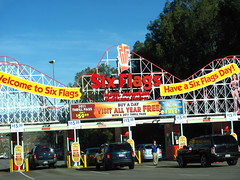 Valencia, California Valencia, California
I join the queue for season pass processing. Six Flags still sells season passes online at a rate that’s less than the combined price of two one-day tickets. As I was visiting Saturday and Sunday this deal made the most sense, but I quickly regretted it when I arrived at the entrance fifteen minutes prior to opening and discovered a processing queue winding around the wall of the inner courtyard between the ticket booths and main gates that could easily take an hour or two to complete. My plan was to arrive forty-five minutes early to make sure I could get my print-off voucher exchanged for plastic in time so I wouldn’t be late for the early morning rush and get several of the major rides in before the queues fill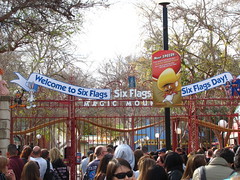 (I am told this is an especially wise idea if one is serious about riding X2 and Tatsu as often as possible, which I was), but this queue had thrown a fine monkey wrench into those plans. Of course it was no one’s fault but my own, which made it all the more bitter pill to swallow. The plaza filled with more and more anxious teens and families, making me wonder if this was an offseason day how packed the entrance must be on a prime season weekend morning; it’s not very big. Now five minutes before they let the chain drop, an older African-American gentleman in a neon yellow uniformed shirt approached me, asking if I had already purchased a voucher. I showed him my black-and-white laser print-out I copied that morning, and he handed me a small red ticket. (I am told this is an especially wise idea if one is serious about riding X2 and Tatsu as often as possible, which I was), but this queue had thrown a fine monkey wrench into those plans. Of course it was no one’s fault but my own, which made it all the more bitter pill to swallow. The plaza filled with more and more anxious teens and families, making me wonder if this was an offseason day how packed the entrance must be on a prime season weekend morning; it’s not very big. Now five minutes before they let the chain drop, an older African-American gentleman in a neon yellow uniformed shirt approached me, asking if I had already purchased a voucher. I showed him my black-and-white laser print-out I copied that morning, and he handed me a small red ticket.
“Well then, if you would like you can show this with your voucher at the gates over there to enter now, and you can come back any time today to get your pass processed up to a half hour after the park closes.”
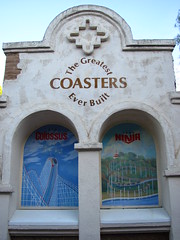 I am left speechless. Really? Really really? As easy as that? I mean, it’s a simple and obvious policy to relieve unnecessary bottlenecks at the front gate, but this is Six Flags Magic Mountain we’re talking about. The place that has a reputation for closing a third of its rides to perpetual maintenance, queues running multiple hours for attractions operating at less than 50% their theoretical capacity, and a clientele that enjoys the occasional knife fight just to keep from getting bored. The amusement park where customer service is sent to die. The park so forsaken that when the new management took over a couple years ago they considered demolishing the entire premises and selling it off for its real estate rather than to continue attempting to conduct this train wreck. Thankfully, someone on Six Flags’ board decided the Mountain was still salvageable (and with eighteen coasters, had tremendous potential) and so the story I’ve been reading since 2008 or so has been that Six Flags has been making a sincere effort to turn the place around. I needed to see for myself, and lo, before I’m even inside the gates they’ve already earned a shiny gold star sticker. Well done, Magic Mountain… I am left speechless. Really? Really really? As easy as that? I mean, it’s a simple and obvious policy to relieve unnecessary bottlenecks at the front gate, but this is Six Flags Magic Mountain we’re talking about. The place that has a reputation for closing a third of its rides to perpetual maintenance, queues running multiple hours for attractions operating at less than 50% their theoretical capacity, and a clientele that enjoys the occasional knife fight just to keep from getting bored. The amusement park where customer service is sent to die. The park so forsaken that when the new management took over a couple years ago they considered demolishing the entire premises and selling it off for its real estate rather than to continue attempting to conduct this train wreck. Thankfully, someone on Six Flags’ board decided the Mountain was still salvageable (and with eighteen coasters, had tremendous potential) and so the story I’ve been reading since 2008 or so has been that Six Flags has been making a sincere effort to turn the place around. I needed to see for myself, and lo, before I’m even inside the gates they’ve already earned a shiny gold star sticker. Well done, Magic Mountain…
When the chains drop, there’s a lively hustle to get our tickets scanned as people flood onto the main midways. I notice about 95% of visitors veer left in the direction of X2, Tatsu and Apocalypse, so I make a last second change in plans to go right instead, figuring I’d be wanting to spend the most time with those three anyway, so I shouldn’t rush to check them off my list too quickly and risk anticlimax by going from best to less. I slow my pace down when I realize I have the entire midway nearly to myself.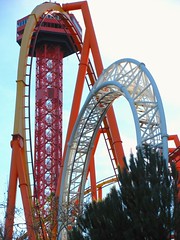
First impressions as I look around seem favorable: the asphalt has recently been power-washed, all the buildings and game pavilions are clean and tidy, and even the roller coasters towering overhead seem to have a glimmer of fresh paint that reflects gorgeously off the southern California late morning sunlight. I’m not certain if it’s just the difference in climate never having to be exposed to the snow, or if Magic Mountain really does expend more cash on repainting projects, but I was quickly reminded of Cedar Point and how many of their steel mountain ranges have a faded, patchy appearance. The axiom is that even though both parks compete for the roller coaster crown, Cedar Point is always the winner in the public’s opinion regardless of whether Magic Mountain gets ahead by a coaster for a year or two. Magic Mountain already stole the coaster crown with Green Lantern. I asked myself based on my initial impressions of how far they’ve come in three years, did I think Magic Mountain had the potential to also steal enthusiast’s hearts in another three years?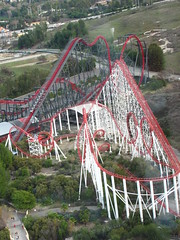
Unlikely, if only because some change on a cataclysmic scale is necessary to completely reverse stigmas, even if they can be forgotten with time. Six Flags Magic Mountain is pretty much a playground with some gigantic, modern toys sprinkled around the lawn. Except for Tatsu, nearly all of the major coasters are confined to a square or rectangular lot, lacking in the same presentation that gives some of Cedar Point’s top draws an aura of mysterious grandeur. Furthermore, in the contest that really matters, Cedar Point’s best rides are able to best Magic Mountain’s best rides with relatively little disagreement. Millennium Force vs. Goliath? Win Cedar Point. Top Thrill Dragster vs. Superman? Again, Ohio wins. Raptor vs. Batman? Mantis vs. Riddler? Perhaps more contentious, but if I were voting I’d give the nod to Cedar Point in both cases. And as awesome as X2 and Tatsu are, I personally would claim they don’t come close to touching Magnum and Maverick. Well, not too close.
Then again, that might not be the full story. While the highs at Magic Mountain are not quite as high as in Ohio, neither are the lows quite as low.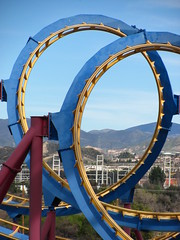 Compare wooden coasters in the back corner of the park and decide for yourself who’s made better progress. Cedar Point has a handful of attractions that it seems necessary for fans to pick on so that the good stuff seems even better by comparison (even though I like Mantis more than Riddler, I know I’m in the minority to even like Mantis at all). Since Psyclone and Flashback were excised, the derided clown of Magic Mountain seems to have shifted to the fact that their B&M floorless coaster is literally built over a parking lot. True, their classic Schwarzkopf terrain looper has unnecessary restraints everyone hates, and Colossus and Viper don’t always get the most love, but none of these are subject to the same levels of vitriol that Mean Streak is subjected to on an annual basis. In an amusement park with this much stuff, those are not the worst weakest links you could have. Not by a long shot. Compare wooden coasters in the back corner of the park and decide for yourself who’s made better progress. Cedar Point has a handful of attractions that it seems necessary for fans to pick on so that the good stuff seems even better by comparison (even though I like Mantis more than Riddler, I know I’m in the minority to even like Mantis at all). Since Psyclone and Flashback were excised, the derided clown of Magic Mountain seems to have shifted to the fact that their B&M floorless coaster is literally built over a parking lot. True, their classic Schwarzkopf terrain looper has unnecessary restraints everyone hates, and Colossus and Viper don’t always get the most love, but none of these are subject to the same levels of vitriol that Mean Streak is subjected to on an annual basis. In an amusement park with this much stuff, those are not the worst weakest links you could have. Not by a long shot.
And for the pure thrill factor, Magic Mountain might have the slight edge, at least for the demographic I assume would be reading this website. A larger percentage of Cedar Point’s coaster collection is generally categorized as family coasters, while Six Flags has been investing much more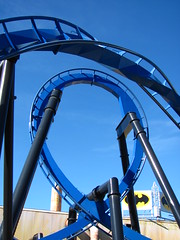 heavily in high-tech scream machines for the past decade, also allowing them to be perceived as more modernized and cutting edge. As of 2011, the median age of a Magic Mountain coaster is 13 while the median age of a Cedar Point coaster is 22. If you ride every roller coaster in the park once, you’ll have gone upside down a total of 35 times at Magic Mountain, and only 15 times at Cedar Point. I won’t conclude anything from these statistics just yet, but they do help paint the picture of the types of entertainment you’ll find at each of these two mega-parks. heavily in high-tech scream machines for the past decade, also allowing them to be perceived as more modernized and cutting edge. As of 2011, the median age of a Magic Mountain coaster is 13 while the median age of a Cedar Point coaster is 22. If you ride every roller coaster in the park once, you’ll have gone upside down a total of 35 times at Magic Mountain, and only 15 times at Cedar Point. I won’t conclude anything from these statistics just yet, but they do help paint the picture of the types of entertainment you’ll find at each of these two mega-parks.
So ignoring the quality of the playground equipment for now (which I will review in full on the following pages) how did I find the general atmosphere of Magic Mountain? Well, the normal Six Flags style of hyperactive teenage appeal is in full force here, with plenty of meme-culture targeted advertising along the queues and midways, many of the speakers tuned to an endless stream of dance music, and lots of Looney Tune and DC Comics tie-ins which the teens seem to eat up despite conventional wisdom thinking that these would have lost their appeal around ages ten and sixteen (probably the fact that it is against conventional wisdom of what is cool that makes these properties cool to people still in their 20’s). (probably the fact that it is against conventional wisdom of what is cool that makes these properties cool to people still in their 20’s).
But I’ll be perfectly honest: I sort of liked all of this. At other Six Flags parks that still have themed zones named things like “Yankee Harbor” or “Lickskillet” this can be very off-putting and reeks distinctly of an impersonal, money-hungry marketing department, especially when you’ve got colorful ads tackily pasted on top of old, peeling buildings formerly styled after French-Colonial architecture. Magic Mountain doesn’t have the same Angus Wynne history tie-ins; it always had a more youthful vibrancy since it started with renegade entrepreneur George Millay. In Valencia, the integration of popular culture into the park feels like it’s supposed to: it’s all an organic product of the local youth trends, and the electric flow of pop-culture everywhere becomes an important lifeblood to Magic Mountain. Normally an old snob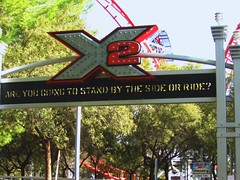 such as myself would have nothing to do with such riff-raff, but being a few miles from the epicenter such as myself would have nothing to do with such riff-raff, but being a few miles from the epicenter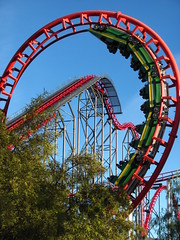 of the American entertainment machine, in a park filled with shiny, high-tech roller coaster candy (as MTV teaches us, if it ain’t pimped-out and tricked-up it ain’t worth a damn… sorry, I’m terrible at youth lingo), the youthful vibe I got from this place was infectious. of the American entertainment machine, in a park filled with shiny, high-tech roller coaster candy (as MTV teaches us, if it ain’t pimped-out and tricked-up it ain’t worth a damn… sorry, I’m terrible at youth lingo), the youthful vibe I got from this place was infectious.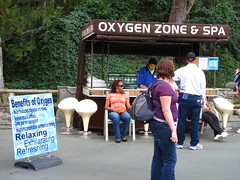 Certainly a far cry from their rather homely and humble competition in Knott’s Berry Farm. And even then they know not to over-do it, and I got a wider range of cross-generational west-coast cultural influences than I might have expected. At one point I heard music playing in the queue for Goliath that Certainly a far cry from their rather homely and humble competition in Knott’s Berry Farm. And even then they know not to over-do it, and I got a wider range of cross-generational west-coast cultural influences than I might have expected. At one point I heard music playing in the queue for Goliath that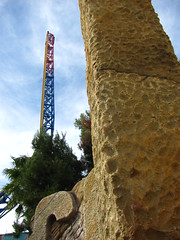 sounded a lot like The Dharma at Big Sur. I wasn’t sure, but if it was I’ll tell you this: I’ve never heard anything that good playing at Cedar Point. sounded a lot like The Dharma at Big Sur. I wasn’t sure, but if it was I’ll tell you this: I’ve never heard anything that good playing at Cedar Point.
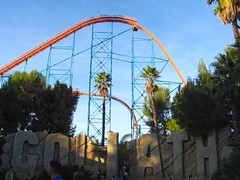 Speaking of Goliath, that was the first queue of the morning I found myself entering, sidestepping around the monolithic “I” that forms part of the name adorning the entry plaza, the cornerstone feature of a tropical-cum-biblical queue design that I wish was extended to the subsequent rides that would borrow its name. I believe this was the last roller coaster that drove an increase in park attendance under the old Burke Speaking of Goliath, that was the first queue of the morning I found myself entering, sidestepping around the monolithic “I” that forms part of the name adorning the entry plaza, the cornerstone feature of a tropical-cum-biblical queue design that I wish was extended to the subsequent rides that would borrow its name. I believe this was the last roller coaster that drove an increase in park attendance under the old Burke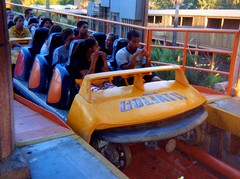 management before the Snyder takeover. This is understandable as it is a pretty nice coaster, smooth, comfortable restraint design, tall, fast and long… and more than a decade later, the only good choice for a mega-coaster on the west coast (not counting launched or looping layouts, the next closest is Desperado on the stateline, after that you’ll be driving for a long ways east). management before the Snyder takeover. This is understandable as it is a pretty nice coaster, smooth, comfortable restraint design, tall, fast and long… and more than a decade later, the only good choice for a mega-coaster on the west coast (not counting launched or looping layouts, the next closest is Desperado on the stateline, after that you’ll be driving for a long ways east).
Unfortunately, as I have been privileged with extensive travel east of the Mississippi, this Giovanola creation tasted a little flat to me by comparison. It was built to be the defining coaster of the year 2000, a claim that ultimately only mattered as it was the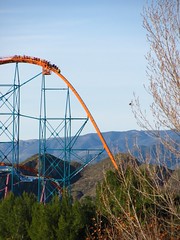 first to open that year thanks to Magic Mountain’s year-round operating season, as Millennium Force opened a few months later showing the Six Flags Corp. how to properly embrace the Y2K craze. Goliath seems even more antiquated as a result. Many of the common criticisms of Millennium Force are also present in Goliath, but without nearly as many positive qualities to mount a defense of the coaster. It’s basically a ride for fans of height and speed, with interesting dynamics a rarity and a nagging feeling that permeates the entire two-minute ride time that this isn’t the giant it once was. first to open that year thanks to Magic Mountain’s year-round operating season, as Millennium Force opened a few months later showing the Six Flags Corp. how to properly embrace the Y2K craze. Goliath seems even more antiquated as a result. Many of the common criticisms of Millennium Force are also present in Goliath, but without nearly as many positive qualities to mount a defense of the coaster. It’s basically a ride for fans of height and speed, with interesting dynamics a rarity and a nagging feeling that permeates the entire two-minute ride time that this isn’t the giant it once was.
The first drop is symptomatic of this: 255’ is big but it’s not the biggest, and a 61° descent means much of the length of the drop follows a perfect straight line. Sometime I like ‘flat’ drops like this, but now that we’re used to drops approaching or beyond 90° on a hill half the size, it feels shallow and like a wasted opportunity to go steeper and get more airtime out of the drop. It feels more like a drop-weight launch, to be honest.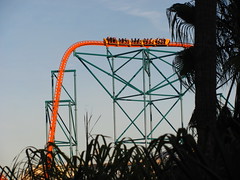
Giovanola basically copied the opening sequence from the previous year’s B&M-built Raging Bull, with the underground tunnel, elevated right fan turn, and a subsequent camelback zero-G hill crossing over the first drop, but despite having 25% more vertical distance to work with, it comes up short against the B&M effort. Judging from this coaster, the short-lived Swiss design firm Giovanola seemed reluctant to play with any sharp dynamic changes (particularly along the heartline path) or any track orientation that has one side tipped steeply above the other, possibly due to the long, inflexible 3-bench car design, and also possibly a reason they only sold three designs before they went back exclusively to fabrication.
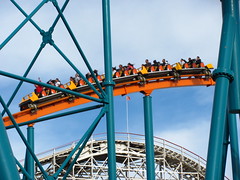 Still, a 255’ drop into a tunnel is never a bad thing, and the following turnaround slows down enough for the banked curve at the top that even if it’s not very extreme à la Millennium Force’s punishing 122° overbank, there’s at least a nice moment to enjoy the vertigo if you’re sitting on the right side and look straight down. The following camelback was where I really got the sense that the old gal wasn’t running quite like she used to. We flirted with floater airtime for a few seconds, when I was expecting the sustained ejector negative-G’s I had once heard raved about. I’m not much a fan of B&M’s 0-G airtime even when they have elevated, tipped backed seats, and now I’m getting the same thing but with back upright and feet flat on the floor. However, I did appreciate that the hill took a different shaping approach to the standard Still, a 255’ drop into a tunnel is never a bad thing, and the following turnaround slows down enough for the banked curve at the top that even if it’s not very extreme à la Millennium Force’s punishing 122° overbank, there’s at least a nice moment to enjoy the vertigo if you’re sitting on the right side and look straight down. The following camelback was where I really got the sense that the old gal wasn’t running quite like she used to. We flirted with floater airtime for a few seconds, when I was expecting the sustained ejector negative-G’s I had once heard raved about. I’m not much a fan of B&M’s 0-G airtime even when they have elevated, tipped backed seats, and now I’m getting the same thing but with back upright and feet flat on the floor. However, I did appreciate that the hill took a different shaping approach to the standard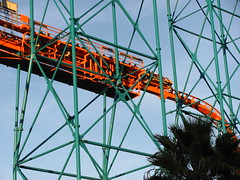 design favored by B&M and Intamin these days, with a long, low, flat parabola that sustains high speed the entire length. It’s not better, just different. By the time we reach the midcourse brake, I’ve adjusted my judgment criteria for Goliath from “is it better?” down to “is it different?”, hoping it will better survive my opinion as a result. The extremely hard midcourse brakes that bring the train to a near stand-still certainly weren’t doing it many favors by the original criteria. design favored by B&M and Intamin these days, with a long, low, flat parabola that sustains high speed the entire length. It’s not better, just different. By the time we reach the midcourse brake, I’ve adjusted my judgment criteria for Goliath from “is it better?” down to “is it different?”, hoping it will better survive my opinion as a result. The extremely hard midcourse brakes that bring the train to a near stand-still certainly weren’t doing it many favors by the original criteria.
Goliath is at least different. I can’t think of any other mega-coasters except for its twin in Six Flags Over Texas that don’t even attempt a moment of airtime in the second half, opting instead for a tangled steel spaghetti bowl of helices and fan turns. We slowly slide off the brake run, the coaster exerting the most extreme moment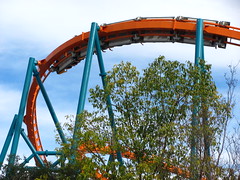 of lateral forces on its riders in the form of hangtime off the side of the car (those in the left side seats: be creative with this moment), and then quickly regain a surprisingly lively clip through the next right fan curve, dipping down through the teal support structure. of lateral forces on its riders in the form of hangtime off the side of the car (those in the left side seats: be creative with this moment), and then quickly regain a surprisingly lively clip through the next right fan curve, dipping down through the teal support structure.
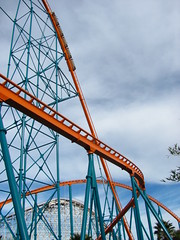 If you’re familiar with Goliath you probably know what comes next. There’s a flat section of track, great for a moment of silence and anticipation, and then we whip around into a downhill 540° helix. This moment is famous for its dangerously strong positive G-forces that intensify as we carousel around the bend. It was not performing at suck-your-hands-down, black-out levels on my visit, but it was still without question the highlight of the ride, the one moment that really puts the “G” in “Goliath”. And it’s different. Having such a strong, sustained focus on only the positive G’s is not particularly common, at least not to the degree that if an online review were to neglect describing the forces I’d wonder if that’s because the reviewer fainted during the maneuver. If you’re familiar with Goliath you probably know what comes next. There’s a flat section of track, great for a moment of silence and anticipation, and then we whip around into a downhill 540° helix. This moment is famous for its dangerously strong positive G-forces that intensify as we carousel around the bend. It was not performing at suck-your-hands-down, black-out levels on my visit, but it was still without question the highlight of the ride, the one moment that really puts the “G” in “Goliath”. And it’s different. Having such a strong, sustained focus on only the positive G’s is not particularly common, at least not to the degree that if an online review were to neglect describing the forces I’d wonder if that’s because the reviewer fainted during the maneuver.
My biggest peeve with Goliath is that this helix so clearly should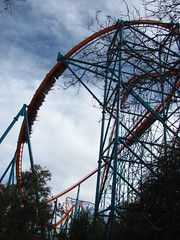 have been the grand finale that it’s actively anti-climatic to have to tool around with another lightweight, swooshy fan and S-curve to get back to the station. Couldn’t they have relocated the centrifuge under the lift hill on the final 180° turnaround? Or better yet, keep the current helix and built another helix there so the second act has double the venom? They actually did bother to add a second helix on Titan a year later, but in the wrong place, high in the air. Well, two ground-level helices for the finale might have been a bit too much for some people. The reason the brakes are on so strongly for the midcourse is because shortly after the debut it became clear that if something weren’t done Goliath would be thinning the gene pool of weak hearts left and right. While the rabid Darwinian theorists might be appreciative of such a ride, the insurance companies I imagine would be much less so. have been the grand finale that it’s actively anti-climatic to have to tool around with another lightweight, swooshy fan and S-curve to get back to the station. Couldn’t they have relocated the centrifuge under the lift hill on the final 180° turnaround? Or better yet, keep the current helix and built another helix there so the second act has double the venom? They actually did bother to add a second helix on Titan a year later, but in the wrong place, high in the air. Well, two ground-level helices for the finale might have been a bit too much for some people. The reason the brakes are on so strongly for the midcourse is because shortly after the debut it became clear that if something weren’t done Goliath would be thinning the gene pool of weak hearts left and right. While the rabid Darwinian theorists might be appreciative of such a ride, the insurance companies I imagine would be much less so.
Yeah, so despite it all I guess I liked Goliath, it was a change from the normal B&M speed lullabies and it’s at least a fairly long ride. Though I firmly believe it will age better as a historical oddity from an unknown company that was unnecessarily reinventing the wheel (and the traditional mega-coaster layout)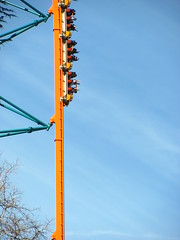 without an altogether clear idea of what purpose they were achieving by doing so. Whether by accident or by design, the helix does become a classic coaster moment, and the rest is fast and smooth so it is a highly re-ridable attraction. Something I did much of my second day at Magic Mountain when the station was walk-on throughout the entire afternoon. It is one of the top ‘must rides’ while at Magic Mountain, and the competition is pretty good at this park. But the fact remains that despite the presence of a vague A-B layout sequence pattern with the midcourse brakes cleanly separating the two halves, the deepest level I could think of it by was asking if I was getting as many forces at each moment as I should have. Jesus, I hate ride reviews that are nothing more than an interpretation of the accelerometer read-outs, without an altogether clear idea of what purpose they were achieving by doing so. Whether by accident or by design, the helix does become a classic coaster moment, and the rest is fast and smooth so it is a highly re-ridable attraction. Something I did much of my second day at Magic Mountain when the station was walk-on throughout the entire afternoon. It is one of the top ‘must rides’ while at Magic Mountain, and the competition is pretty good at this park. But the fact remains that despite the presence of a vague A-B layout sequence pattern with the midcourse brakes cleanly separating the two halves, the deepest level I could think of it by was asking if I was getting as many forces at each moment as I should have. Jesus, I hate ride reviews that are nothing more than an interpretation of the accelerometer read-outs,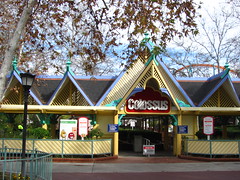 but that’s the best Goliath could allow me to muster. but that’s the best Goliath could allow me to muster.
Wanting to stay one step ahead of the crowds (not that they were ever going to be particularly big), I continued downhill into the far corner to Colossus and Scream, only to discover that Colossus was closed for maintenance and Scream would be opening an hour after the rest of the park. Scream I was indifferent towards but Colossus was disappointing news, as I have never been on it and last I heard there was a rumor floating around that it could be scheduled to get a New Texas Giant style make-over in the near future, probably before I’d have a chance to return and sample the original. While I would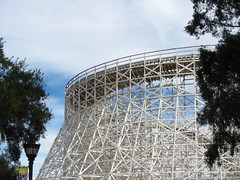 probably be in favor of some modifications, I’d fear that a full Rocky Mountain Iron Horse make-over would carve into the symmetry of the whitewashed wooden structure, disfiguring Colossus’ best asset: its beauty. Topper track, new rolling stock and a minor reprofiling of some of the hills to improve the pacing (especially where the midcourse block brakes were built over what used to be a double dip) would be more than enough to satisfy me on a return visit. If they want 90°+ turns and flame throwers, ask Rocky Mountain to build a new coaster from scratch in some adjacent lot, it would probably cost about the same amount anyway and would be one more coaster to cement their hold on the coaster crown. probably be in favor of some modifications, I’d fear that a full Rocky Mountain Iron Horse make-over would carve into the symmetry of the whitewashed wooden structure, disfiguring Colossus’ best asset: its beauty. Topper track, new rolling stock and a minor reprofiling of some of the hills to improve the pacing (especially where the midcourse block brakes were built over what used to be a double dip) would be more than enough to satisfy me on a return visit. If they want 90°+ turns and flame throwers, ask Rocky Mountain to build a new coaster from scratch in some adjacent lot, it would probably cost about the same amount anyway and would be one more coaster to cement their hold on the coaster crown.
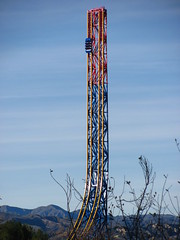 None of the new-for-2011 coaster projects had opened yet when I visited, although Superman: Escape From Krypton was close. Later the first Saturday I was at the park I was taking a picture of the tower from over by the X2 bridge, and just before I hit the shutter, I noticed a big blue thing shoot up the tower. Click! Perfect timing. (That shot even made Screamscape the next day!) Apparently this was the first day they tested the launch (at least with the public around), and when I checked the internet that night I saw the fan sites were all abuzz with the same news, particularly over how far up the tower the ride was going. I definitely approve of Six Flags reinvesting in their existing attractions like on Superman, X2, and potentially Colossus to make sure they remain popular and don’t fall into disrepair (even if I’m apprehensive Colossus might be ‘improved’ too much, and have been less than wowed by some of the feedback on the east coast Bizarro transformations). Other regional theme park chains should take note; I’m curious what the return on investment of some of these projects have been. The only question I have to ask about Superman: Escape From Krypton is why didn’t they elect to keep one side of the track facing forward and one facing backward? None of the new-for-2011 coaster projects had opened yet when I visited, although Superman: Escape From Krypton was close. Later the first Saturday I was at the park I was taking a picture of the tower from over by the X2 bridge, and just before I hit the shutter, I noticed a big blue thing shoot up the tower. Click! Perfect timing. (That shot even made Screamscape the next day!) Apparently this was the first day they tested the launch (at least with the public around), and when I checked the internet that night I saw the fan sites were all abuzz with the same news, particularly over how far up the tower the ride was going. I definitely approve of Six Flags reinvesting in their existing attractions like on Superman, X2, and potentially Colossus to make sure they remain popular and don’t fall into disrepair (even if I’m apprehensive Colossus might be ‘improved’ too much, and have been less than wowed by some of the feedback on the east coast Bizarro transformations). Other regional theme park chains should take note; I’m curious what the return on investment of some of these projects have been. The only question I have to ask about Superman: Escape From Krypton is why didn’t they elect to keep one side of the track facing forward and one facing backward?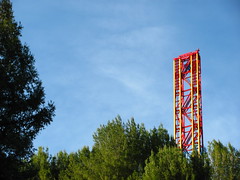 It seems they’d get double the usage out of it as you’d have to ride it twice to get the complete experience, but I guess it could lead to uneven capacity issues especially when the backwards-facing gimmick is still the exciting new draw in the coaster’s first couple of years. Green Lantern wasn’t even a hole in the ground yet when I was there. It seems this coaster went from dirt pile to media day in almost no time, from what I recall of construction updates over the spring. Personally, if Six Flags Corp wants to spend the next couple years giving aging rides makeovers and installing the occasional ZacSpin, Eurofighter or GCI, I would certainly not complain, though I’m not sure if Al Weber is going to have quite the same business philosophy as Mark Shapiro. Time will tell… It seems they’d get double the usage out of it as you’d have to ride it twice to get the complete experience, but I guess it could lead to uneven capacity issues especially when the backwards-facing gimmick is still the exciting new draw in the coaster’s first couple of years. Green Lantern wasn’t even a hole in the ground yet when I was there. It seems this coaster went from dirt pile to media day in almost no time, from what I recall of construction updates over the spring. Personally, if Six Flags Corp wants to spend the next couple years giving aging rides makeovers and installing the occasional ZacSpin, Eurofighter or GCI, I would certainly not complain, though I’m not sure if Al Weber is going to have quite the same business philosophy as Mark Shapiro. Time will tell…
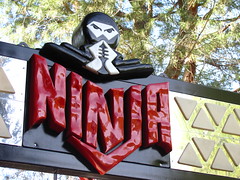 After completing the coasters along the back edge of the park with still no wait times, I was winding up the side of the mountain to Samurai Summit. This is a surprisingly pleasant part of the park, with the walkways shaded by an abundance of mature pine trees and a moment to escape from the flashy colors and wide vistas, the nearby roller coasters tantalizingly heard in all their aural magnificence, but only briefly glimpsed through the branches. At the top I joined the queue for the Ninja, which due to one-train operation had accumulated a twenty-five minute wait inside its pagoda station house. I wasn’t entirely pleased with this given the walk-on waits on everything else prior to this; After completing the coasters along the back edge of the park with still no wait times, I was winding up the side of the mountain to Samurai Summit. This is a surprisingly pleasant part of the park, with the walkways shaded by an abundance of mature pine trees and a moment to escape from the flashy colors and wide vistas, the nearby roller coasters tantalizingly heard in all their aural magnificence, but only briefly glimpsed through the branches. At the top I joined the queue for the Ninja, which due to one-train operation had accumulated a twenty-five minute wait inside its pagoda station house. I wasn’t entirely pleased with this given the walk-on waits on everything else prior to this;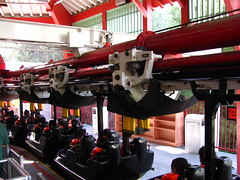 heck, even X2 had a shorter line that day. heck, even X2 had a shorter line that day.
Ninja is a bit of an oddity. It appears Arrow Dynamics were faced with severe space constraints and so they had to get creative with the station and layout. Positioned at the top of the mountain along a narrow ridge of land, the coaster has two lift hills. One at the very beginning, one at the very end, with the transfer tracks way down at the bottom of the hill. The station platform track even has a slight dogleg in the middle of it, which helps it fit into the round pagoda station. The lift hill is pretty short, a nice trick to conceal how long and fast the layout down the hillside that follows will be. The coaster paces itself quite well, much quicker than the ambling, occasionally lethargic coasters at Cedar Point and Chessington, but slower and longer than the five-second whirlwinds at Kings Island and Canada’s Wonderland. We got some reasonably decent swinging action I’m not accustomed to on the Iron Dragon, and the layout was deceptively longer than I had been anticipating. Just as I thought the brakes would be coming up, we turned around for another figure eight. Barring Eagle Fortress, the Ninja probably has the best location of any remaining suspended coaster, at Kings Island and Canada’s Wonderland. We got some reasonably decent swinging action I’m not accustomed to on the Iron Dragon, and the layout was deceptively longer than I had been anticipating. Just as I thought the brakes would be coming up, we turned around for another figure eight. Barring Eagle Fortress, the Ninja probably has the best location of any remaining suspended coaster,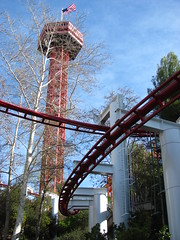 with the previously mentioned uneven terrain and a plethora of vegetation growing around the track producing some close calls and keeping the layout hidden from view so we never with the previously mentioned uneven terrain and a plethora of vegetation growing around the track producing some close calls and keeping the layout hidden from view so we never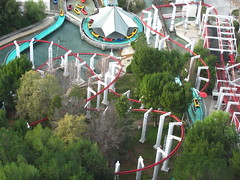 knew what was around the next turn. I still can’t memorize the layout even after riding it and viewing the POV videos multiple times. knew what was around the next turn. I still can’t memorize the layout even after riding it and viewing the POV videos multiple times.
That said, despite how much Ninja gets right that other suspended coasters don’t, I couldn’t help but feel this installation was lacking a certain je ne sais quoi that I’ve come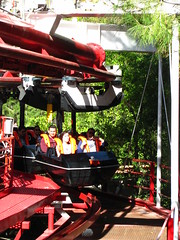 to expect from the genre. Perhaps it’s a sense of storytelling. With its constant direction changes, the layout is ultimately rather directionless and it’s hard to discern what exactly the coaster is about. Iron Dragon, Vampire, and especially the late Big Bad Wolf all have a very clear progression that ends with the ‘big finale’ (the pretzel lagoon turn, the underground tunnel, or the river dive), even if they always remain comparatively tame. Ninja doesn’t have that strong finish after a mid-course lift. It just wanders over and under the log flume until the cars run out of speed, making the last set of curves the weakest point in the ride, not the strongest. And while it has some good moments, it’s not the kind of thrill ride that leaves me breathless and wanting more right away like Flight Deck, Vortex and (I can only imagine!) Eagle Fortress. Ninja is balanced right in the middle of every scale, and that proves to be both a blessing and a curse. I sure as hell hope it never leaves the park anytime soon, however, as Magic Mountain would be losing a truly great (and increasingly rare) family thrill coaster. to expect from the genre. Perhaps it’s a sense of storytelling. With its constant direction changes, the layout is ultimately rather directionless and it’s hard to discern what exactly the coaster is about. Iron Dragon, Vampire, and especially the late Big Bad Wolf all have a very clear progression that ends with the ‘big finale’ (the pretzel lagoon turn, the underground tunnel, or the river dive), even if they always remain comparatively tame. Ninja doesn’t have that strong finish after a mid-course lift. It just wanders over and under the log flume until the cars run out of speed, making the last set of curves the weakest point in the ride, not the strongest. And while it has some good moments, it’s not the kind of thrill ride that leaves me breathless and wanting more right away like Flight Deck, Vortex and (I can only imagine!) Eagle Fortress. Ninja is balanced right in the middle of every scale, and that proves to be both a blessing and a curse. I sure as hell hope it never leaves the park anytime soon, however, as Magic Mountain would be losing a truly great (and increasingly rare) family thrill coaster.
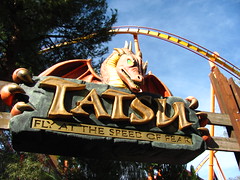 Tatsu is something of a miracle. How did we end up with such a creative interpretation of the flying roller coaster? It opened in 2006, at the tail end of one of the most loathed management regimes in theme park history. Somehow the people known for parking lot coasters managed to produce a swan song triad consisting of this, New Jersey’s El Toro and Georgia’s Goliath. While those other two rides dominate the respective wood and steel polls today, perhaps Tatsu manages to be the most mature vision of the three. It uses the natural terrain to its advantage. It does not confine its flight path to a square box. The elements are sequenced in a logical progression pattern that escalates to a well-defined climax, and finishes with a clean resolution. It alternates between moments that are serene and featherweight, and powerful and heavy. Tatsu is something of a miracle. How did we end up with such a creative interpretation of the flying roller coaster? It opened in 2006, at the tail end of one of the most loathed management regimes in theme park history. Somehow the people known for parking lot coasters managed to produce a swan song triad consisting of this, New Jersey’s El Toro and Georgia’s Goliath. While those other two rides dominate the respective wood and steel polls today, perhaps Tatsu manages to be the most mature vision of the three. It uses the natural terrain to its advantage. It does not confine its flight path to a square box. The elements are sequenced in a logical progression pattern that escalates to a well-defined climax, and finishes with a clean resolution. It alternates between moments that are serene and featherweight, and powerful and heavy.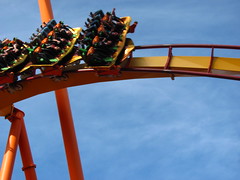 With Tatsu, the flying roller coaster finally realized its untapped potential. With Tatsu, the flying roller coaster finally realized its untapped potential.
This is at least the story I was telling myself before I entered the 40 minute queue for Tatsu. The reality isn’t quite as glamorous as everything stated above, but reality rarely is that way. I have some superficial aesthetic bones to pick with Tatsu’s appearance. A few problems ran deeper but I’ll get to those later. For one thing, the station structure is fugly. It’s basically a giant tin box on a very visible location on the front face of the hillside. Thankfully it’s painted in fairly neutral pastel colors so it doesn’t actively draw attention to itself, but they could have done so much more with the Japanese themed design that it makes me sad they decided to run a tab on sheet metal instead. Similarly I’m not a huge fan of the color scheme.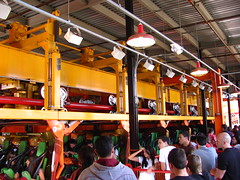 The bright orange supports get to me. They’re too omnipresent to be painted such an sharp color. Something that would blend in with the surrounding trees and hillside better like a spring green or sky blue, would also better highlight against the sky the bright yellows and reds of the elegant, dragon-like twisting track; visually the track gets lost amid all the vertical orange bars. The vehicles at least look cool with their metallic dragon design, and I appreciated the small touches such as how a few of the large footers that came close to the midways were covered with stone mosaics. By the way, one thing I learned from my Japanese class, the ride’s name should be pronounced as “TA-tsu”, not “tat-SU” like the operators were singing into their microphones on each dispatch. The bright orange supports get to me. They’re too omnipresent to be painted such an sharp color. Something that would blend in with the surrounding trees and hillside better like a spring green or sky blue, would also better highlight against the sky the bright yellows and reds of the elegant, dragon-like twisting track; visually the track gets lost amid all the vertical orange bars. The vehicles at least look cool with their metallic dragon design, and I appreciated the small touches such as how a few of the large footers that came close to the midways were covered with stone mosaics. By the way, one thing I learned from my Japanese class, the ride’s name should be pronounced as “TA-tsu”, not “tat-SU” like the operators were singing into their microphones on each dispatch.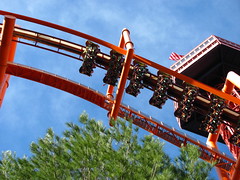
With the all-clear, our seats are raised into the flying position which gets all the teenage girls onboard screaming before the train has even moved an inch forward. The lift hill is absent of any staircase or protective netting like on most inverted coasters, allowing us to face the ground directly without any protection against the vertigo. At 170′ most riders will probably have been on a taller coaster earlier in their day, but it might not feel like it at the top. Observe the strong convergence lines of the supports as your eyes trace them further down to the pathway immediately below, and then look up to witness the horizon miles away, the mountaintop location effectively doubling the altitude of the flyer’s apex.
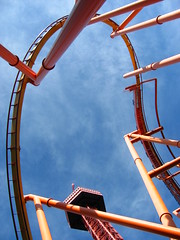 Sitting in the front row we hang forward in our seats, halfway to upside-down, waiting for gravity to catch up. We feel awkward, and strangely a bit claustrophobic and agoraphobic at once. Wondering if this set-up foreshadows a particularly venomous beast about to strike, the tension is quickly released when we tip to our starboard side and release into smooth freefall. The pull-up at the bottom of the spiraling drop is surprisingly soft (it’s “only” 111’ long), and this curve merges seamlessly as we angle straight up Sitting in the front row we hang forward in our seats, halfway to upside-down, waiting for gravity to catch up. We feel awkward, and strangely a bit claustrophobic and agoraphobic at once. Wondering if this set-up foreshadows a particularly venomous beast about to strike, the tension is quickly released when we tip to our starboard side and release into smooth freefall. The pull-up at the bottom of the spiraling drop is surprisingly soft (it’s “only” 111’ long), and this curve merges seamlessly as we angle straight up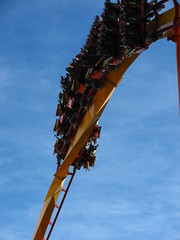 into the first half of the double rollover. It’s such an easy, carefree inversion, and on the exit we’re gliding nearly 100’ above terra firma thanks to the hilly terrain. Again, without any unnatural changes in direction, we turn onto our backs for the second half of the rollover mirroring the first. These first three elements merge seamlessly into one another, flowing as one continuous maneuver with a grace and perfection that only B&M could create. into the first half of the double rollover. It’s such an easy, carefree inversion, and on the exit we’re gliding nearly 100’ above terra firma thanks to the hilly terrain. Again, without any unnatural changes in direction, we turn onto our backs for the second half of the rollover mirroring the first. These first three elements merge seamlessly into one another, flowing as one continuous maneuver with a grace and perfection that only B&M could create.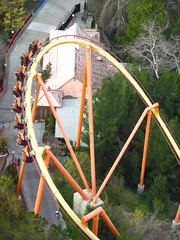 In fifteen seconds Tatsu has already accomplished a greater sensation of flight than John Wardley managed to convey with his entire layout in Air, and we’ve still got another two-thirds to complete. In fifteen seconds Tatsu has already accomplished a greater sensation of flight than John Wardley managed to convey with his entire layout in Air, and we’ve still got another two-thirds to complete.
The flow is broken for a brief moment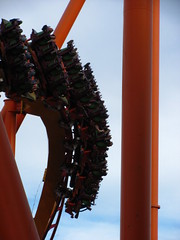 as we charge down the back side of the mountain towards a midway, the forces developing a potential for a sharper edge as we soar up into a tall horseshoe turnaround. This is another moment in which the flying seat design is allowed to show its full strength, as everyone is afforded a front seat view looking across the entire park, the sense of freedom and flight still pure but with a bit more urgency. as we charge down the back side of the mountain towards a midway, the forces developing a potential for a sharper edge as we soar up into a tall horseshoe turnaround. This is another moment in which the flying seat design is allowed to show its full strength, as everyone is afforded a front seat view looking across the entire park, the sense of freedom and flight still pure but with a bit more urgency.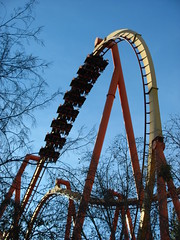 Coming out of this turn over the station and maintenance lot (this scenery could have been improved) the flying beast surprises with an uncharacteristically acute fore-and-aft torque onto our sides as we quickly scoot around a 90° banked turn threaded through bright orange supports. We’re still soaring, but we’re beginning to relinquish Coming out of this turn over the station and maintenance lot (this scenery could have been improved) the flying beast surprises with an uncharacteristically acute fore-and-aft torque onto our sides as we quickly scoot around a 90° banked turn threaded through bright orange supports. We’re still soaring, but we’re beginning to relinquish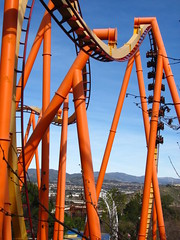 control over our flight path as we’re yanked in unexpected directions. We slow, a long moment of uneasy serenity as if our winged beast has caught an updraft and is surveying the land for prey. We’re suddenly about 125’ in the air thanks to the steeply uneven land, looking at the track at the bottom of the signature pretzel loop, and realize we’re dangerously close to the edge of the calm before the storm. control over our flight path as we’re yanked in unexpected directions. We slow, a long moment of uneasy serenity as if our winged beast has caught an updraft and is surveying the land for prey. We’re suddenly about 125’ in the air thanks to the steeply uneven land, looking at the track at the bottom of the signature pretzel loop, and realize we’re dangerously close to the edge of the calm before the storm.
It’s impossible to prepare for Tatsu’s pretzel loop. Hell, I’ve been on all three of the Supermen: Ultimate Flight clones which each have their own pretzel loop, and I was still unprepared for this one. The scale and force is on an entirely different level from anything I’ve ever experienced on a flying coaster before. Having spent the entire ride up to this point lying on our chests, when the train crests the pretzel loop our situation quickly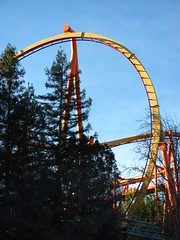 becomes one of weightlessness as we lift up off our restraints. The dragon dives straight down for the kill, turning our orientation completely upside down as the train dives 90 degrees down. Quite rapidly, that ‘weightless’ force keeps pressing against us as the loop begins to bottom out, morphing back into lung-crushing G-forces along the opposite axis as we’re pulverized into our seat backs at the bottom of the loop. Because the flying position has us oriented to the track differently, traditional concepts such as “positive G-force” and “negative G-force” (at least as they affect the body) become skewed into something very different, and the pretzel loop is where this difference is most clearly highlighted. It’s tough to describe the full range of sensation in words, so I will simply summarize the force analysis to noting that after my first ride, becomes one of weightlessness as we lift up off our restraints. The dragon dives straight down for the kill, turning our orientation completely upside down as the train dives 90 degrees down. Quite rapidly, that ‘weightless’ force keeps pressing against us as the loop begins to bottom out, morphing back into lung-crushing G-forces along the opposite axis as we’re pulverized into our seat backs at the bottom of the loop. Because the flying position has us oriented to the track differently, traditional concepts such as “positive G-force” and “negative G-force” (at least as they affect the body) become skewed into something very different, and the pretzel loop is where this difference is most clearly highlighted. It’s tough to describe the full range of sensation in words, so I will simply summarize the force analysis to noting that after my first ride,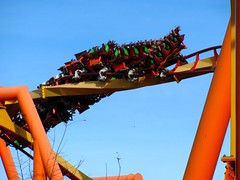 I was sure to empty my pockets before getting on again. I was sure to empty my pockets before getting on again.
The following zero-G roll is the one element in Tatsu’s oeuvre that I’m not entirely sure if I like. With the short lead-in and fast heartline rotation in a high-altitude setting, this could have been an amazing element on a standard inverted coaster, but with the flying cars the impact seems neutered. Not that it’s a bad element, but coming seconds after the pretzel loop it strikes me as a half-realized idea that was inserted in the wrong place on the wrong coaster, lacking the sense of flow and sequence that the other elements before it all had. However the final maneuver, a slow-paced helix situated high above Magic Mountain plaza, contextualizes these maneuvers to fit as the descending action and then resolution to the layout narrative. I guess it doesn’t help that even in traditional storytelling I’m generally skeptical about the role and importance of descending action, but the resolution is always important. Therefore the helix is more effective by this interpretation, as I genuinely had a sense of calming catharsis in those final moments soaring high over the ants of people watching us from below. There’s a small upward skip into the brakes, which slow us most of the way before a dipped banked turn realigns us with the station and the final set of brakes reigns our winged beast back to earth. situated high above Magic Mountain plaza, contextualizes these maneuvers to fit as the descending action and then resolution to the layout narrative. I guess it doesn’t help that even in traditional storytelling I’m generally skeptical about the role and importance of descending action, but the resolution is always important. Therefore the helix is more effective by this interpretation, as I genuinely had a sense of calming catharsis in those final moments soaring high over the ants of people watching us from below. There’s a small upward skip into the brakes, which slow us most of the way before a dipped banked turn realigns us with the station and the final set of brakes reigns our winged beast back to earth.
A central reason why I’ve felt every other stateside B&M flyer has failed in some regard is that the pretzel loop is too powerful of an element to put in the beginning of the layout, causing the ride to blow its wad too early and then spend the rest of the layout literally sweeping back and forth to clean up the mess (many apologies for the metaphor). By holding what is clearly the centerpiece element that everyone talks about back two-thirds of the layout, the flying coaster takes on a symphonic quality as it goes through its movements to reach a crescendo and then resolution. It begins with the ominous but ambiguous tones of the prelude (the vertigo-inducing lift hill climb), before the symphony begins with the bright consonant tones of the first drop and rollovers, intensifying development with the horseshoe turn and fast left banked turn, silencing for a brief middle bridge before reaching B&M flyer has failed in some regard is that the pretzel loop is too powerful of an element to put in the beginning of the layout, causing the ride to blow its wad too early and then spend the rest of the layout literally sweeping back and forth to clean up the mess (many apologies for the metaphor). By holding what is clearly the centerpiece element that everyone talks about back two-thirds of the layout, the flying coaster takes on a symphonic quality as it goes through its movements to reach a crescendo and then resolution. It begins with the ominous but ambiguous tones of the prelude (the vertigo-inducing lift hill climb), before the symphony begins with the bright consonant tones of the first drop and rollovers, intensifying development with the horseshoe turn and fast left banked turn, silencing for a brief middle bridge before reaching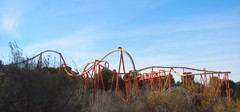 the thundering climax of the 124’ pretzel loop, and finishing with a coda that resolves tension and restores harmony. The topographical interplay and resultant variable speeds are absolutely essential to allow for such a progressive structure to prevent a ride that doesn’t just diminuendo the whole way like so many B&M designs tend to do. Although the first drop is 111’ feet deep, the bottom of the pretzel loop is a full 263’ feet below the crest of the lift hill. Personally, I find that statistic to be absolutely incredible. the thundering climax of the 124’ pretzel loop, and finishing with a coda that resolves tension and restores harmony. The topographical interplay and resultant variable speeds are absolutely essential to allow for such a progressive structure to prevent a ride that doesn’t just diminuendo the whole way like so many B&M designs tend to do. Although the first drop is 111’ feet deep, the bottom of the pretzel loop is a full 263’ feet below the crest of the lift hill. Personally, I find that statistic to be absolutely incredible.
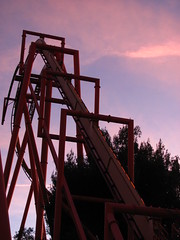 And yet I feel guilty because I’ve been describing a roller coaster that I should conclude to be a top ten ride, but after twelve rides over two days I had to be honest with the fact that it didn’t quite sing top ten to me. Something essential was missing. For as much as I enjoyed comparing it to a symphony, it was a symphony that lasts only 45 seconds from the first movement to the final chord. Roller coasters are able to communicate a lot more in a shorter And yet I feel guilty because I’ve been describing a roller coaster that I should conclude to be a top ten ride, but after twelve rides over two days I had to be honest with the fact that it didn’t quite sing top ten to me. Something essential was missing. For as much as I enjoyed comparing it to a symphony, it was a symphony that lasts only 45 seconds from the first movement to the final chord. Roller coasters are able to communicate a lot more in a shorter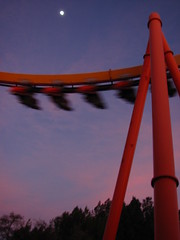 period of time due to the increased brain activity in response to the adrenaline, but especially for a ride that spends at least half the layout toning the adrenaline down in favor of graceful aerobatics, I think that’s simply not enough time to make the full emotional connection this type of ride needs to make. I would still like to see the flying equivalent of the Big Bad Wolf, with a long layout broken between two lift hills and the action spread out over two minutes in length, but given the engineering costs already involved with this technology that gets expensive. Also, after multiple rerides the pretzel loop was becoming the dominating feature in my psychological relationship to the coaster, muting the softer features as I could only think about getting to or coming from that loop. In a weird way, it’s almost too good of an element. period of time due to the increased brain activity in response to the adrenaline, but especially for a ride that spends at least half the layout toning the adrenaline down in favor of graceful aerobatics, I think that’s simply not enough time to make the full emotional connection this type of ride needs to make. I would still like to see the flying equivalent of the Big Bad Wolf, with a long layout broken between two lift hills and the action spread out over two minutes in length, but given the engineering costs already involved with this technology that gets expensive. Also, after multiple rerides the pretzel loop was becoming the dominating feature in my psychological relationship to the coaster, muting the softer features as I could only think about getting to or coming from that loop. In a weird way, it’s almost too good of an element.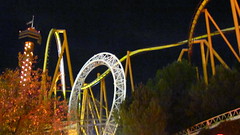
Tatsu was a miracle to have, still in my opinion by far the best flying roller coaster in the world, and easily one of the top three rides at Magic Mountain. It is in no way an unsuccessful ride, as any changes I could make to it if given the chance would nearly all be superficial. It is the first and only flying coaster to actually deliver everything the genre had always promised, and any shortcomings of Tatsu I think are fundamental shortcomings of the flying coaster. They are, nevertheless, shortcomings, and my search for the roller coaster at Six Flags Magic Mountain wasn’t over yet.
|
|
Comments