Busch Gardens Williamsburg
Williamsburg, Virginia – Friday, June 16th, 2023
 When Busch Gardens Williamsburg opened in 1975, one of the land use stipulations for Anheisur-Busch was that the park could not use a colonial American theme, to avoid conflicting with the Colonial Williamsburg historical sites nearby. From a creative experiential perspective, this was absolutely the right move. Of course, given the location and the fact that a stipulation had to be made explicit, an American history theme park would be the most obvious use. But it also surely would have been the most dull. The European hamlets of Busch Gardens Williamsburg are such iconic, loved spaces, it’s hard to imagine the possibility of this park ever being anything else. The European theme is a refreshing contrast not just to the local Colonial Williamsburg setting, but the entire regional theme park landscape across the United States, where both well-done and half-assed
 local identity, history, or heritage motifs are typically the default theme (apart from IP-based ones).
Building an amusement park with a local, state, or national theme is of course a political act. Being big, expensive investments, theme parks are always going to be political, and so usually they try to represent whatever they think is at the center of that polity to avoid any potential controversy down the road; hence you get places like Six Flags Over Georgia, Carowinds, or Dollywood. But expanding that story to encompass all of American history opens up avenues for new controversies. Just look at what happened to Disney’s America. While “Colonial Williamsburg” is generally associated with a friendly, quaint sense of history, any attempt to build an entire theme park around it would very quickly have to contend with the colonialism that’s implied. How are the diverse groups that make up America represented (or not) in this park, and what does the selection of geographical regions or historical eras say about the value the park places on them? Down the road, the relatively apolitical Kings Dominion operated with the “Rebel Yell” roller coaster for nearly fifty years before it realized a change was needed to continue to remain non-political. I can’t see an American history-based version of Busch Gardens that would have aged nearly as gracefully through to today.
Yet the choice to model a theme park based on somewhere else real in the world carries its own political risks. The U.S. and Europe have had generally good relations for the 50 years that Busch Gardens has been around, but historically speaking that’s not a guarantee. (Just look at the 50+ years prior to Busch Garden’s debut.) And in general, people can often be provincially minded, which is why it’s much easier to build a theme park celebrating your local culture than it is to glorify someplace further removed, even despite the promise of themed design to experience farther flung locales much closer to home. So while there is some risk from a European theme, the romanticization of Europe in the popular American consciousness means that any risk is still very low, and much lower risk than an American history alternative.
That said, a European themed park in the context of Colonial Williamsburg doesn’t completely avoid any knottier interpretations of history. Why put a massive entertainment property dedicated to Europe in a place like Williamsburg? What’s the thematic connection? Intuitively, that connection has always seemed obvious, even when I was young. Williamsburg was originally an English settlement, so Busch Gardens complements the narrative of Colonial Williamsburg by taking several steps backward to celebrate this area’s European heritage. But as soon as I start to consciously dwell on that connection too much, a whole Pandora’s Box of Problematic starts to crack open. Are we simply trading a post-colonial landscape for a pre-colonial one from the perspective of the colonizers? Or, by encompassing all of Europe, does that telegraph a belief that the origins of the United States are intrinsically connected to a white European identity that doesn’t extend equally to people from other parts of the world?
I begin this review this way not because I think any of this is a serious obstacle to being able to enjoy a day at Busch Gardens Williamsburg.1 I believe theme parks can and should be richly meaningful places with complex subtext that evolves over time and with closer examination. By reading into the possibilities of meaning at Busch Gardens Williamsburg, I am paying it a complement as a place worthy of, and able to shoulder the responsibility of, such kinds of analysis. Until more recently, Busch Gardens Williamsburg was long the preeminent example of the high-level theme park design in the United States found outside the main hubs of California and Florida.
I still want Busch Gardens Williamsburg to be that kind of park, even if some more recent additions have been more questionable on the thematic merits that have allowed regional competitors like Dollywood or even Kings Dominion to surpass it. It would be a death knell for a theme park to claim that the newer stuff is consistently inferior to the older stuff, which for a little while appeared to be the direction they were heading. Fortunately, a more recent revelation that “nostalgia sells” has led to some improvements and what’s hopefully the start of a righting of the ship. But that hunger among visitors for “Classic Busch Gardens” does mean that most of the older rides and areas of the park have a certain unmatched consistency of quality, as well as a certain je ne sais quoi that I’ll try my best to describe anyway in the reviews to follow.
Loch Ness Monster
 I’m not certain if I can declare a favorite or best attraction at Busch Gardens Williamsburg.2 But the most iconic, the first thing I think of when I think of BGW, is undoubtedly the Loch Ness Monster. Opening in 1978, just three years after the introduction of the first modern steel looping coaster, I can only imagine what a revelation the Loch Ness Monster must have been at that time. Not only was the size and technological innovation quite significant, but it did so in service of a ride that told a complete story and was presented as a work of art.
 Even if they never duel any more, those interlocking loops over the water are such an integral part to Busch Garden’s landscape that if this ride were to ever reach the end of its lifespan, they’d have to close the rest of the park with it.3 Then there’s the two big drops over the water that precede the upper loop, the rich yellow track reflecting inches above the surface. That first drop is “only” 114 feet deep, but with the scale of the surrounding trees it still feels like one of the largest coasters in a park filled with three that scrape near or past the 200’ mark. Then there’s that loooooong triple helix tunnel that represents the dark heart of the monster, elevating the dramatic stakes before the final loop brings the experience home. Somehow Arrow figured out the perfect formula for their looping coasters just a couple tries in, and it took them another 20 years with Tennessee Tornado to get close to it again.
 Yet, for as perfect as the Loch Ness Monster is, I have to remind myself every time I return to ride Nessie that its iconic presence is more a factor of clever design, and the actual ride is fairly small and conservative. One hundred fourteen feet is not a huge drop, nor is 3,240 feet a particularly long ride, despite being one of the few looping coasters to ever earn a second lift hill. The first two drops and vertical loop are the only sustained “high thrill” portion of the layout, which when you break the elements apart has nothing too dissimilar from Geauga Lake’s simple Double Loop coaster built the year before. The middle section cleverly obscures the fact that you’re going about 15 mph in circles, and after the pause for the second lift, the last drop and vertical loop is less of a final act and more of a quick punctuation mark. My reaction at the end is usually along the lines of “that was great… is that it?”
 Which ultimately speaks to how well this ride was designed to make relatively little feel like a lot. The absence of any particularly extreme maneuvers undoubtedly helps Nessie’s longevity,4 especially when considering how a couple of newer, more aggressive Arrow Dynamics coasters at this park have long ago met their demise. It also makes it the perfect “family thrill” coaster, precisely because it still looks like a regular “big thrill” ride, and even goes upside down a couple times, so it feels like a major accomplishment for kids to conquer, but it paces itself with enough slower sections and downtime to not overwhelm them. Frankly, I think there’s still a lot about perspective, placement, pacing, and showmanship that modern roller coaster designers have forgotten and could learn from the Loch Ness Monster.


Alpengeist
There’s something weird to me about the fact that Alpengeist, which represents one of the later escalations during the 90s Coaster Wars to one-up Busch’s own Kumba and Montu, is the second oldest roller coaster at Busch Gardens Williamsburg, and has been for some time. After the Batman-Raptor-Montu one-upmanship, Alpengeist took one more huge step forward with a massive 195 foot tall lift… and arguably took it too far, given that Montu remains the more beloved of the set, and that no other complete circuit inverted coaster ever came close to trying to beat that statistic to claim a true inverted hypercoaster.
 Alpengeist is no doubt impressive, but it also feels just a little overgrown for the narrow plot of land it had to work with. It starts with a sweeping spiral drop and a huge set of inversions including an Immelmann, vertical loop, and cobra roll; heavy positive forces are the name of the game, all with long, powerful, spine-crushing curvatures along the bottom halves of the elements, and sharp snaps at the top. Accordingly the midcourse brake feels much more pronounced on Alpengeist, as a necessary corrective to reign in and control the oversized alpine beast.
The second half thus feels ill-matched to the first, like it was plugged in from a completely different coaster design. This section primarily features a diminutive smaller zero-g roll feeding into a corkscrew in the opposite direction, what I always regarded as an odd pairing of too-similar but markedly different maneuvers. The final helix through a snow bank trough is a decent idea for a finale, recalling the trench runs of Montu or Nemesis, but just feels a little lethargic, especially compared to much stronger finishes on rides like Raptor, or even the first half of Alpengeist.
 Yet if I can look past the uneven pacing and unrealized potential of the world’s first and still only (almost) hyper-inverted coaster, what lies underneath it is still a pretty good example of 1990s B&M and Busch Gardens both at the top of their games. Alpengeist is easily in the top tenth percentile of the most intense B&M coasters, the largest and last of the old-school aggressive design style. And it still has my favorite thematic details of any coaster in the park (at least around the loading area): the Swiss chalet station, quadruple diamond slope ratings, ski lift styled lift supports, and especially the skis neatly tucked along the back of each row of seats, a feature that after a quarter century I was astounded hadn’t been removed during some cost-conscious refurbishment. Every time I rode, I was reminded that for me Alpengeist might still be as high as a top three attraction at this park.


Apollo’s Chariot
 With Alpengeist as a bare-knuckled brawler of a B&M, their follow-up in Apollo’s Chariot took the opposite tact with a touch so featherlight I sometimes hardly even notice it. In some ways Apollo’s Chariot is the coaster I’m most frustrated by at Busch Gardens Williamsburg, because it doesn’t do much for me, even though objectively it has a lot of features and qualities that I feel I ought to join the chorus singing it high praises. As the first B&M hyper coaster, it both establishes the archetypal airtime-focused design (similar as my beloved Kumba did for the multilooper layout), but also has a lot of odd or distinctive profiling that would be smoothed out of later efforts. The anticipation of the initial pre-drop, the intermittent flat speed ramps, unpredictable drop lengths, uneven compound curvatures, and especially the creative, well-integrated use of terrain
 that preserves most of the nearby natural landscape. Pausing for a heartbeat at the bottom of the first drop to skim across the water at 73 mph before angling back skyward is simply a beautiful design feature.5
Yet for all of Apollo’s eccentricities, if I were to close my eyes and rely on my inner ear’s sense of motion, I’m not certain I would notice any of it. For the most part the camelback hills give consistently light floater air, with the valleys and curves offering very gentle, gradual positives, and it simply alternates between these two mild poles. It’s too smooth, too perfect, too… dull. I keep expecting the little profiling quirks to do something, to introduce some sharpness and personality to the contours of the ride experience, but they never do. The physical sensations remain relatively formless. If Alpengeist is a strong counterpoint to the argument that B&M doesn’t design forceful rides, then Apollo’s Chariot would serve as Exhibit A for that position.
It’s possible I’ve caught Apollo’s Chariot under less than ideal circumstances, and repeated rides and more familiarity will give me greater appreciation of its qualities. I want to believe in them! I’ve often heard similar accusations leveled against Nitro, and my memories of that ride include wild ejector airtime and even hard, body-slamming laterals. But nor am I saying Apollo’s Chariot has to give that kind of experience to be a great ride. Gracefulness and elegance are often under-appreciated qualities in roller coasters. But I shouldn’t confuse the effect of elegance with that of Ambien.


Griffon
The last time I was at Busch Gardens was for the 2007 opening of Griffon.6 It was my first-ever dive coaster and it left enough of an impression that I included it on my list of top coasters for many years, even after trying several other dive coasters. However, the genre continued to become more and more commonplace, and eventually the sameness of the “vertical drop into an Immelmann” motif caused me to lose much of my enthusiasm for Griffon specifically. It took me until 2023 (and seven other dive coasters) to try it again, and even then I didn’t spend as much time with Griffon (a total of three or four rides over two days) to focus on the park’s more unique offerings.
Despite my apparent coolness toward Griffon, I think my original appreciation of the coaster from 2007 still holds up in many ways. If forced to choose, I would rank Griffon as the best dive coaster I’ve been on.7
 The trains are the big difference. Since 2016 the new dive coasters use the vest restraint, which is a great design for twisty-turny layouts to reduce headbanging, but on an already glass-smooth dive coaster where the emphasis is on straight drops, the traditional foam restraint offers more flexibility and freedom to enjoy the weightless vertical freefalls.
Then there’s the fact it uses 10-abreast trains, which if you can score an outside (or even a second-to-outside) seat, will have you extended over the edge of the rail as far if not farther as a B&M wing coaster. Even if you’re not in an edge seat, I still find myself in awe at just how massive these trains are; the back row, center is one of my favorite spots for this reason. It feels less like riding in a roller coaster vehicle and more like riding an entire section of theater seating down a 200 foot vertical plunge. An object this large should not be moving through the sky this fluidly. Only two other dive coasters in China have the 10-abreast design, and neither has nearly as attractive of a setting or layout.
As for the layout, I appreciate the poetic simplicity of repeating the same drop/Immelmann pattern twice, with the water splashdown as a conclusion. Earlier dive coasters were too focused on the novelty of the vertical drop, while many of the newer ones, especially with the smaller gauge track and trains, tend to be more focused on multiple inversions, which I find essentially makes them a floorless coaster with a steep first plunge. It’s not the most dynamic layout, and I could also consider arguments in favor of some of the more complex designs on newer installations, but I feel like Griffon falls near the golden mean of the kinds and quantity of elements a dive coaster should have.
If there’s one area where Griffon falls a bit short, it’s in the overall visual presentation. It’s still very good, especially with the commanding presence of the 200 foot drop as the centerpiece of the French hamlet. But compared to Oblivion or SheiKra, which dug huge tunnels and put a lot of consideration into the station experience and surrounding thematic design, Griffon’s more two-dimensional approach to design and placement was a step towards making the dive coaster (once one of the most advanced, specially-engineered coaster models in the world) an off-the-shelf product that any regional amusement park could drop onto an empty plot of land.


Verbolten
“Verbolten.” “VerBOLTen.” I just… no. No matter how many times I say it, I find myself turned off by this ride just starting with the name. Taking someone else’s language and modifying their words into a weak sauce English-specific pun is just not it.8 This ride already had an uphill battle to win over my affections, having replaced and literally filled the shoes (or footers) of a beloved and sorely missed predecessor. Then it took several creative choices that made winning that battle more difficult, starting with that cheesy name. Verbolten was the first major coaster to represent a shift in Busch Garden’s design philosophy away from simple cultural sophistication into more complicated original concepts.
 The theme and storyline continue the failure to assuage my qualms. Actually, the Autobahn motif is a clever concept for a German-themed coaster, and it includes some nice details in the queue and the great vintage car design for the ride vehicles. But I was a little wary when the logline to “Brave the Black Forest” seemed to take a region I associate with the cutest parts of Mitteleuropa, of cuckoo clocks and cakes and ham and funny hats, and replaced it with some wild, untamed horror-adjacent realm, seemingly based on the English connotation of “black” as a descriptor for a dangerous place. Together with the punny name, these choices feel less like an approximation of German identity, and rather serves as a spoof of an American’s idea of Germany, regardless of what Germans might think.
 And finally, if this roller coaster is supposed to be about the thrill of racing a car through the woods, and the site already has a natural forest setting home to a previous coaster that captured that exact thrill very well, then why why why clear-cut a large part of that forest to put the majority of the ride inside a warehouse filled with psychedelic blacklight tree cutouts? The indoor and outdoor halves don’t match at all: the artifice is too overwhelming to suspend disbelief, and transitioning from one setting to the other is pure dissonance of the tonal, thematic, and cognitive kinds. The transition isn’t even done competently, with the corrugated steel warehouse in clear view on the approach, and the one themed tunnel entrance prop that’s supposed to sell the effect clearly floating some fifteen feet off the ground.
 The irony of these criticisms is that Verbolten is by a considerable margin the most expensive roller coaster ever constructed at Busch Garden (either park)… and that money shows! Indoor show buildings aren’t cheap, nor are custom vehicle designs, or multiple launch tracks, and especially not the engineering and programming for a drop track element. The problem is that total immersion is expensive, and doubly so when it’s 100% artificial… but triply so when the artificial has to seamlessly blend with authentic natural landscapes.9 Verbolten was an ambitious concept, and unfortunately I don’t think it could ever live up to that ambition. I just wish it could have been a bit smarter about what choices and compromises it had to make.
 But $54 million dollars can still take you a long way to winning the battle to become a beloved attraction. Setting aside those qualms and taking the experience at face value, I can see why people like Verbolten. It has a lot of elements to offer for a family coaster! The theme is more story-driven than anything that came before, and higher quality than anything that came after. There are some strong forces in the indoor portion, and the drop track is a fun surprise. Plus you still get that great finale over the Rhine River, with a sharp drop before speeding back and forth over the water. But then I think, “you know what would make this section even better: if the track were inverted so you have a better vantage point of the water rushing just inches under you, and if those S-bends gave a stronger sensation of sweeping uncontrollably around the corners!” Yeah, that would have really made this a great ride!


Tempesto
Tempesto was closed for my visit, as was every other Premier Rides Sky Rocket II model for much of the summer of 2023 due to some unspecified manufacturer recall. Oh well. Across a two week road trip, this was one of only three rides I wanted to do but couldn’t due to mechanical closure, which I think was a pretty good success rate.10 Building a 600pph theoretical capacity attraction next to one that can pull 1,750pph is certainly a choice, as was the choice to use modern Italian circus tropes in the part of the park ostensibly based on ancient Roman history (although they weren’t very disciplined with that theme to begin with).11


Invadr
 When a Viking themed GCI wood coaster was announced for the New France area of Busch Gardens, it filled me with a lot of hope. Not only was Busch Gardens Williamsburg the park I considered most overdue and with ripe potential for a fantastic wooden coaster, but it also hinted at the possibility of converting the always-strange inclusion of New France (basically French Canada) into a long-overdue new Scandinavian hamlet. Then more details came out.
First, there would be no general Danish or Norwegian or Scandinavian redesign to the nearby log flume or restaurant. Rather, the storyline would incorporate vikings into the existing New France realm, portraying Quebequois settlers defending their village from a horde of viking invaders. Never mind the French colonies took place in the 17th century while the viking era ended in the 11th century. For comparison, this is about as anachronistic as if Colonial Williamsburg depicted the American Revolutionary War fighting an invasion by Genghis Khan. It also revives the archaic “unbaptized savages” stereotype of historic Nordic peoples by making them faceless invading foreigners rather than build a hamlet from their cultural perspective.
Then, once again, there was the name. A naming contest offered the public three choices: Viking Raider, Battle Klash, or Invadr. I couldn’t bring myself to vote for any of them. Ultimately, Invadr won,12 which sounds like a Silicon Valley lifestyle app for the modern genocidal authoritarian.
 Even the ride itself was a bit of a letdown. Not that any GCI wooden coaster can ever be called a disappointment, but at 75 feet tall and 2,118 feet long, it has more in common with the company’s handful of family coasters and FEC installations than any of their marquee full-sized creations. The lift hill has an odd design, with a dip into a wide flat curve before popping back up into the main drop, which is completely enclosed by a tunnel. I don’t know if there were any site restrictions or ordinances that had to be considered, but it certainly gives that impression without trying to hide it very well. The rest of the layout is focused on numerous pops of airtime in between several sweeping low-level turns, with an inclined helix finale.
 Given the limitations it’s probably about as good of a ride as could be expected from GCI, but still far, far, far from their top tier coasters, and even a step or two below the comparably sized White Lightning at Orlando’s Fun Spot.
The diminutive size also apparently limited the Millennium Flyer train length from the standard twelve cars to eight, despite inheriting the set of four full-sized trains from the retired Gwazi. As a result, hourly capacity is well under the needs of a major regional park like Busch Gardens Williamsburg, with the ride still excluded from multiple re-rides on Quick Queue to not overwhelm demand. As a result I only got to ride it three times on my two day visit. Even the two beautifully-crafted figureheads on the zero-cars, which I regarded as the most successful elements of the theme and story after it opened, were since replaced with unadorned metal nose pieces by the time of my visit. Invadr is better than nothing, but I’m not sure if it was worth the opportunity cost that means this park will now likely never get the full-sized wooden coaster it deserves.13


Finnegan’s Flyer
For the first major outdoor ride to their Irish hamlet in 2018, Busch Gardens Williamsburg took a simple giant swing attraction and designed it to place visitors on opposing green and orange sides, swinging them back and forth at each other.
To paraphrase the modern online philosopher @dril: “trying desperately to come up with a name for my new european styled ride that isnt racist and just fucking up constantly in the worst ways”.
Pantheon
 After a string of borderline culturally offensive creative misses, Busch Gardens Williamsburg staged a remarkable comeback with 2022’s Pantheon by more or less avoiding themed design entirely! There’s a stone stylized sign out front with a few posters in the queue summarizing several ancient Roman deities, and that’s about it! Just a plain metal shed for the station that wasn’t even able to properly route a Quick Queue merge point.14
There are no excuses for the lackluster presentation that essentially ceded the title of Virginia’s premier theme park to Kings Dominion the same year that Jungle X-Pedition debuted. Yet the fact of the matter is that, even as a ride plopped down in an empty field, Pantheon is a great roller coaster, easily the best modern thrill ride found at Busch Gardens Williamsburg. This is almost 100% to ride manufacturer Intamin’s credit (although Busch Gardens provides the budget and blank canvas for Intamin to work with). Everything from the ergonomics of the open-air trains and restraints, to the technical innovation of the swing launch with high-speed switch track, and the creative ambition of the elements packed into 3,328 feet of track, all synthesize into one of the most enjoyable steel coasters along the east coast.
The size and elements reminds me of a modernized Storm Runner. But while the hydraulic launch gives a sudden burst of speed and a blink-or-you’ll-miss-it ride experience, Pantheon uses LSMs and high-speed switches for a more gradual sense of rising and falling action, and is a more complete and satisfying experience.
Pantheon starts with a slow serpentine S-curve out of the station. This is where some additional theming or at least landscaping would have most benefited the on-ride experience. The S-bends signify the sense of wandering at the start of a journey along a trail or river, but there’s nothing around it except some back of house junk to justify that emotional interpretation.


A short launch track boosts the train to 36 mph, into a hybrid zero-G roll and corkscrew inversion. It’s a nice way to start the escalation of the ride without getting too intense.


After that there are a set of reverse-banked bunny hops. Individually, the combination of gentle lateral and negative G-forces are an unusual sensation for most roller coasters, and the repeated back and forth pattern gives it a sense of rhythm and playfulness that could build on the initial S-bends.


After this it passes over the high-speed switch track for the first part of the triple swing launch, speeding over the bunny hill at 50 mph before stalling out on the top hat. Going backward at 61 mph, the bunny hill starts to have some bite, and the sustained weightlessness looking back at the ground on the reverse spike is Pantheon’s first big “wow moment”.


Then it’s the final launch forward at 67 mph, and the bunny hill gives an almost scary pop of ejector airtime; some people cite this as their favorite moment of the entire ride. The train then surges up and over the top hat, falling back down the Rhine River valley 180 feet at 95 degrees, again with very impressive negative G-forces on the way down. (The valley still stays some distance away from the river; apparently the first version of the design came much closer to the water similar to Big Bad Wolf/Verbolten on the opposite bank, but had to be revised for environmental impact reasons.)

The outward banked camelback hill, while not an extreme maneuver by force, is still a wild visual experience with a graceful sustained out-of-seat sensation. The only similar maneuvers I’ve experienced were all by Rocky Mountain Construction, so the improved seating ergonomics made a big difference here.

Then there’s a high speed curve that arcs up into an inverted zero-G stall, which I think works well as a counterpart to the outward banked camelback hill, both being gentle weightless maneuvers that use gravity in very different ways.


Lastly, there’s another ground-level turn that tries to do a quick back-and-forth S-bend, then rising up into a twisted wave turn before hitting the brakes. The sudden change to a faster, more unpredictable pacing with quick side-to-side laterals could work well as a finale, quickening the tempo in the final moments while echoing some of the first maneuvers at the beginning of the layout, but the idea is a little too quick and last-second to really work in this context. If it could have been extended into something like the finale sequence on Kondaa, it would have pushed Pantheon into an even more elite tier of coasters.


DarKoaster
 Approaching four in the afternoon, storm clouds started rolling in and many of the big outdoor rides went down for weather. This was the perfect time to use our one-time Quick Queue15 on the new for 2023 attraction, DarKoaster, an indoor family launch coaster inside the former building occupied by the Curse of DarKastle dark ride. Especially as weather patterns grow more extreme and unpredictable due to climate change, indoor attractions are going to prove increasingly valuable to all amusement and theme parks.
In this regard it’s unfortunate that Busch Gardens couldn’t figure out how to make their advanced motion-base dark ride successful enough to keep it around. One challenge at regional amusement parks is visitors are trained to want to see the ride with their eyes before deciding to wait in line, something that a dark ride doesn’t permit, and they often suffer in popularity as a result. Add in declining show quality as maintenance budgets are cut while popularity drops, and it becomes a death spiral for many of the more ambitious dark rides at regional parks.
DarKoaster, while outwardly a silly name, is also a smart one, since it explains what the ride is right on the marquee. Along with the low capacity ensures it has some of the longest lines in the park. Personally, I was underwhelmed by the Curse of DarKastle on my previous visit in 2007, finding the story trite and overly reliant on mid-quality CG animation. It did however fit the mood of the German hamlet, fulfilling the aspiration for this European-based theme park to have a signature castle filled with dark, mysterious passages to explore.
DarKoaster, as an Intamin straddle coaster, comes equipped with snowmobile/jet ski style ride vehicles by default, which required updating the rest of the storyline to fit the modern day. Taking place long after the events of the original DarKastle, it now has a “paranormal investigations” motif tracking the ghost of King Ludwig. It’s a little confusing to see a bunch of computers and video recording equipment inside what’s supposed to be an old, decrepit castle, but the story has a light touch and is more about sustaining mood than trying to tell any more complicated beats beyond that setup.
 The challenge with putting a coaster inside a dark ride show building is that coasters take up a lot more space than most dark rides, and even with an efficient layout, it would only have enough track length for about 30 seconds of ride time given the 36mph launch. The solution for DarKoaster was to build a switch track that allows the train to bypass the loading platform and complete the circuit twice—60 seconds by contrast is a respectable ride length for the action part of a roller coaster. The first pass has several illuminated special effects of lightning or wraiths, while the second pass is mostly in the pitch dark with a projected King Ludwig ghost at the very end.
It’s not the most ambitious attraction, but it uses old-school dark ride techniques and misdirection in a way that largely works. After our first ride, my riding partner had no idea we went around the layout twice, and even after explaining it, it took until our third lap that they were able to figure out how it worked. I would imagine the majority of visitors are none the wiser. If it were all built from scratch this way, DarKoaster should absolutely be regarded as a flop. But given the history of the location, restrictions of the show building, and challenges with maintaining and promoting indoor dark attractions at non-Disney or Universal parks, DarKoaster strikes me as a respectable solution at a reasonable budget. Certainly much better than use for storage or flexible event space.


Das Festhaus
Fittingly, after “escaping the storm” on DarKoaster, we exited the castle to find a real storm bearing down on the park, severe enough that even the indoor coaster was forced to shut down soon after. Planning ahead for this forecast, we made our way to Das Festhaus to escape the rain as we got a late lunch/early dinner.


The heavier German fare certainly hit the spot after several hours hiking around Busch Gardens.


I was pleased to see that they still kept live oompa music and dancing as part of the Festhaus experience. It would be easy to see them replace it with more standard pop music theme park entertainment, or nothing at all (as has been the fate at nearly every theme park’s western saloon venue I can think of).

I also perused a gift stand. Roller coaster pendants and souvenir plates were the main items on offer. I ended up picking out a couple of plates as well as a Drachen Fire pendant, which I have a special connection to.


The storm continued for a while, so after food we retired to the bar for a couple more rounds of beer over conversation about the trip so far, and comparing the park today to previous visits to Busch Gardens in 2007 and 1996.
***Flashback Effect***
Drachen Fire
Although this was only my third-ever visit to this park, Busch Gardens Williamsburg was actually the fourth amusement park I had ever been to in my life, and my first proper theme park. A year after my first visit to Cedar Point imprinted roller coasters hard on me, my family planned a much longer road trip inspired by a couple of roller coaster books and TV specials that were available in the mid-90s. Along with stops at Kennywood (#3) and Paramount’s Kings Island (#5), Busch Gardens Williamsburg was the main destination for our family trip in 1996.16 Loch Ness Monster and the Big Bad Wolf were big draws, but the ride I was most looking forward to was Drachen Fire.

 I can’t remember too much about Drachen Fire, but we did get a photo of the infamous coaster from the train, and I also recall that I rode it three times. Obviously whatever reputation it had for roughness wasn’t so bad that I was turned off from going around again, although I do recall the queue was very short and we didn’t have to wait long, even as the other two coasters in the park were much more popular. The ride has a lot of weird maneuvers that were far too complex for Arrow Dynamic’s engineering capabilities at the time. Yet the one track element I most distinctly remember was one of the simpler ones: the camelback hill following the wraparound corkscrew drop. While I had experienced strong airtime before on Magnum XL-200, having a sustained moment with only the horsecollar restraint, for which I was still too short for it to rest near my shoulders and offered more of a gap around my legs, was a surprising, unnerving sensation. I liked it.
At the time I regarded Drachen Fire as another cool roller coaster from my coaster VHS collection that I got to ride a few times, but as the years went by I came to regard it as a much more special experience. There were a number of long lost attractions that were still around in my early years that I wish I had prioritized riding.17 Drachen Fire was by far the most significant that I actually did get to experience. It closed just two years later in 1998, and was eventually torn down in 2002. This makes Drachen Fire the longest-ago defunct roller coaster I’ve ever ridden, and the second-longest of any amusement ride, just after riding Cedar Point’s Pirate Ride (relocated from New York’s failed Freedomland U.S.A. theme park) in 1995, which closed at the end of the 1996 season. As I get older and the theme park landscape continues to change year after year, I realize I’ll hold onto these experiences as my most cherished “coaster geezer” cred, similar to the amazement I have for people today who in their youth rode an original Flying Turns, or the Riverview Bobs or Coney Island Tornado.
The Big Bad Wolf
 While Drachen Fire is the more personally precious defunct roller coaster I got to ride, the Big Bad Wolf was the far more significant one to Busch Gardens’ legacy. Fortunately, I had the opportunity to ride the Big Bad Wolf on two separate occasions, in 1996 and 2007, and as such have a far better recollection of the experience. Given that two out of my three visits to Busch Gardens Williamsburg included the Big Bad Wolf in the ride lineup, it still feels strange to me that it’s no longer around. I don’t think it’s hyperbole to claim the Big Bad Wolf was the most significant roller coaster removal from an American theme park in the 21st century. The fact that they have now spent many, many millions building three separate roller coasters as direct successors or that pay homage to the Wolf, I suspect Busch Gardens would be the first to agree.
 Like the Loch Ness Monster, the Big Bad Wolf was iconic, one of the most successful examples of a roller coaster that can tell a complete dramatic story while still being “just a roller coaster” with a few well-placed scenic elements. The multi-part experiential structure, first with a rampage through a German village before retreating deeper into the woods, pausing for a second lift, and then ending with the big finale 80 foot drop above the Rhine River, swinging wildly from side to side over the water’s surface, gave a perfectly paced storyline that every visitor, no matter how young, intuitively understood and loved. Even more ambitious successors like Verbolten can’t come close to the simplicity and effectiveness that made the Big Bad Wolf such an icon.
 However, also like the Loch Ness Monster, on my last rides in 2007, I recall finding that the Big Bad Wolf was another example of a ride that does a lot with seemingly not too much. The first lift was quite diminutive even by suspended coaster standards at just 50 feet tall, quite a bit less than even the slow and steady Iron Dragon. I recall finding the first half of the ride had a nice setting but was not very big, fast, or thrilling. At just 2,800 feet of total track length, the midcourse brake and second lift arrives very soon, and then it’s another wait for the second drop. The ending was of course spectacular, but after two big swishes back and forth, it already runs out of speed and returns to the final brake. As someone who had ridden quite a few coasters by 2007, I found the Big Bad Wolf just a little underwhelming. (A consistent rattle in the cars didn’t help matters.)
Yet despite my so-so assessment from my most direct memories of the ride, my overall impression of the Big Bad Wolf today is still closer to that formed back in 1996. The fact that it was more approachable as a family coaster yet still felt like a huge adventure that built up to one significant yet brief high thrill section was a big part of the formula that made it such a beloved intergenerational classic even fifteen years after its removal.
***Flash Forward Effect***
Rain Out
We were slowly working on our third round of beers about two hours later when an announcement suddenly pulled us back to the present: due to the weather, Busch Gardens was closing for the day.
While I hadn’t minded taking an afternoon break, and we still had a half day scheduled at the park the next day, this was a very disappointing conclusion given the skies had already cleared and the park was supposed to be open for another four hours.
Of course, as we walked the nearly empty pathways back to the exit, it was clear that only a small fraction of visitors were able to wait out the storm indoors and the vast majority had long ago vacated, making little business sense to continue operations. We stopped by guest services, the one somewhat busy area of the park, where we were eventually compensated a few additional Quick Queue passes for the next day. (Although we used our Quick Queues for DarKoaster, the attendants for some reason never scanned or took them, so according to the computer they were still technically unused.) Given the circumstances this was as good of an outcome as I could hope for, and we headed back to the hotel.


Colonial Ghosts Tour
Williamsburg, Virginia
While I was bummed to miss out on what I had hoped to be an hour or two of night riding Loch Ness Monster, Pantheon, and others, the clear skies meant we still had other options for the evening. In a longer itinerary I had included a half day to explore more of Colonial Williamsburg, but a need to compress the schedule (and a realistic assessment that neither of us were likely to be very enthusiastic for an open air history museum two weeks into an intensive road trip) meant it was an easy cut. Still, I’d have liked to see a bit more of the historic village while we were in the area for Busch Gardens, and some quick research turned up a perfect solution: there were a few tickets left for that evening’s Colonial Ghosts Tour through Historic Williamsburg. We quickly freshened up and headed to the meeting point in Merchant’s Square next to the statue of Thomas Jefferson.


The tour started in Merchant Square, ventured down into the residential area along Duke of Gloucester Street, and then doubled back to conclude at the College of William & Mary. From what I could see, it remains well preserved with a low density of historic buildings and plenty of green space in between. Being one of the oldest cities in the United States, there were plenty of ghostly and/or ghastly stories to tell. I won’t share any of them here, both because that’s an experience one should have for themselves, and because frankly I’m writing this over two years after the fact and can’t remember them in enough detail. But overall it was a good tour, and we appreciated the theatricality our guide put into his storytelling as the skies changed from dusk to night.


After the tour and back in the hotel, I couldn’t help but pull up and rewatch a video I will now associate with every ghost tour until I die. (Fortunately for our tour guide this evening, this was not the Adult Tour; it was for a few kids.)
Busch Gardens Roller Coaster Insider Tour
Williamsburg, Virginia – Saturday, June 17th, 2023
We were at the park bright and early the next morning to take part in Busch Garden’s Roller Coaster Insider Tour. Recognizing the niche market potential of coaster fans, several parks now offer behind-the-scenes morning tours of their attractions, but I believe Busch Gardens Williamsburg was the first to come up with the concept. In addition to getting to see backstage and maintenance areas for the rides and learn a bit more about how they function, you also get priority boarding on most of the attractions covered by the roughly three hour tour. I booked it during the previous year’s Black Friday Sale for $40 per person, which I would call an astonishingly good value. After picking up our lanyards and meeting our guides and the rest of the group (about ten people if I recall), we set out through the empty park to our first attraction.
We started the tour at Verbolten, where they pointed out a few easter eggs, like this German quote by Yoda.

The most unique highlight of the tour is getting to go backstage into Verbolten’s main show building. We’re not allowed to photograph inside, but it was fascinating to watch the ride cycle for the morning with the work lights on, particularly to see the mechanics of the freefall drop track up close. The guides also explained the intent of some of the scenic design, like a large “moon” disk mounted on the floor that’s supposed to confuse your sense of spatial direction. I never grasped that intent on the ride, and there seemed to be general agreement among everyone that the ride was due for a more comprehensive overhaul.


Stepping back outside, we got to watch the test launches into the show building and then back out up the hillside to the broken bridge. The dispatches have to be timed to ensure that both launches into and out of the building aren’t activated at the same time.


To get back for our first-of-the-morning rides on Verbolten, we detoured through Festhaus Park, passing by the old Drachen Fire station. At the time this area was primarily used in the fall for their Howl-O-Scream event, but as of 2025 has now been converted back into daily theme park use with the addition of the Big Bad Wolf: The Wolf’s Revenge.


The next stop was at Alpengeist. This aquifer pipe just behind the station was significant to the design of Alpengeist. It reaches down hundreds of feet to supply water to the nearby Le Scoot. Since it couldn’t be moved, B&M had to carefully design Alpengeist to preserve access to this aquifer.

We next went into the maintenance house for Alpengeist. Besides getting to see the disassembled parts for one of the three trains undergoing refurbishment, we also got to hold one of the wheels, see a demonstration of the harness locking mechanism, and try our hand at pulling a metal fin through a magnetic brake clamp. It does require quite a bit of effort, and the more strength you apply, the more the magnets grip harder.


The third of four stops was at Griffon. Years ago when the tour was first offered, I believe it included a trip to the top of Griffon’s 205 foot high catwalk. That’s no longer part of the tour, but it was still interesting to stand at the bottom of the lift and watch the counterweight keeping tension on the lift chain flex as the massive trains engaged.


Going into the maintenance bay, we got to stand underneath one of Griffon’s massive trains. Play with the articulated wheel bogies, try latching and unlatching the catch dogs for the chain lift and holding brake, and even get to hold one of Griffon’s massive wheels. All the sublime joy of seeing big mechanical systems that serve as a testament to human resourcefulness and ingenuity.


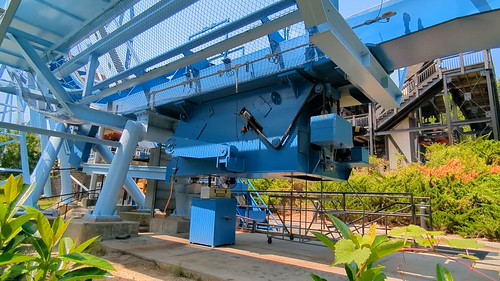
I also learned the purpose of this odd steel frame structure around the track on approach to the final brakes. While I long figured it was an unfinished piece of theming for the end of the ride, it’s actually to protect Griffon from the Aeronaut Skyride as it passes overhead in the event that any of the cars or cable might fall too low.

After getting a couple of laps on Griffon, we proceeded to our final attraction of the tour, the venerable Loch Ness Monster. We took a private backstage route underneath the rail bridge to get there.


I was glad to have Nessie included on the tour, as it allowed us to contrast the older engineering methods with the more modern ones found at other attractions. Yet even after 45 years, the fundamentals of how a roller coaster functions haven’t changed too much.


One interesting fact I learned at the end of the tour was about the Roller Coaster Insider Tour itself: we were the first test group to do the tour in reverse order. Previously the tour started at Loch Ness and finished at Verbolten, the idea being to show the progression in roller coaster technology. But it seemed we all agreed the tour felt natural in reverse order, and from what I’ve seen they’ve kept it in that order since.18

We finished the Roller Coaster Insider Tour with two priority boarding laps on Loch Ness Monster.

We still had a few hours after the tour ended before we needed to hit the road. This included taking a few more laps on a few favorites, as well as picking up the final coaster I needed for my list: Grover’s Alpine Express.


Since we both had SeaWorld parks Platinum Passes, we took advantage of that summer’s “Free Beer” promotion, harkening back to the days of Anheisur-Busch ownership, only now the cost comes out of the park’s own pocket. If a complementary little dixie cup of tasteless Bud Lite is all that separated Busch Gardens and SeaWorld’s past success from its more recent decline, as some analysts might suggest, I would think every park in the country would have adopted this promotion.


Go-Karts Plus
Williamsburg, Virginia
While departing Williamsburg, we made a quick stop at Go-Karts Plus, a small family entertainment center with a few go-karts and other rides.


I was there for one reason only: to add the Python Pit kid’s coaster to my count.

This is one of numerous E&F Miler family coasters produced for the former “Jeepers” FEC chain all under the same name. With that chain now defunct, many have scattered and found new homes across the country. There was one in Michigan I rode several times when I was younger, which is now in Washington state. This one originates from Ohio and, later, North Carolina. Obviously “Python Pit” didn’t remain trademarked after Jeepers’ dissolution as several including this one still keep the original name. Admission was free and it was just a few dollars for a single ticket.


All told I was in and out of there in under ten minutes. I spent more time writing about it than I did having the experience itself; of course that’s true of virtually every park and attraction on this trip series. After 8,700 words I should really learn to keep it short(er).
Comments